How Fantasy Flight Games Livestreams Can Inform Your Illustration Portfolio
Fantasy Flight Games has announced its August 2026 livestream schedule, including a designer interview on August 11 focused on the upcoming Arkham Horror: The Card Game expansion, Children of Blood.
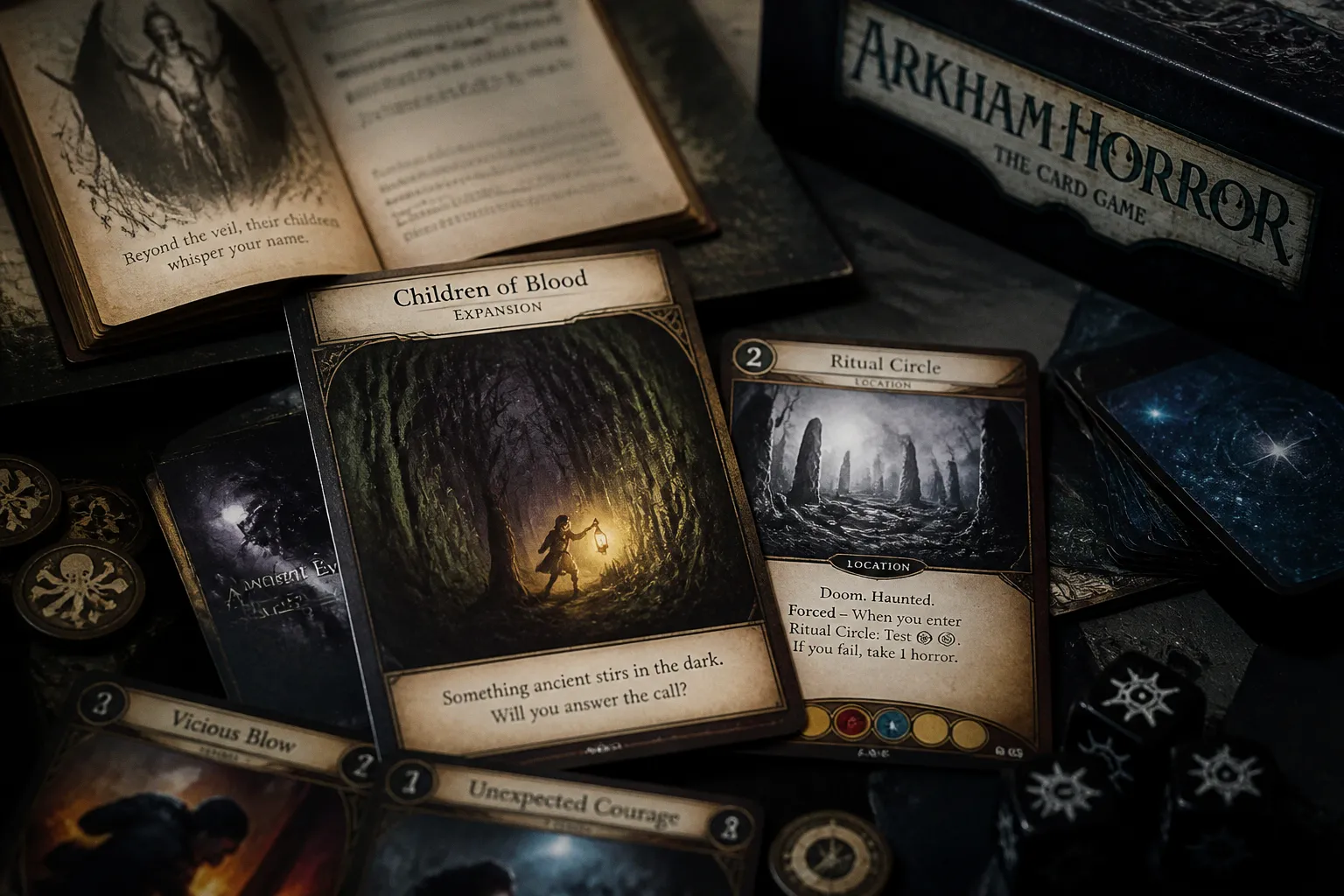
For tabletop artists, this is less about treating a livestream as a marketing event and more about knowing where a project’s visual brief may become clearer. If you work in TCG, horror, or narrative illustration, this is a sensible date to put on your calendar.
Why the August 11 interview matters
A designer interview is one of the more useful formats to watch when you are trying to understand how a card game wants its world to feel. The announcement confirms the subject: Children of Blood, an upcoming expansion for Arkham Horror: The Card Game. It does not yet provide a detailed art brief, card list, release breakdown, or visual guide, so you should resist filling in those gaps from assumption.
That restraint is important in your own portfolio work, too. One of the most common mistakes I see is an artist committing to a polished image before the brief has established the actual priority. Is the client looking for atmosphere, character readability, a strong silhouette, a specific narrative beat, or a piece that will still pop at card size? Those are different problems. Until the source gives you more, treat the interview as a chance to listen for emphasis rather than as a promise of specific imagery.
For your notes, track three practical things:
- how the expansion is described in terms of story and mood;
- which characters, conflicts, or locations receive attention;
- whether the designers frame the set around individual moments or a broader world-building arc.
Those observations can help you decide whether your portfolio should lead with cinematic key art, tightly staged character pieces, or compact narrative illustrations that communicate quickly.
What artists should watch for
If your work leans toward fantasy or horror, the useful takeaway may not be a single reveal. It may be the language the team uses to describe the expansion. Words around tone, tension, investigation, danger, or character motivation can point toward the kind of visual problem an illustrator would eventually be asked to solve.
I would watch the interview with your portfolio open beside you. Choose two or three pieces and ask whether they demonstrate the same skills a narrative card project needs: clear focal hierarchy, readable silhouettes, controlled value structure, and enough texture to establish genre without muddying the image. Oil technique can give horror work wonderful depth, but subtle glazing that disappears in a small reproduction is not doing the commercial job. Your strongest piece is the one that survives the format, not necessarily the one with the most finish.
Also pay attention to what remains unknown. Fantasy Flight Games has announced the livestream schedule and the designer interview, but the available information does not confirm further details about the expansion’s art direction. That means this is not the moment to build a speculative Children of Blood sample and present it as if it answers an official brief. If you create a personal response, label it clearly as an interpretation. A good fan piece can show range; it should not blur the line between your idea and the client’s requirements.
The wider TCG signal
This August announcement sits alongside other tabletop signals: Wizards of the Coast has announced five Magic: The Gathering | Star Trek Welcome Decks intended to introduce new players ahead of the main set’s release. Separately, Polygon reported on a designer discussing a low-cost Avatar: The Last Airbender Commander option. These are different stories, but together they underline a practical point for artists: card games are speaking to both established players and people entering through recognizable worlds.
That gives your portfolio two jobs. It needs to prove that you can deliver a compelling fantasy image, but it also needs to show that you understand communication. A character should read quickly. A scene should have a clean pop at thumbnail size. The mood should arrive before the viewer has to study every brushstroke.
So, mark August 11, watch the Children of Blood interview when it airs, and update your notes afterward—not with vague inspiration, but with specific visual questions. Which kind of scene could you pitch? What would the silhouette be? Where would the eye land first? That is how a news item becomes useful to your portfolio rather than simply another announcement in the feed.