Why Reality Fracture Is Redefining Visual Storytelling in Magic: The Gathering
Wargamer is hyping the five standout cards from Magic: The Gathering's upcoming Reality Fracture set, and if you work in TCG illustration — or just want to understand why the community is talking…
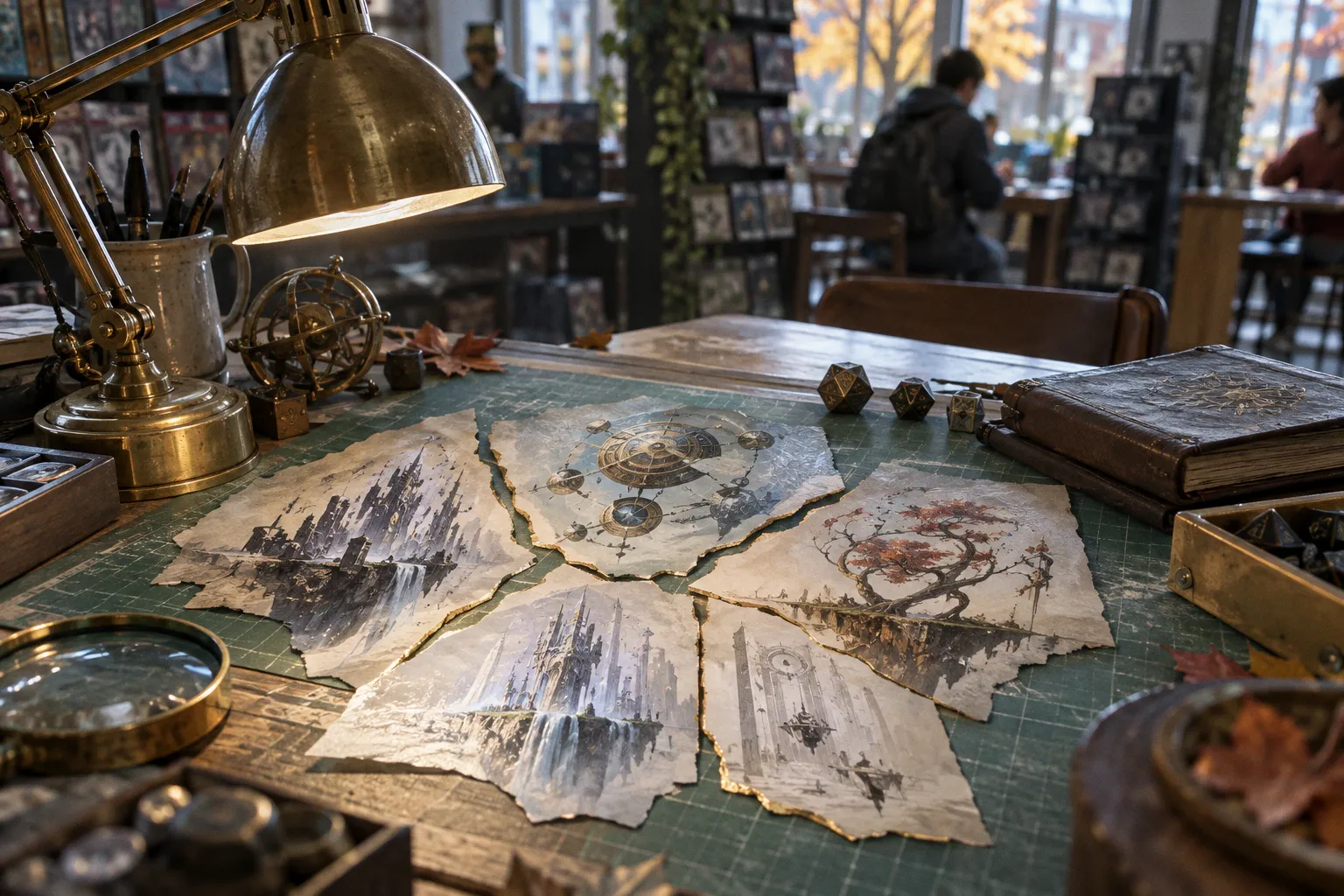
Wargamer is hyping the five standout cards from Magic: The Gathering's upcoming Reality Fracture set, and if you work in TCG illustration — or just want to understand why the community is talking about it nonstop — this is the set to watch right now. From where I sit commissioning card art, what makes Reality Fracture genuinely interesting isn't the chase sheet; it's the brief, which asks every illustrator on the team to paint one half of a visual conversation.
The design challenge behind the pairs
Reality Fracture design lead Yoni Skolnik walked through the framework in a recent Wizards post, and it's a surprisingly candid read about how a set's visual spine gets built. Three pillars hold the whole thing up: a legendary creature pair landing in every booster that puts duality front and center, schools and Planeswalker characters that anchor players in the lore, and ten color-pair draft archetypes stitched through the common and uncommon slots.
If you've ever tried to interpret a brief that asked you to make a character feel like themselves and their opposite at the same time, you already know how tricky that is. Skolnik's team landed on a structure where every color has a core theme feeding two of its color pairs — basically a built-in overlap that lets one card serve multiple archetypes. It's a smart answer to a real production problem, and the kind of design logic that quietly shapes every painting decision downstream.
The other number worth noting: three legendary creatures per booster. That's a serious density bump, and Skolnik's own write-up notes that more than half of the set's uncommons end up being legends. For artists, that raises the bar on every piece — you can't coast on "this is just a common," because the math of the set doesn't allow it. Skolnik also namechecks Time Spiral as the cautionary tale, since that block famously alienated players who weren't deep into Magic's history, and the team clearly built the school structure and Planeswalker entry points to solve for that. Easier legibility for players usually means clearer briefs for artists, which is a win downstream.
The public art conversation
Beyond the hype list, MTG Rocks is reporting that Wizards has responded to artwork concerns around the set. That's the kind of thread I always tell emerging artists to read carefully. How a studio handles a controversy in public — what they clarify, what they stand behind, what they revise — often tells you more about how the commissioning process actually works than any style guide. Worth bookmarking once the full spoiler season lands and the dust settles.
What to do with this if you're building a portfolio
Here's the practical part, the way I'd walk you through it over coffee: when the Reality Fracture cards start getting spoiled in full, treat them like a study sheet. Pull the paired legends side by side and ask which compositions still hold up at two inches — thumbnail readability is where most TCG paintings live or die. Notice how the artists handle silhouette, how color temperature shifts between the echoed versions, where the background geometry rhymes and where it deliberately contradicts. That's the muscle a TCG art director is testing when they flip through your portfolio, and Reality Fracture is handing you a free master class in exactly that problem.
If you're aiming your portfolio at Wizards specifically, this is also the set to study for how the studio handles a high-legend-density brief. Expect that kind of structure to influence future Magic sets, and the artists who internalize the echoed-pairs thinking now will be ahead of the curve when similar briefs land on their desk.