Darrington Press Sets Three-Year Expansion Roadmap for Daggerheart
Darrington Press is at least making the production target explicit: according to Blizzard Watch, Daggerheart now has a three-year roadmap built around two major books per year.
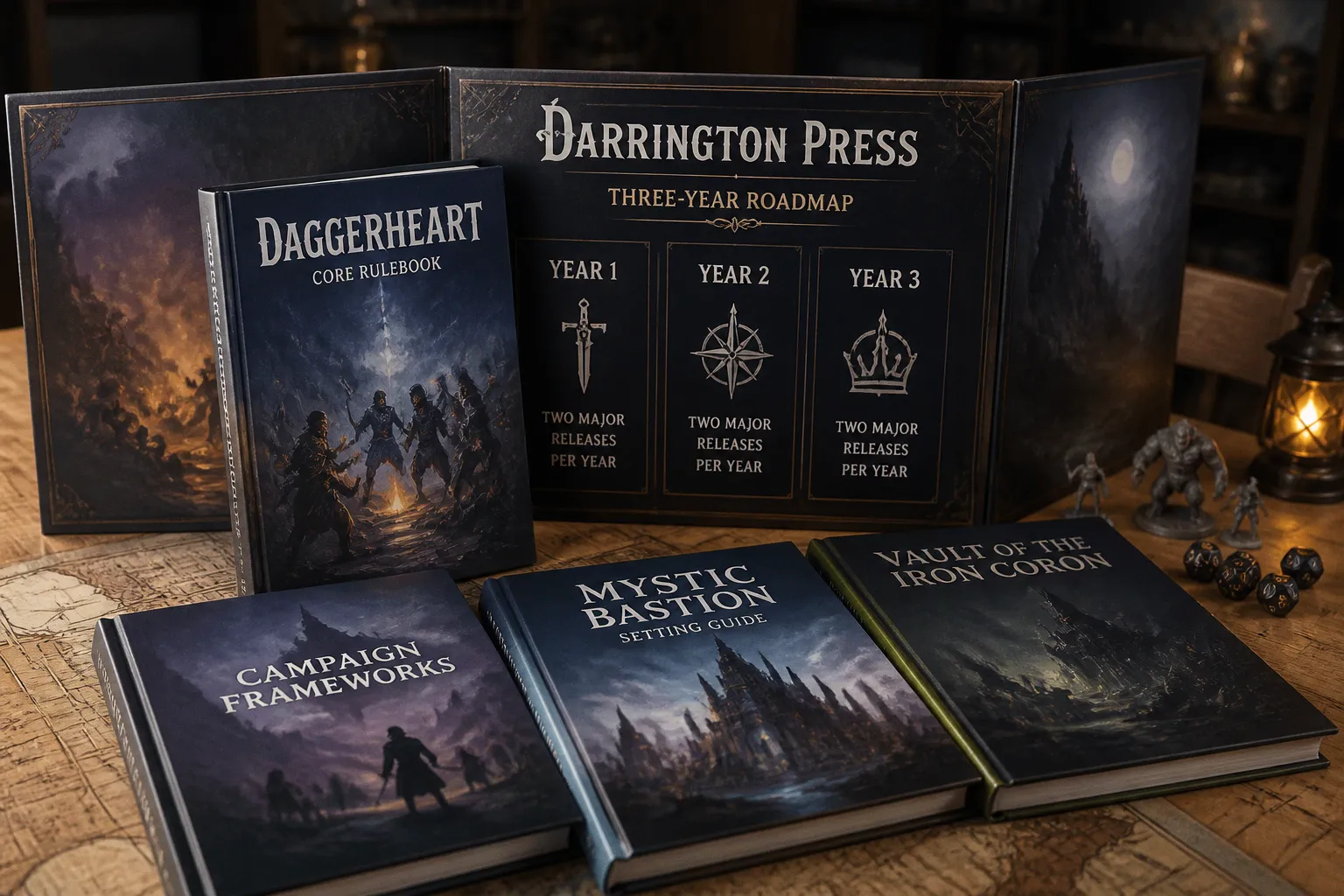
Most tabletop art pipelines fail when they confuse volume with direction. Darrington Press is at least making the production target explicit: according to Blizzard Watch, Daggerheart now has a three-year roadmap built around two major books per year. For artists and visual storytellers, that means a steady stream of settings, campaigns, expansions—and more opportunities for the game’s visual language to either sharpen or collapse under its own ambition.
A roadmap with a clear publishing rhythm
Darrington Press plans to release two new Daggerheart books annually, with the lineup expected to include setting books, campaign books, adventure books, and other expansions. The company has not announced release dates for those books, so the roadmap is a production promise, not yet a usable calendar.
One confirmed project is the game’s first official setting book, being developed by Rowan Hall. It is described as a place built around the wonder, hope, and danger associated with Daggerheart. Spenser Starke has also suggested that its world may be recognizable, while offering deliberately cryptic hints involving kaiju and archipelagos. In other words: the concept art brief exists in spirit, but the final frame is still out of focus.
Jeremy Crawford is working on another setting book described as “devilishly spooky.” Some of its material is already in playtesting, with elements also appearing in Critical Role’s Age of Umbra: Shallowlands game. No release date has been given for either setting project.
That uncertainty matters. A setting book is not simply a pile of lore with decorative borders. It needs a visual hierarchy: what defines the world at a glance, what belongs to its iconography, and what becomes the narrative hook on a cover or spread. Until the books have firmer details, there is no responsible way to judge whether Daggerheart is building a coherent visual system or merely commissioning more attractive fragments.
The nearer-term releases are more concrete
The roadmap arrives alongside several products still due out this year. Blizzard Watch reports that Daggerheart has three physical releases remaining: a GM screen featuring artwork and quick-reference material, a Fear tracker, and an Adversary Deck containing enemy stat blocks.
The Fear tracker is particularly notable from a visual storytelling perspective. It makes escalating tension visible at the table, rather than leaving the emotional temperature of a scene buried in a conversation between GM and players. That is a small but effective piece of framing: the mechanic gets a focal point, and the players can see how bad the situation is becoming.
The Adversary Deck applies a similar logic to enemy information. Turning stat blocks into cards gives the GM a more immediate visual interface, while the GM screen combines reference material with artwork. These are functional objects, but function is where commercial tabletop design earns its keep. A fantasy illustration can look impressive and still fail if it does not guide attention, support play, or establish the game’s tone.
The Hope and Fear expansion is reported as available at Gen Con and scheduled to reach retailers on August 25. Class Packs have also launched this year. Beyond physical products, the romantic fantasy campaign frame With Love and Magic is due in the fall as a standalone digital-only release.
Digital distribution expands the visual surface
Darrington Press is also committing to free and paid digital products. A free Digital Adventure Pipeline is planned to begin in August on the Daggerheart website. One upcoming adventure will draw on A Familiar Find, a game in which players take the role of a familiar rather than a conventional hero. The adaptation was described with a deliberately strange comparison: “Carmen Sandiego played by the cast of Homeward Bound and Carmen is a witch.”
That pitch tells us more about the intended narrative hook than a generic fantasy label ever could. It establishes role reversal, pursuit, comic energy, and a specific kind of oddity. For an illustrator, that is useful direction because it suggests framing and character action rather than merely supplying a list of creatures and locations.
The game is also expanding its virtual tabletop support. Daggerheart is already available on Demiplane, with Hope & Fear support planned for August. Foundry VTT is joining as an official digital partner, while Alchemy VTT is also receiving Hope & Fear support.
The practical takeaway is simple: do not treat the two-books-a-year announcement as a complete art brief. Treat it as a signal that Daggerheart is building a larger and more sustained publishing ecosystem. The details worth watching are the first setting book’s visual identity, the balance between physical and digital releases, and whether the artwork gives the system a recognizable frame—or just paints every corner of the room.