Designing for Stormlight: War for Roshar and the Art of Tabletop Clarity
According to IGN’s first look, Brotherwise Games is preparing Stormlight: War for Roshar, a large-scale board game built around Brandon Sanderson’s Stormlight Archive.
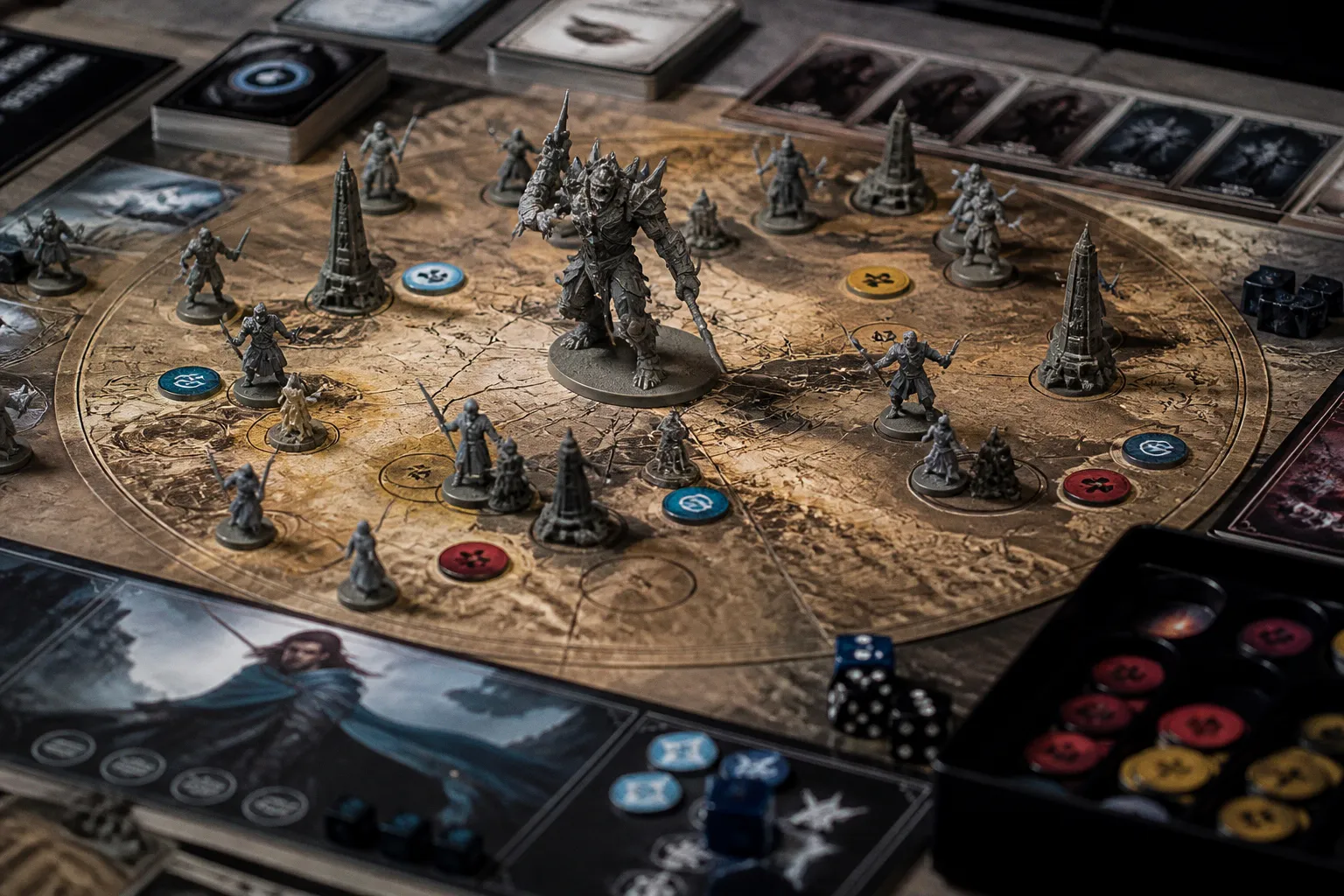
For TCG and tabletop artists, the interesting part is not simply that another Cosmere game is on the way: it is the brief implied by the format—factional war, named leaders, territory control, and a map that must stay readable while carrying a famously dense fantasy setting.
I’ve seen portfolios lose their strongest painting instincts when the work has to function at card size or across a crowded board. Roshar is exactly the kind of IP where silhouette, hierarchy, and a disciplined value structure will matter as much as spectacle.
A war-game brief with several visual jobs
IGN describes War for Roshar as a game balancing the abstraction of a Euro game with the analytical calculation of a war game. Players lead either the Coalition or Odium, moving forces and characters around a map, claiming territories, making alliances, battling, pursuing objectives, and fighting for Oathgates.
That is a lot of information competing for attention. In art-direction terms, this is not one “epic fantasy illustration” brief—it is a system brief. The map needs clear ownership and routes. Leader art needs instant identification. Cards need to communicate abilities without dissolving into decorative noise. And the conflict between the two sides needs to read before a player has absorbed every piece of Sanderson lore.
If you are building your own tabletop portfolio, this is a useful distinction to study. A moody full-bleed painting can sell a world, but a game component has to do a job at a glance. Ask yourself whether your focal point survives beneath iconography, rules text, borders, and the visual clutter of an active play area. If it does not, it may be lovely editorial art—but it is not yet a production-ready game asset.
Leaders need gameplay silhouette, not just character likeness
The core box includes Coalition leaders Kaladin, Dalinar, Jasnah, and Shallan, alongside Taravangian, Nale, Leshwi, and Raboniel for Odium, according to IGN. Each player forms a team of two leaders, with distinct abilities, advancement paths tied to swearing Ideals and using Surges, plus unique cards that enter a deck.
That structure is a reminder of what character art has to accomplish in a strategy game. You are not only painting a recognisable person; you are helping the player remember a tactical role. IGN’s examples are especially clean: Kaladin can gain the ability to fly around the board, while Dalinar can recharge a force’s Stormlight reserve.
For artists, this is where the portfolio test gets practical. Could a player distinguish your two heroes from each other in a two-inch crop? Does one have a silhouette that says mobility, while another has visual weight that suggests command or support? You do not need to illustrate the rules literally, but the pose, prop language, costume massing, and colour accents should give the mechanics somewhere to land.
Watch the information design as closely as the paintings
The game’s stated path to victory involves reaching a shifting victory-point threshold or finishing eight rounds with the most points. Cards in hand and Stormlight are its main resources, with Stormlight used to play and acquire stronger cards.
For a card-game illustrator, that is the piece worth watching as more material appears. Resource economies and advancing character decks usually create a wide range of component needs: clear card families, repeatable framing, upgrade logic, and art that can support both flavour and fast recognition. The best visual solution will not necessarily be the most rendered one. It will be the one that gives the player enough pop to make a confident decision without breaking the atmosphere of Roshar.
That is the professional lesson in a release like this. Put a finished fantasy scene beside a small mock card, a leader marker, and a board-space crop in your portfolio. Your work should still read when the game—not the painting—becomes the main character.