Visualizing the Gamble: How Illustrators Capture the Tension of Push-Your-Luck Mechanics
If you've ever watched a player hover over "Draw Card" knowing the next draw could blow up their whole turn, you already understand what Goomba Stomp just dug into.
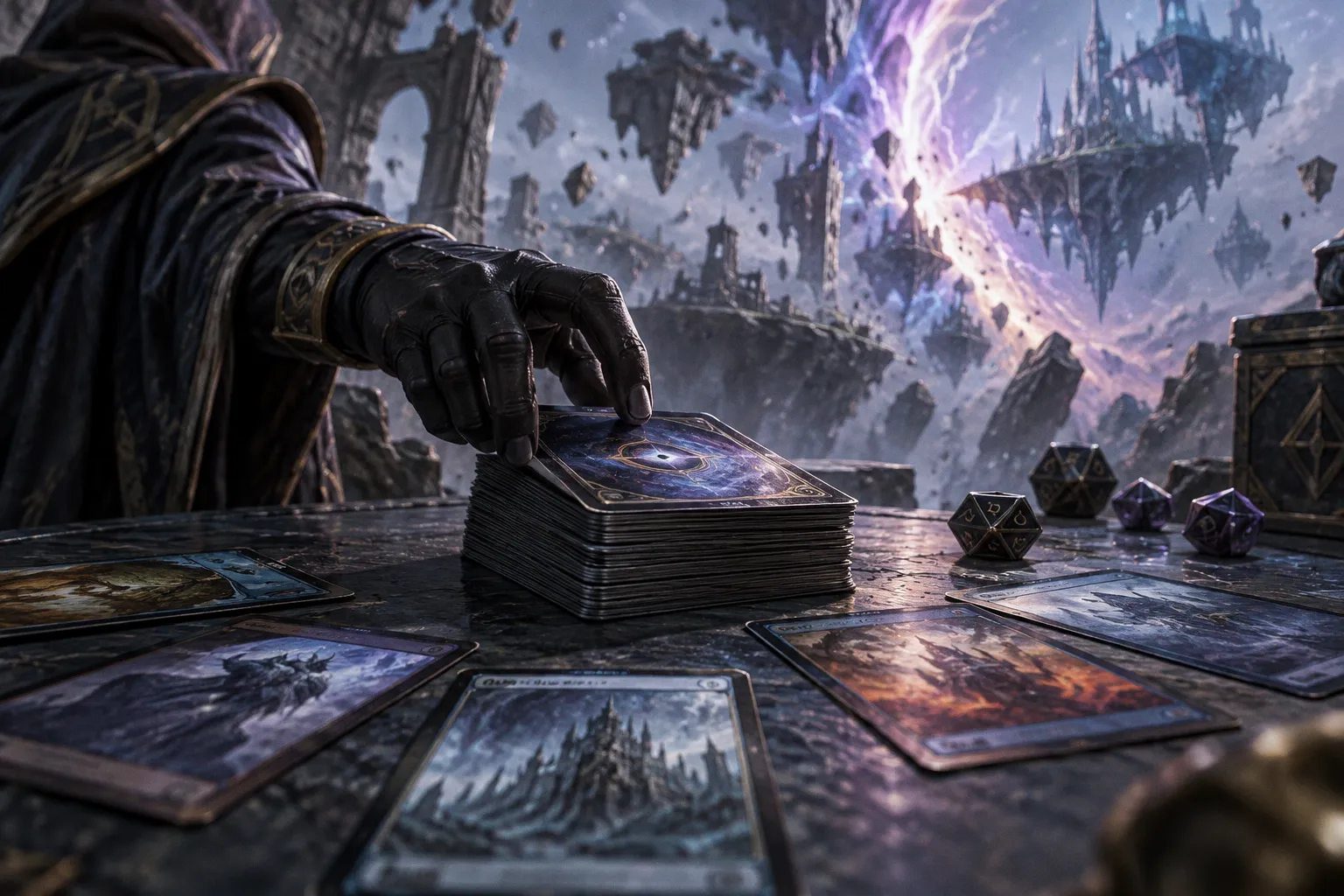
Their piece on the psychology of push-your-luck traces the mechanic from ancient dice games like Hazard and the 1940s Pig dice game through 1990s arcade cabinets and straight into modern deckbuilders. For us on the illustration side, that history reads like a creative brief worth studying closely, because every push-your-luck card asks the same visual question: can you paint the moment right before the player commits?
The tension your brush has to carry
The Goomba Stomp piece points to brain-imaging research showing that near misses land in reward circuitry almost like actual wins, which is exactly why stopping feels so hard in the moment. The same pattern shows up whether the near miss comes from a spinning reel, a rolled die, or a card that just misses a winning hand, and regular players show a stronger version of that response than casual ones. For your portfolio, that distinction matters more than it might seem. When you illustrate a card built on this loop, you are not really depicting the outcome. You are depicting the hesitation. A silhouette frozen mid-decision reads completely differently than a silhouette mid-celebration, and players feel it before they have language for it.
Designers have known this intuitively for decades. The 1990s arcade hit Cyclone reportedly pulled in unusually large hauls of tokens within just two weeks at some locations precisely because it weaponized that near-miss pull. Wheel 'M In worked the same way earlier in the decade, rolling a coin down a spinning treadmill toward ticket strips of different payouts, and the design only worked because players kept nudging their aim toward riskier strips instead of the safe middle lane. The mechanic never really changed — bank what you have, or press your luck — only the container did. The underlying pattern is what behavioral psychologists call a variable-ratio reward schedule, the same structure B. F. Skinner used to explain why pigeons and players alike keep responding long after any predictable timeline falls apart.
What to watch in the next Magic set
That background matters because Wizards is about to release Reality Fracture, a "climactic" event set that closes the three-year Metronome Arc and finally ends Jace's attempt to mend the Multiverse. According to the Draftsim breakdown, prepare returns from Secrets of Strixhaven with new entries, and empower Jace works much like amass — creating a token if you need one, then stacking loyalty counters onto the named planeswalker token if you already have it. The ride-on mechanic is the main way to push card selection and card draw, and creatures can either enter prepared or ready up again when a condition is met. Two new tokens show up with the set: the 2/2 wizard soldiers called Cadet, which Draftsim notes can do the bidding of nearly any color, and Heartwood, whose mechanical role spoilers will apparently reveal in time.
The most interesting illustration brief hiding in that list is the Jace subtype appearing on non-planeswalker tokens for the first time since original Lorwyn. That is a real visual problem — how do you make a token read as Jace without the planeswalker frame? If you are building portfolio pieces around Magic art direction, that question is exactly the kind of art-drop opportunity worth sketching toward. Draftsim also speculates that mechanics like cascade, warp, or suspend could return to sell the idea of reality fracturing, which would give illustrators a chance to push compositions off the usual card frame and play with the exile zone.
The takeaway for your portfolio is simple. Push-your-luck is older than arcades, older than Magic, and it survives because it lets cautious and volatile players share the same game while playing it differently. If you are painting for a TCG, the near-miss tension is the brief hiding inside almost every card worth illustrating.