Aquopolis Cartaya Tickets: Hidden Costs and Time-Wasting Traps
The ticket price printed on the gate is never the final number. Walk into Aquopolis Cartaya with only that figure in mind and the day's actual expenditure will exceed it — sometimes by a wide margin.
The gap between advertised entry cost and real spending is a structural feature of the park's revenue model, not an accident. Understanding it before arrival is the difference between a calculated visit and an expensive improvisation.
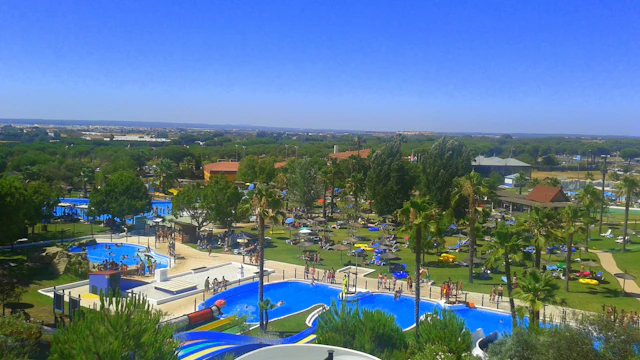
Aquopolis Cartaya
- Official ticket · General admissionofficial ticketfrom€16.90
Prices checked on August 17, 2026 · current price on the partner page.
Official website — cartaya.aquopolis.es
Prices are indicative and may change — confirm the price and availability on the partner page.
Partner link — GetYourGuide ticketsWhat follows is a layer-by-layer breakdown of how Aquopolis Cartaya prices its access, where the hidden costs sit, and which operational details — re-entry windows, queue management, rental structures — will cost you time or money if you arrive unprepared.
Decoding the Height-Based Pricing Model
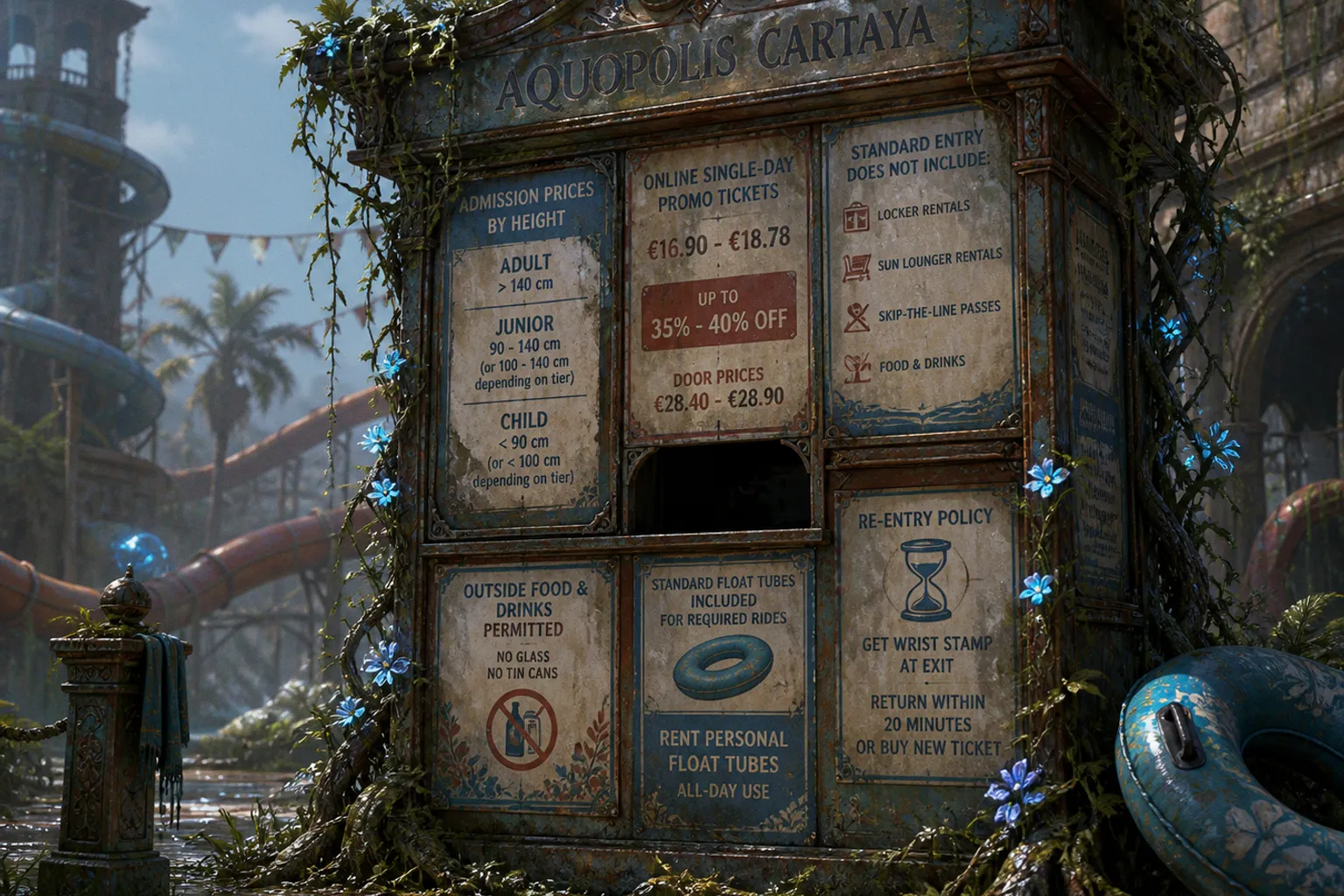
Aquopolis Cartaya does not price tickets by age. This is the first point most visitors get wrong. The system operates on a height threshold model with two breakpoints: 90 cm and 140 cm.
Children under 90 cm enter at no charge. Between 90 cm and 140 cm, the junior rate applies. Above 140 cm, the full adult tariff kicks in. There is no senior discount tier, no student rate, no family bundle built into the base structure — height is the sole variable.
This matters because a child who is eight years old but tall for their age will be charged at the adult rate. Conversely, a twelve-year-old who hasn't hit the 140 cm mark still qualifies for junior pricing. Parents who assume age-based brackets will miscalculate their group cost at the gate.
The pricing model doesn't care how old your children are. It cares how tall they stand when measured at the entrance.
Measure your children before you buy. If a child is hovering near the 140 cm threshold in shoes, expect the gate measurement to determine the final classification. The park measures without footwear.
The Financial Gap Between Gate and Online Rates
The spread between walk-up gate pricing and advance online purchase is substantial — not a token gesture, but a genuine structural discount. Full-price gate tickets sit in a range that online promotional pricing undercuts by roughly a third to nearly forty percent, depending on the booking platform and how far in advance the purchase is made.
This is not unusual for the water park sector, but the magnitude of the gap at Aquopolis Cartaya is worth noting. The difference between the cheapest advance online rate and the top gate price can approach nearly double. That is not a rounding error — it is a deliberate pricing architecture that rewards planning and penalizes spontaneity.
| Purchase Channel | Typical Pricing Behavior |
|---|---|
| Gate (walk-up) | Highest tier, no discount applied |
| Same-day online | Moderate discount, limited availability |
| Advance online (days ahead) | Deepest promotional pricing |
| Third-party platforms | Variable, sometimes bundled with extras |
The practical instruction is straightforward: buy online, buy early. The platforms offering advance tickets rotate promotional pricing, and the best rates appear when inventory is still wide open. Waiting until the morning of your visit to book online narrows your options and pushes you toward higher tiers.
One operational detail worth noting: tickets are generally available for same-day and next-day purchase through major booking platforms, so even a last-minute decision retains some online discount — just not the maximum one.
Hidden Costs Beyond the Entry Fee
The entry ticket buys access to the water. Everything else is incremental.
Lockers. Personal belongings need secure storage, and locker rental is a separate line item. The park does not bundle locker access into the admission price. Exact daily rates fluctuate by season and are not published in advance on most booking platforms, but expect to pay per locker per day — and expect them to be necessary, not optional.
Sun loungers. Seating around the pool areas is not guaranteed with entry. Lounger rental is another discrete charge. On peak days, unrented loungers become scarce by early afternoon, which creates a secondary pressure: arrive late and you either pay for whatever's left or stand.
Food and beverages. On-site catering operates at theme-park margins. This is where the budget can unravel quietly if you're not tracking it. A family of four eating lunch and buying drinks inside the park can easily match or exceed the cost of their entry tickets.
The entry fee is the cheapest part of the day. Lockers, loungers, and lunch will each take their own cut.
Here is the critical detail most guides omit: outside food and drinks are permitted inside Aquopolis Cartaya. The restriction is on containers, not content — glass bottles and tin cans are prohibited. Plastic containers, sealed water bottles, packed sandwiches — all allowed. This single policy, if used, is the most effective cost-control measure available to visitors.
Pack a cooler bag with plastic-wrapped food and sealed drinks. The savings over a full day of on-site purchases are not trivial.
Smart Strategies for Food and Park Re-entry
The re-entry policy at Aquopolis Cartaya operates on a strict time limit. Visitors who leave the park can return without purchasing a new ticket, but only within a narrow window — approximately twenty minutes — and only after receiving a wrist stamp at the exit. Exceeding that window means the ticket is void and a new one must be purchased.
Twenty minutes is not enough time to leave, drive to a restaurant, eat, and return. It is enough time to reach a car in the parking lot, retrieve supplies, and walk back in. This is the intended use case: the re-entry system is designed for quick retrieval runs, not extended breaks.
The operational playbook:
1. Arrive with provisions. Pack food and drinks in compliant containers before entering. This eliminates the need for re-entry entirely.
2. If you must leave, stamp immediately. Get the wrist stamp before exiting. Do not assume you can negotiate the time limit at re-entry — the system is automated and rigid.
3. Park strategically. If you plan a midday supply run, park close to the entrance. Walking distance eats into the twenty-minute window faster than expected.
4. Coordinate timing. One person exits while others hold position. The stamp holder returns with supplies. This avoids the logistical waste of a full-group exit and re-entry.
The re-entry window is a trap for the unprepared. Families who leave for lunch without understanding the time constraint end up buying a second set of tickets. The park's policy is clear — the penalty for exceeding the window is full repurchase, not a surcharge.
Navigating Queue Management and Rental Options
Standard float tubes required for rides are included in the admission price. This is a point worth clarifying because the rental structure creates ambiguity.
The park offers two categories of flotation equipment:
- Standard ride tubes. Included with entry. These are the tubes required to access specific attractions — no additional charge, no rental process. You collect them at the ride entrance and return them after.
- Personal day-rental tubes. A separate rental product for visitors who want a dedicated tube for general pool use throughout the day. This is optional and priced independently.
The distinction matters because some visitors assume all tube access requires rental payment. It does not. The rides themselves supply what's needed. The personal rental is a convenience product for lazy-river and wave-pool use, not a gatekeeping mechanism.
Queue management is the other variable that affects the quality of the day. Aquopolis Cartaya, like most water parks in southern Spain during peak season, develops significant queue density at popular slides between early and mid-afternoon. The park offers expedited access options — a skip-the-line product — but the specifics of pricing and availability for the Cartaya location are not consistently published across booking platforms.
The included ride tubes are sufficient for every attraction. Renting a personal tube is a comfort choice, not a requirement.
The practical approach to queue management is temporal, not financial. Arrive at opening. Hit the high-demand slides in the first ninety minutes. Shift to pools, lazy rivers, and lower-demand attractions as the midday crowd builds. This sequencing extracts maximum ride count without purchasing any queue-skip product.
Operating Hours and Arrival Timing
Standard daily operating hours run from early afternoon through early evening. This compressed window means every hour carries weight. A visitor who arrives at opening has roughly six and a half hours of usable park time. Subtract thirty minutes for locker setup, changing, and initial orientation, and the effective window shrinks further.
Arriving ninety minutes after opening — which is the default for families who underestimate travel time or stop for breakfast — costs you the best queue conditions of the entire day. Those first ninety minutes are when ride throughput is highest and wait times are lowest. They are non-recoverable.
The timing calculus:
- Arrive at opening. Maximum ride access, minimum queue time, best lounger selection.
- Arrive mid-afternoon. Compressed schedule, peak queues, limited seating, higher food spend (no time to pack and retrieve supplies).
- Arrive late afternoon. Discounted experience in every dimension except price — you pay full admission for half the day.
The Verdict
Aquopolis Cartaya is a straightforward operation with a layered pricing structure that rewards preparation and punishes assumption. The height-based ticket model eliminates age-based ambiguity but introduces measurement risk for children near the thresholds. The online-versus-gate price gap is wide enough to make advance booking a non-negotiable step. The hidden costs — lockers, loungers, food — are manageable if you arrive with provisions and understand the container restrictions. The re-entry policy is a hard constraint, not a guideline.
The visitor who buys tickets online in advance, arrives at opening, packs food in plastic containers, parks near the entrance, and sequences rides by queue density will spend the least and experience the most. Everyone else will pay a premium for the same water.
Practical info
Currency: EUR
Driving: on the right
Emergency number: 112