Steampunk book cover design: budget traps in artist hiring
A steampunk cover fails financially long before the invoice arrives. The first distortion occurs when an author compares a $150 premade composite with a $1,800 custom illustration as though both are the same object. They are not.
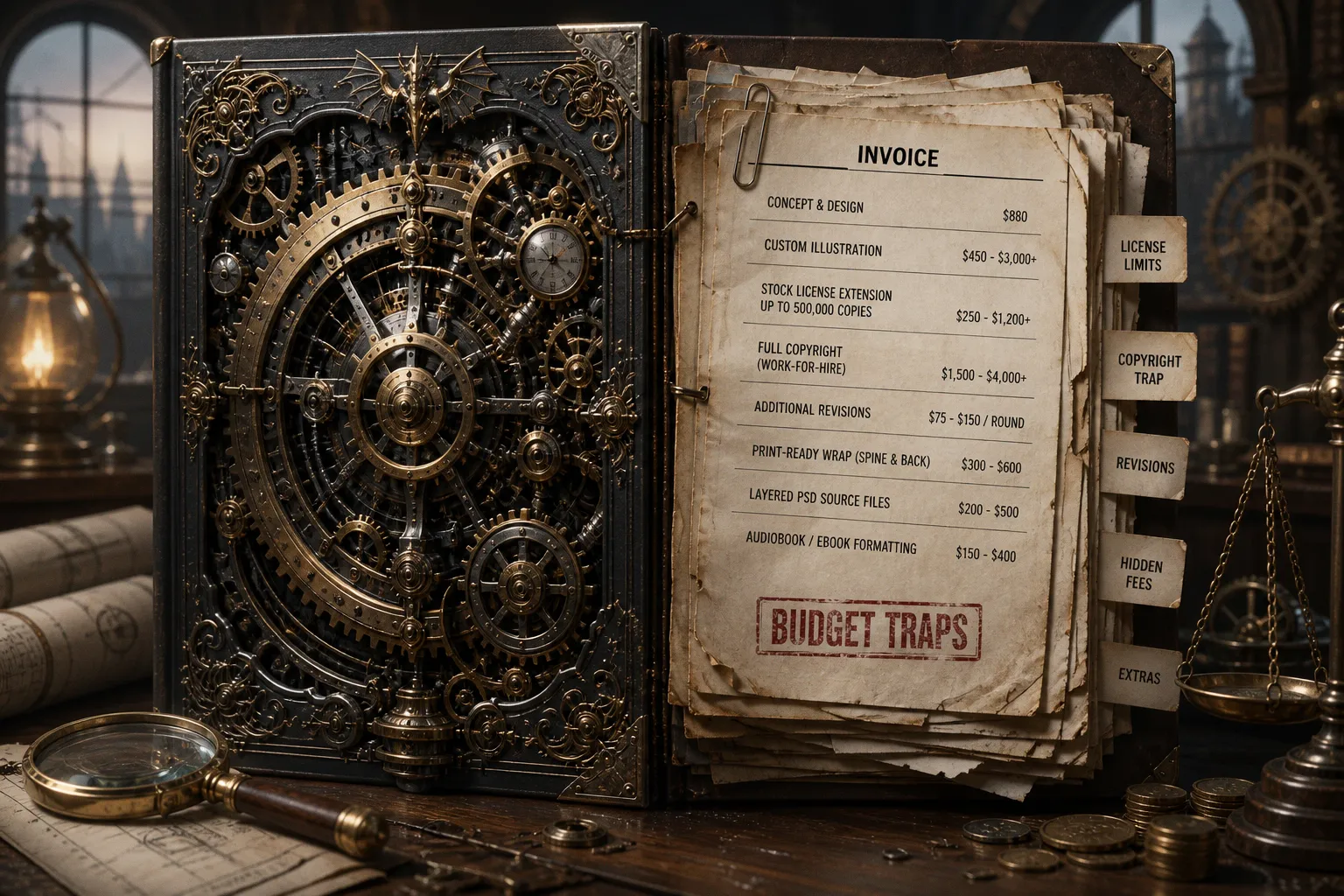
One is a licensed arrangement of existing parts. The other is a purpose-built image: character design, machinery design, typography clearance, print geometry, and a chain of rights that must survive publication.
The average professional book cover design sits around $880, while many projects fall between $625 and $1,250. Steampunk commonly climbs toward the upper edge because the genre is mechanically dense. Brass fittings, pressure gauges, articulated limbs, period tailoring, smoke effects, and impossible architecture all demand time. Worse, each element creates another place for the budget to fracture.
The steampunk book cover design budget traps are not mysterious. They are usually omitted line items, imprecise rights language, and revisions requested after the image has already hardened into its final layers.
A premade cover and a custom illustration are built differently
Premade covers generally cost $50 to $500. They can be efficient when the book needs a fast digital release, the title can adapt to an existing composition, and exclusivity applies only to the assembled cover rather than every visual component inside it.
That last distinction matters. A premade design may contain stock imagery licensed legally for cover use, but the author does not automatically own the underlying photographs, textures, typefaces, or rendered mechanical assets. The designer has constructed a finished surface from licensed material. It is not the same as acquiring an original painting with every component made from scratch.
Custom illustrated covers start around $450 and can exceed $3,000. For steampunk, the high end is not extravagance by default. It is labor. A cover showing a single airship over a city silhouette can be controlled with a narrow set of forms. A cover showing an inventor in fitted Victorian clothing, holding a custom weapon before a multi-level industrial city, is a different workload. Every rivet has to agree with the perspective. Every brass plane needs a coherent light source. The machinery must read at thumbnail size without collapsing into visual grit.
| Cost factor | Premade steampunk cover | Custom steampunk illustration |
|---|---|---|
| Typical price range | $50–$500 | $450–$3,000+ |
| Composition | Existing; title and author name adapted | Designed around the manuscript and market position |
| Mechanical details | Limited to what already exists | Built to specification |
| Character likeness | Usually unavailable or restricted | Can be designed for the story |
| Production time | Often short | Longer, with staged approvals |
| Rights structure | Usually a license to a finished design | License or copyright transfer negotiated separately |
A cheap custom quote also deserves inspection. It may cover only a front-facing ebook image. It may use unlicensed or weakly licensed stock. It may exclude typography. It may deliver a flattened JPEG that cannot be adapted when the paperback page count changes.
A low starting price is not a budget. It is merely the first pigment layer.
When hiring steampunk book cover artists, the author should identify which visual problem is actually being purchased. There are three common categories:
1. Typography-led cover with stock or digital assets. The title carries the hierarchy. Machinery functions as texture or framing. This is often the most economical route, but its originality depends on selection and compositing discipline.
2. Hybrid cover. A custom-painted or rendered focal element sits over licensed stock, textures, or a manipulated background. It can produce a strong result at a middle price point, provided licensing is documented.
3. Fully custom illustration. Characters, aircraft, cityscapes, creatures, and props are drawn or painted for the book. This is the appropriate route when the cover must establish a proprietary visual identity across a series.
The error is ordering category three while budgeting for category one.
Stock licensing is not decorative paperwork
Steampunk cover design frequently relies on stock portraits, corsetry references, clockwork textures, antique maps, smoke, leather, and industrial interiors. A designer may use one stock image or several. The exact number varies. The author should not assume that a stock-heavy cover has no rights cost merely because stock is visually invisible beneath paint-over and color grading.
Standard stock licenses often cap print runs at approximately 500,000 copies and may prohibit use on promotional merchandise. For a first paperback run, that limitation can appear theoretical. It stops being theoretical when the cover moves onto posters, convention banners, bookmarks sold as products, game tie-ins, or merchandise.
Extended licenses commonly cost $49 to $99 per image. The number is modest until a composite cover uses multiple billable assets and the author discovers that the original quote covered only standard licenses.
The clean question is not, “Are the images licensed?” That question is too soft. Ask instead:
- Which third-party assets are used in the final cover?
- Is each asset covered for ebook, print, audiobook, advertising, and social media use?
- What print-run ceiling applies?
- Does the license permit merchandise, or only book promotion?
- Is the license purchased in the author’s name, the designer’s name, or both?
- Who retains the asset documentation if the designer stops working?
A designer who uses original illustration may still use stock for reference. Reference is not necessarily a licensing issue if it does not enter the finished image as a copied or composited element. But the boundary should be clear. A photo-based face or an imported brass texture is materially different from studying a nineteenth-century boiler and painting an original interpretation.
For series work, licensing must be considered across time. A cover built from a limited asset library may be quick to produce, yet it can become difficult to extend coherently across five books. Reusing the same woman, the same gear cluster, or the same factory corridor produces visual fatigue. Replacing those elements later can require an expensive redesign.
Copyright ownership is expensive because it removes future income
Many authors hear “you own the cover” and assume that means copyright ownership. Usually, it does not.
In most standard arrangements, the designer or illustrator retains copyright while granting the author a license to use the finished cover for the book and agreed promotional channels. That is normal. It is not a defect. The license can be broad enough for publication, ebook editions, paperbacks, hardbacks, audiobooks, advertising, and translations, depending on the contract.
A full copyright transfer or work-for-hire agreement is a separate purchase. It can add 100% to 200% to the base fee. That surcharge reflects the fact that the artist gives up future control and potential reuse value. A commissioned airship illustration might otherwise be licensed later for a game card, an anthology, a print, or an editorial feature. Under a full transfer, that route closes.
The sensible decision depends on the project.
| Rights arrangement | What the author receives | Typical budget effect | Appropriate use |
|---|---|---|---|
| Limited cover license | Use for specified formats and territory | Usually included in base quote | Single edition with defined needs |
| Broad exclusive license | Extensive publication and promotion rights; artist retains copyright | Higher negotiated fee | Series branding and long-term publishing plans |
| Full copyright transfer / work-for-hire | Copyright ownership of final artwork | Often adds 100%–200% | IP expansion, adaptation, merchandise control |
Do not pay for copyright transfer because the phrase sounds safer. Pay for it when the publishing plan requires it.
A novel intended only for ebook, paperback, audiobook, and ordinary online advertising may function perfectly under a comprehensive exclusive license. A property expected to become a tabletop game, a collector-print line, a film pitch package, or a branded merchandise operation may justify a broader acquisition of rights. The contractual language should state the permitted uses rather than relying on verbal assurances.
There is another material distinction: copyright in the final cover artwork is not always copyright in the fonts, stock images, or software resources used to build it. Even a work-for-hire arrangement cannot magically convert third-party licensed assets into author-owned property. If the cover contains stock, those licenses remain governed by their own terms.
This is one of the more persistent steampunk book cover design mistakes. Authors pay a premium for “full rights,” then assume they can place the cover art on enamel pins or sell posters without examining the component licenses. The surface looks unified. The rights underneath may not be.
Copyright transfer is not a decorative seal. It is a separate economic instrument.
Revision rounds become costly when the brief remains soft
Most designers include one to three revision rounds in a base package. Additional rounds may cost $25 to $100 or more each. On a simple cover, that structure is manageable. On a mechanically crowded steampunk commission, late revisions can trigger structural work rather than cosmetic adjustment.
“Make the brass warmer” is a color correction.
“Move the protagonist’s mechanical arm so it does not cover the title” is a redraw.
“Add a second airship, remove the monocle, replace the coat, increase the gears, and make the city less Victorian” is a new composition disguised as feedback.
Traditional painting offers a useful analogy. Once the underpainting has established the major value masses, shifting the central figure is not a touch-up. It means breaking the dried surface, re-establishing the drawing, correcting cast shadows, and rebuilding the surrounding edges. Digital work is more reversible, but not frictionless. The labor has still occurred.
The commission brief should therefore lock the load-bearing decisions before final rendering begins:
1. Define the market reference, not merely the genre. “Steampunk” is too broad. Is the book closer to soot-dark dieselpunk, polished retro-futurism, occult Victorian fantasy, or bright adventure serial? Supply a small reference set and state what is being borrowed: typography scale, color temperature, figure placement, or mechanical density.
2. Specify the focal hierarchy. At thumbnail scale, readers usually register title, face or silhouette, and one large symbolic form. If every gear, weapon, and building is equally prominent, none will survive reduction.
3. Approve the sketch before detail rendering. A grayscale or flat-color comp is where composition should be corrected. Demanding a new camera angle after polished metal highlights and smoke layers are complete is financially irrational.
4. Consolidate feedback. One designated decision-maker should send one organized response per round. Contradictory notes from an author, editor, spouse, and marketing assistant create avoidable revisions.
5. Separate factual corrections from preference changes. “The title spelling is wrong” belongs in correction. “The protagonist should now be older and carrying a different device” belongs in a paid change order.
For a cover with Victorian dress and engineered props, the author should provide factual visual notes early. If the protagonist’s coat must be an Inverness cape rather than a frock coat, say so before the sketch is approved. If the airship uses exposed lift fans rather than a gas envelope, that is not a late-stage decorative note. It controls the entire silhouette.
A competent artist will often limit revision scope after sketch approval. That is not inflexibility. It is edge control. Without it, the project becomes a wet surface continually disturbed by new solvent.
The base quote may exclude the files publication actually needs
An ebook front cover is not a paperback wrap. A paperback wrap is not a hardcover case. An audiobook square is not a cropped version of a vertical composition unless the image was built with safe zones from the beginning.
Base packages often exclude print-ready wraps, spine and back-cover layout, layered PSD source files, and audiobook formatting. These are not trivial appendices.
A print wrap requires the final page count, paper stock, trim size, bleed specification, spine width, barcode placement, and back-cover copy. The spine cannot be accurately built while the page count remains unstable. Commissioning the front first and assuming the rest will be “a quick extension” is how authors receive a second invoice.
Layered PSD files are another frequent misunderstanding. Some artists do not provide them at all. Others provide them for an added fee. In a hybrid composite, the layered file may contain licensed stock assets or proprietary brushes and working layers that cannot be redistributed cleanly. The author may need only export-ready files, not the studio’s entire construction process.
Before signing, identify the actual deliverables:
- Ebook front cover in the required retailer dimensions.
- Print-ready full wrap, if paperback or hardcover is planned.
- Audiobook square version, if audio rights are active or imminent.
- Web and advertising crops, if launch graphics are required.
- A high-resolution archival master of the approved final cover.
- Source-file policy: included, purchasable, unavailable, or supplied in a limited form.
- Typography licensing and editability if titles may change for translations or later editions.
The same discipline applies to typography. Steampunk titles often depend on distressed display faces, engraved serif forms, or bespoke lettering. A font that works in a flattened cover image may not be licensed for the author to install, edit, or send to a translator. The quote should say whether type is rasterized into the artwork, whether editable text is delivered, and whether a font license is required for future adaptation.
Build the quote around production stages, not a single attractive number
The reliable steampunk book cover commission cost is the total of a defined production sequence. It should be possible to see where the money goes.
A workable quote usually distinguishes between concept development, sketch approval, final illustration or compositing, typography, revision allowance, and output formats. It should also identify rights and third-party assets. If those components are invisible, the quote is not necessarily dishonest. It is incomplete.
A practical commissioning route looks like this:
- Start with the publishing formats planned for the next 12 to 24 months, not only launch day.
- Select premade, hybrid, or custom illustration based on the cover’s actual job.
- Request a written scope with revision count, turnaround expectations, deliverables, and rights.
- Approve a composition before intensive rendering begins.
- Reserve money for extended stock licenses, added formats, and a limited number of paid changes.
- Keep the final agreement, invoice, asset licenses, and delivered files in one archive.
The author does not need to purchase every conceivable right or format in advance. That is another form of waste. But the future uses should be named while the work is still on the easel. Adding an audiobook crop at the start may be minor. Reconstructing a vertical airship composition into a square image six months later may require a new painted field.
Steampunk thrives on visible mechanisms. Cover budgets should be treated the same way. Every gear should be exposed: artwork, license, revision, rights, typography, and output. If a cost has no label, it will eventually acquire one.