Sci-fi concept design: avoiding revision budget traps
Sci-fi concept design fails financially at a predictable point: the client starts correcting decisions that should have been settled in silhouette while the artist is already resolving metal wear, emissive spill, cockpit geometry, and material separation.
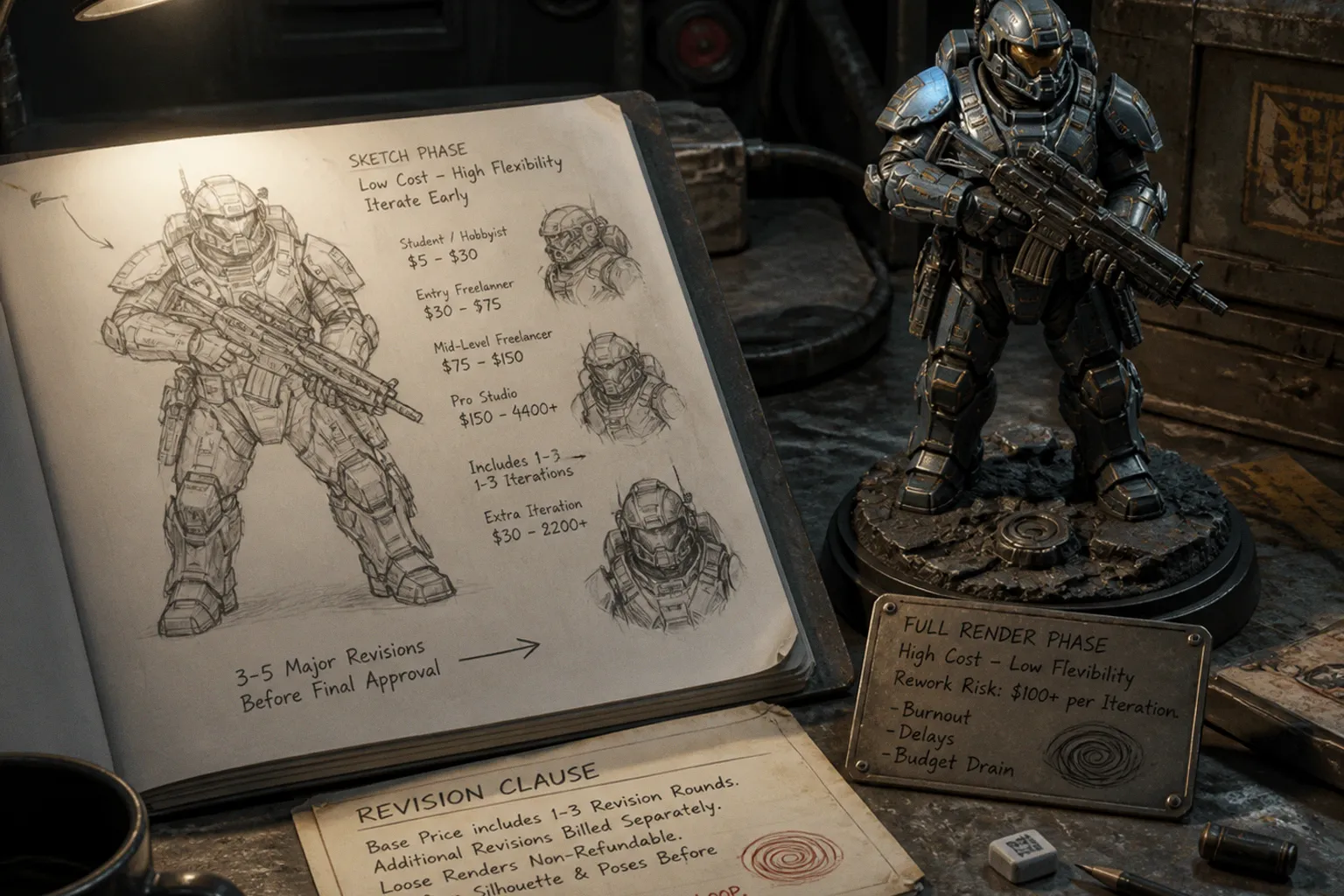
At that stage, the image is no longer a sketch. It is a stack of dependent decisions. Change the torso proportion, and the shoulder armor, weapon mount, reflected light, cast shadow, and background clearance must all move with it.
That is not “one small revision.” It is structural rework.
The usual budget leak is not an artist charging too much. It is a project treating every stage of an image as equally reversible. They are not. A black-and-white thumbnail can absorb a radical change in minutes. A rendered keyframe with controlled edge hierarchy, translucent canopy glazing, and six surface materials cannot.
Most professional freelance arrangements include one to three revision rounds in the base fee. That limit is not bureaucratic decoration. It is the pressure boundary that prevents sci-fi concept design revision traps from becoming an endless production loop.
The hidden cost of changing a finished-looking image
A concept image has layers, whether it is painted in oil, built in 3D, or assembled in a digital pipeline. The names vary. The dependency chain does not.
First comes the design proposition: role, scale, silhouette, technology level, visual language. Then come proportion and pose. Then value grouping and perspective. Only after those decisions hold should the artist commit to surface behavior: brushed alloy, painted armor, oxidized copper, ceramic insulation, wet asphalt, refractive visors, or sodium-vapor haze.
Late feedback often attacks the first layer after the artist has completed the fifth.
Consider the apparently harmless instruction: “Make the pilot’s exosuit bulkier and more industrial.”
That request may require:
- widening the outer silhouette, which alters the negative space around the figure;
- rebuilding joints so the suit can plausibly articulate;
- moving hard cast shadows across torso plates and thigh modules;
- revising specular bands on every curved surface;
- rebalancing the character against the vehicle or architecture behind it;
- correcting contact points between boots, deck plating, cables, weapons, and harnesses;
- repainting atmospheric overlap if the figure has moved forward in depth.
The client sees one sentence. The artist sees a collapsed underdrawing.
In classical paint terms, this is equivalent to asking for a new anatomical construction after the imprimatura, underpainting, dead-color pass, and much of the final scumbling have already been laid down. Digital work has an undo command, certainly. It does not eliminate labor. It only makes destruction cleaner.
For a compact character-design commission, the price of one iteration can range widely: roughly $5–$30 at the student or hobbyist end, $30–$75 for entry-level freelancers, $75–$150 for mid-level freelancers, $150–$400 or more for professional studios, and $400–$1,000 or more for industry veterans. Those figures are not interchangeable quotes. They describe different levels of experience, process control, and deliverable complexity.
The more relevant number is the multiplier created by timing. A revision that costs little at thumbnail scale may trigger a substantial redraw after rendering has begun. In some mobile RPG production contexts, a late rework has been priced around $100 per iteration. The exact number is less important than the mechanism: render time compounds the cost of unresolved design.
A polished rendering does not make a decision correct. It merely makes correcting it expensive.
Sketch-phase feedback is where the budget is protected
The cheapest version of a sci-fi concept is not the first draft. It is the draft in which the largest number of meaningful variables remain loose.
A competent sketch phase should be visibly incomplete. That is its function. It should not seduce the team with glowing engines and intricate panel seams before anyone has approved the vehicle’s mass distribution.
At this point, feedback should interrogate the design at low resolution:
1. Silhouette and role. Can the object be identified without surface detail? A reconnaissance drone should not read as a cargo unit. A salvage mech should not share the same stance as a military exosuit unless that ambiguity is intentional.
2. Scale relationship. Does the character look credible beside the door, weapon, maintenance gantry, or cockpit? Sci-fi scale fails most often at interfaces: hands on controls, boots on rungs, heads under helmets.
3. Shape language. Are forms blunt, faceted, tubular, or skeletal? A dieselpunk gunship built from broad compressed volumes belongs to a different visual system than a needle-like orbital interceptor.
4. Value architecture. Is the focal point established before color arrives? If the helmet, weapon, and chest insignia all carry the highest contrast, the composition has three competing centers and no hierarchy.
5. Technology logic. Does the design show how it is powered, opened, serviced, carried, or stabilized? Not every mechanism needs to be literal. But the image requires a coherent visual answer.
The objective is to approve the skeleton before the skin. The artist can then render with intent rather than with the quiet knowledge that the next email may invalidate eight hours of work.
Industry guidance commonly places one to three revision rounds within the base price. That is generally enough for a disciplined sketch stage: one round to identify the wrong direction, one to refine the selected direction, and, where needed, a final pass for minor alignment. It is not enough if six stakeholders are making independent aesthetic decisions from different reference folders.
Keeping feedback in the sketch phase can reduce iteration costs by as much as 40% compared with allowing the same changes to reach the rendering phase. The saving is not mystical. There are fewer locked edges, fewer dependent forms, and less texture to reconstruct.
What a useful feedback note looks like
“Make it cooler” is not feedback. It is an atmosphere leak.
“Reduce the shoulder width by approximately 15%; retain the heavy lower-leg silhouette; shift the primary light from upper left to frontal-left so the helmet lens remains the highest-value accent” is feedback an artist can execute.
The distinction is operational. The second note identifies the affected variables and preserves what should not change.
A usable review document separates comments into three columns:
| Design layer | Productive feedback | Budget-damaging feedback |
|---|---|---|
| Silhouette | “Option B reads too humanoid at thumbnail size; test a wider sensor array.” | “Can we see a totally different body shape after render approval?” |
| Proportion | “Shorten the cockpit by one module; the rear engine mass is overpowering it.” | “The cockpit feels strange. Please explore.” |
| Material | “Replace glossy black plating with matte ceramic; preserve the pale edge accent.” | “Try more detail everywhere.” |
| Composition | “Move the cruiser higher to reveal the docking arms.” | “Could it feel more cinematic?” |
| Final rendering | “Reduce the cyan bloom around the thrusters.” | “Redesign the ship, but keep this finish level.” |
The table is blunt because the problem is blunt. A note that cannot be assigned to a design layer cannot be estimated properly.
Tiered pricing is not arbitrary
Clients often compare concept-art quotes as if they are purchasing identical objects. They are not. One artist may quote for a single front-view character with one revision round. Another may quote for exploratory silhouettes, a selected color key, an orthographic sheet, callouts, and source files. Both may describe the work as “character concept art.” The label has almost no pricing value without scope.
A reliable quote distinguishes the stages.
| Stage | What should be decided here | Cost of changing direction |
|---|---|---|
| Brief and reference alignment | Function, genre boundary, deliverables, exclusions | Low |
| Thumbnails / silhouettes | Mass, pose, readability, broad language | Lowest |
| Selected sketch | Proportion, major components, perspective, composition | Low to moderate |
| Loose rendering / color study | Palette, value hierarchy, material families, lighting direction | Moderate |
| Final rendering | Edge control, texture, wear, atmosphere, presentation | High |
| Production sheet or 3D handoff | Orthographic consistency, modularity, technical callouts | Highest once downstream work begins |
Additional revisions are commonly billed as a per-round fee or hourly work. Typical published ranges run from about $30 to $200 or more per additional iteration, or approximately $25 to $100 per hour. A veteran specialist or studio can sit well above those figures, especially where the art feeds into a game pipeline with multiple approvals.
The issue is not whether a client deserves revisions. They do. The issue is whether the requested revision belongs to the stage that has already been approved.
A renderer asked to repaint a localized light effect is performing a different task from a designer asked to solve a new silhouette. The first is finishing labor. The second is concept development. Treating them as the same category produces sci-fi concept art budget waste with remarkable consistency.
There is another distortion: flat fees conceal risk. When an artist quotes a fixed sum with vague revision language, the client may assume broad freedom to redirect. The artist may assume the client will make decisions promptly. Both assumptions are defective. The result is friction, unpaid labor, or a final image compromised by exhaustion.
The contract needs to define where change is still cheap
A revision clause should state more than the number of included rounds. It should identify the stage at which each round occurs, the person or team authorized to consolidate feedback, the turnaround expectation, and the rate for additions.
The following terms are not theatrical legalism. They are functional controls for managing sci-fi art commissions.
- Define the deliverable with physical precision. “One sci-fi vehicle concept” is inadequate. Specify whether the work includes silhouettes, one final perspective view, color variants, orthographic views, interior details, weapon callouts, layered source files, or print-ready art.
- Name the approval gates. The project should have explicit sign-off points: thumbnail direction, selected drawing, loose color/material pass, and final. Approval at each gate means later changes are quoted as new work if they alter earlier decisions.
- Limit rounds, not individual comments. Ten consolidated notes in one document are manageable. Ten messages from ten people over four days are not a round. A round is one coordinated response to one submitted stage.
- Separate corrections from redirection. Correcting a missed brief requirement is not the same as changing the brief. If the artist omitted the specified twin-reactor configuration, that is a correction. If the client now wants an articulated ring drive, that is redirection.
- Use a loose-rendering clause. A color study should be described as a statement of scale, shape, value, palette, and overall feel—not a promise that every incidental mark will appear unchanged in the final. This prevents pointless disputes over transient brushwork or provisional texture.
- Price post-approval changes visibly. The agreement should state either a per-revision amount or an hourly rate. Ambiguity invites bargaining after labor has already been performed.
- Set a pause condition. If feedback does not arrive within the agreed window, the schedule moves. Otherwise the artist is forced to reserve production time indefinitely while the project silently loses momentum.
A useful contract does not make the process rigid. It makes the consequences of flexibility legible.
The revision clause is not a wall against client input. It is a map of where input remains affordable.
This becomes more severe once concept art crosses into 3D modeling, engineering, or production asset work. A changed contour on a two-dimensional sketch may mean revised topology, UVs, baked normals, rigging allowances, collision boundaries, and texture sets. At that point, a flat visual adjustment has become a pipeline event. Some custom design workflows explicitly apply significantly higher fees after approval and 3D transition; charges around $100 CAD per revision are one documented example. The principle is sound even where the number changes.
The revision loop usually begins before the first sketch
Concept design feedback mistakes are often blamed on indecisive clients. That is incomplete. Indecision is frequently built into the brief.
A brief that says “retro-futurist but not too retro, industrial but elegant, practical but alien, dark but readable” gives the artist a cloud of adjectives rather than a hierarchy of decisions. The first sketch then functions as a test balloon. The client reacts to its finish rather than its structure. A revision loop begins.
The cure is not a longer mood board. It is a decision hierarchy.
For a sci-fi commission, the brief should establish the following before drawing begins:
1. Primary function. What does the object or character do in the world? Hauls, scouts, breaches, repairs, surveils, survives hostile terrain, negotiates zero gravity. Function selects form.
2. Visual ancestry. Identify two or three firm reference directions and one rejected direction. “Cold-war avionics with ceramic medical equipment; explicitly not sleek cyberpunk” is usable. “Somewhere between everything” is not.
3. Priority order. Determine what must survive compromise: silhouette, lore fidelity, production feasibility, editorial readability, or visual novelty. Every project has trade-offs. Pretending otherwise merely delays the conflict.
4. Audience and crop. A cover illustration, a game asset sheet, and a trading-card image use different compositions. A card illustration may tolerate selective detail and compressed depth. A character turnaround cannot.
5. Decision owner. One person must return consolidated feedback. In larger game development, character designs may undergo three to five major revisions before finalization because programmers, narrative designers, visual artists, and early playtests all exert pressure. That can be productive—but only when someone has authority to resolve conflicts.
6. Reference annotations. Every reference should have a reason attached. “Use this for ribbed radiator geometry.” “Ignore the palette.” “Use this framing only.” Without annotations, artists are asked to reverse-engineer intent from a pile of unrelated images.
This preparation does not sterilize creativity. It protects it. An artist can take informed risks within a fixed perimeter. Without a perimeter, every risk becomes a potential unpaid detour.
Rendering is a commitment, not a progress bar
Clients understandably want to see polish early. It reassures them that their money is producing something substantial. But premature rendering creates the worst kind of false confidence: the image looks advanced while its design remains provisional.
The eye is easily distracted by surface finish. A convincing corroded edge, a crisp rim light, or a carefully controlled bloom around a reactor can make an unstable design feel resolved. The rendering acts like varnish over a flawed drawing. It deepens color. It does not repair structure.
In a disciplined pipeline, the transition to rendering happens only after several questions have been answered:
- Does the silhouette read at the intended final size?
- Is the focal path deliberate?
- Have the major light and dark masses been approved?
- Are all essential functional elements present?
- Does the selected view communicate the required information?
- Has the client committed to the pose, proportions, and scale relationship?
- Is the palette direction approved broadly enough that no full repaint is likely?
Only then should the artist invest in fine edge transitions, material-specific reflectance, and local texture. Metal requires a different value behavior from rubber. Painted armor needs different wear patterns from bare aluminum. A visor needs controlled refractive cues, not a generic white streak. None of this should be built on an unapproved chassis.
For the client, the operational discipline is simple: do not use final-render feedback to reopen sketch-stage questions. If the torso is too narrow, say so at the drawing gate. If the entire visual language is wrong, stop the rendering process. Paying for an additional sketch cycle is cheaper than commissioning a forensic reconstruction of a finished image.
A final verdict on control
The endless revision loop is not evidence of high standards. Usually it is evidence that standards were never translated into decisions early enough.
Good sci-fi concept design has room for iteration. It requires iteration. Three to five major revisions in a structured production environment may be entirely normal when gameplay, narrative, technical constraints, and art direction are converging. The trap appears when the project confuses exploration with completion and expects one fee to cover both without limit.
Approve silhouette before surface. Approve proportion before lighting. Approve value structure before texture. Put revision rounds and post-approval rates in writing. Assign one decision owner. Treat every rendered hour as a commitment of budget, not a decorative milestone.
That is the entire mechanism. The rest is pigment, pixels, and labor.