Fantasy Art Commissions: Licensing Traps to Avoid
The most expensive failure in a fantasy art commission usually occurs before the first thumbnail. It sits in one sentence of a contract: “Client owns all rights.” That sentence may be ineffective, incomplete, or far broader than either party understands.
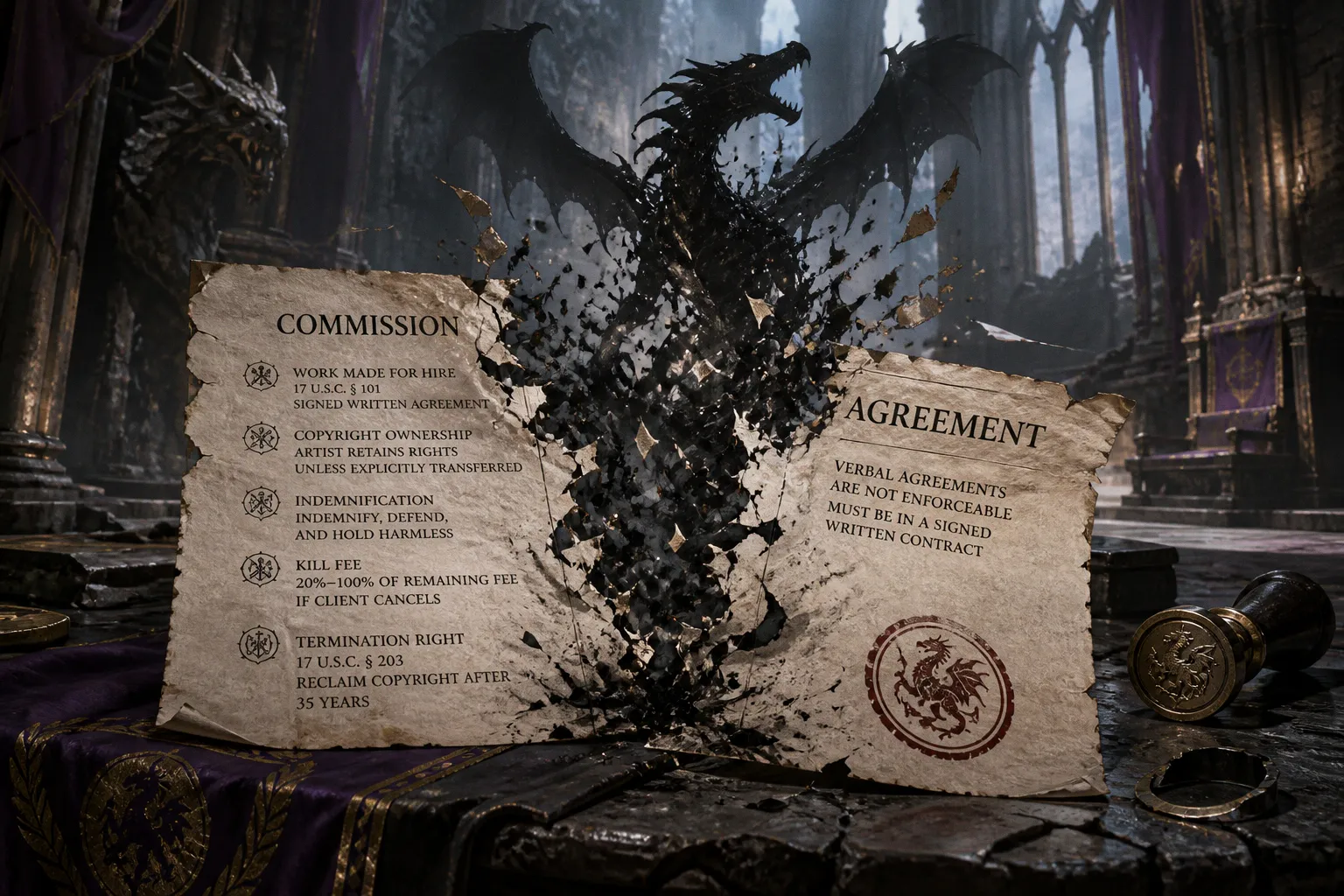
In the worst version, it is paired with a work-made-for-hire label and an indemnity clause that transfers every downstream risk to the illustrator.
Fantasy illustration is unusually exposed to this problem. A dragon painting may become a book cover, a card-game asset, a miniature box, a convention banner, a social-media campaign, or a print sold years after the original commission. Each use has a different commercial weight. Treating them as one undifferentiated “commission” is poor drafting.
The physical object, the original layered TIFF, and the copyright are separate materials. They do not fuse because money changes hands.
Payment buys the work described in the agreement. It does not automatically buy every future use of that work.
These fantasy art commission contract pitfalls are not minor legal housekeeping. They determine who can reproduce the image, alter it, sublicense it, sell derivative products, and absorb the cost when a third party objects.
A commissioned painting is not an automatic copyright transfer
Clients commonly assume that commissioning an illustration gives them full ownership. Artists commonly assume that keeping the layered source file preserves their control. Both assumptions can fail because they address different things.
Under U.S. copyright law, the illustrator ordinarily owns the copyright from the moment an original image is fixed in tangible form: on board, canvas, paper, or a digital file. The client may own the delivered physical painting. They may possess a 6,000-pixel PNG, a print-ready CMYK TIFF, or an original oil panel. None of that, by itself, transfers the exclusive rights to reproduce and distribute the image.
A client who buys an original knight-and-griffin painting may be entitled to hang it in a private office. That does not automatically permit:
- printing the image in a novel, anthology, or rulebook;
- placing it on trading cards, playmats, apparel, or packaging;
- using it as a logo or brand mark;
- creating cropped, recolored, animated, or AI-adapted variants;
- sublicensing it to a publisher, distributor, game studio, or merchandiser;
- selling posters, prints, or digital collectibles built from the image.
The commission agreement must state which of those uses are licensed. If the client wants ownership of copyright rather than a license, the transfer needs to be explicit and signed in writing. A conversation, an email thread with vague language, or an invoice marked “full rights” is not a clean substitute for a signed copyright assignment.
This distinction is basic, but it is routinely blurred by the phrase “exclusive commission.” Exclusive can mean several incompatible things:
| Contract term | What it should mean in practice | What it does not automatically mean |
|---|---|---|
| Exclusive license | The client alone may use the image within the defined scope | The artist has transferred copyright ownership |
| Copyright assignment | Ownership of copyright moves to the client through a signed agreement | Every vague future medium has necessarily been priced fairly |
| Original-art sale | The buyer owns the physical board, canvas, or print | The buyer can reproduce the image commercially |
| Portfolio embargo | The artist delays showing the work publicly | The artist loses all authorship or future rights |
| Buyout | A commercial shorthand, not a legal category | Unlimited use without defined territory, duration, and media |
The practical error is not merely failing to say “copyright.” It is failing to specify the license geometry: media, territory, duration, exclusivity, print run, language editions, derivative works, and sublicensing. A license for one paperback cover in North America is a different asset from worldwide use across books, games, apparel, and advertising in perpetuity.
That difference should appear in the fee.
“Work made for hire” is not a spell
The phrase “work made for hire” is often treated as a solvent that dissolves an illustrator’s copyright. It is not. In U.S. law, an independently commissioned work qualifies as work made for hire only under narrow statutory conditions.
For a freelancer, the work must be specially ordered or commissioned, governed by a signed written agreement stating that it is a work made for hire, and fit into one of nine statutory categories listed in 17 U.S.C. § 101. Those categories include, among others, a contribution to a collective work and a supplementary work.
A standalone fantasy character painting is not automatically converted into a work made for hire because a contract uses the phrase three times in bold type. The label has no force if the statutory structure beneath it is absent.
This matters particularly in speculative-fiction production. A publisher may commission interior spot illustrations for an anthology, a game studio may commission a suite of card images, or a creator may commission a single key-art scene for crowdfunding. These are not identical legal situations. A contribution intended for a collective work may be analyzed differently from a standalone promotional illustration. The contract must identify the actual function of the artwork, not apply a stock clause copied from a corporate template.
There is another reason not to treat work-for-hire language casually. Under 17 U.S.C. § 203, an author who transfers copyright may generally have a termination right after 35 years, subject to statutory procedure and conditions. That termination mechanism does not apply to genuine works made for hire.
The distinction is not decorative. It affects the long tail of an image’s commercial life.
A competent agreement therefore separates the fallback positions:
1. It states whether the parties intend a work-made-for-hire arrangement.
2. It identifies the statutory basis rather than relying on a label.
3. It provides a signed copyright assignment as a fallback if work-for-hire status is later found not to apply.
4. It defines exactly what rights move, and when payment triggers that transfer.
5. It states whether the illustrator retains portfolio, self-promotional, print-sale, or original-art rights.
The last point is where many hiring fantasy illustrators mistakes become visible. Clients demand every right as a precaution, then use only one cover image. Artists surrender every right to close a job, then discover that the image has become a recurring commercial property. Neither result is technically necessary.
A broad rights grant is not professional by default. It is only professional when its scope matches the client’s actual exploitation plan.
Licensing has a measurable commercial shape
“Full usage” is an imprecise request. It is not a brief. The client should know whether the artwork is a single-use asset, a campaign anchor, or a durable piece of intellectual-property infrastructure.
For an illustrator, the task is to price the image-making labor separately from the rights being acquired. The rough sketch stage, reference construction, drawing, color study, rendering, revisions, and final delivery are the production fee. The rights package is another layer. Conflating them makes negotiations opaque.
A robust license description addresses the following points in plain language:
- Medium: print book, ebook, card game, digital game, web use, social media, packaging, advertising, broadcast, or merchandise.
- Territory: one country, a defined language market, or worldwide.
- Term: a fixed period, a publishing cycle, or perpetual use.
- Exclusivity: whether the artist may license the same image elsewhere, sell prints, or reuse non-client-specific elements.
- Print and production scale: a limited print run is materially different from unlimited product manufacture.
- Alteration rights: cropping is not the same as repainting, recoloring, compositing, or training a generative system on the image.
- Sublicensing: whether a publisher, distributor, foreign-language partner, game licensee, or manufacturer may use the work without a fresh artist approval.
- Credit: where the illustrator’s name will appear and whether omission is permitted in constrained formats.
The fantasy art licensing rights cost rises when these variables expand. That is not opportunism. It is the correct response to a larger economic field.
Consider a commissioned oil key image for a tabletop campaign. A narrow license might permit use on one crowdfunding page and the first edition of a rulebook. A wider license may add card decks, box art, miniatures packaging, translations, retailer banners, paid advertising, and perpetual merchandise. The painted dragon is the same. The commercial surface area is not.
The contract should also distinguish pre-existing material from newly commissioned work. An illustrator may use established brush libraries, texture scans, compositional methods, reference archives, or signature motifs. A client purchasing a specific final image does not acquire the artist’s underlying process inventory.
For traditional work, the original object needs its own clause. It should state whether the panel or canvas is included, when it ships, who bears freight and insurance costs, whether the artist may scan it before delivery, and whether the client may resell it. The original object has one chain of possession. Copyright has another. Do not let the contract smear them together.
Indemnity clauses can turn a commission into an unlimited liability event
The phrase is familiar: “Artist shall indemnify, defend, and hold harmless Client from any and all claims.” It is also dangerous when drafted without limits.
Indemnification decides who pays when someone alleges infringement, defamation, breach of privacy, unauthorized reference use, or another legal injury. The word defend is especially consequential. It can require the artist to fund legal defense from the start, even before liability is established.
In a commission context, a broad indemnity clause can make the artist responsible for claims caused by the client’s own conduct: a later crop, a misleading advertisement, an unapproved edit, a product use outside the licensed scope, or a prompt supplied by the client that resembles another creator’s protected character.
That allocation is structurally wrong. Liability should follow control.
A narrower approach assigns the artist responsibility for claims arising from the artist’s original final artwork as delivered, while carving out client-supplied materials, client instructions, client modifications, and uses outside the agreed license. The client, in turn, should indemnify the artist for claims tied to those client-controlled elements.
The contract should also identify operational details that stock language usually obscures:
- Who controls the defense and selects counsel?
- Must the indemnified party provide prompt notice of a claim?
- Can either party settle without the other’s consent?
- Is liability capped at the commission fee or another defined amount?
- Does the obligation survive indefinitely, or only for a stated period?
- Does it cover merely alleged claims, or only proven losses?
An artist who agrees to indemnify a multinational publisher for “any and all claims” in exchange for a modest cover fee has created a mismatch of scale. The fee is finite. The theoretical exposure is not.
This is not an argument for adversarial contracts. It is an argument for clean edges. In painting, an edge controls where one plane ends and another begins. In a commission agreement, indemnity performs the same function. If it is soft everywhere, the forms bleed.
Kill fees are not penalties; they preserve reserved production time
Commission work is often cancelled after the artist has already invested in research, thumbnails, drawing, color architecture, and preliminary rendering. In fantasy work, that investment can be substantial before the image looks “finished” to a client. Constructing armor reference, creature anatomy, costume motifs, heraldry, environment geometry, and lighting logic is labor, not preparatory vapor.
A kill fee clause establishes what happens when the client stops the job. It should be linked to actual production stages and the amount already earned.
Kill fees commonly range from 20% to 100% of the remaining contract value, with 25% to 50% frequently used as a middle range. The correct figure depends on the payment schedule, the stage of completion, and whether the cancellation deprives the artist of other booked work.
A staged structure is more precise than a single vague cancellation term:
1. Before work begins: the deposit may be retained to compensate for scheduling and administrative preparation.
2. After thumbnails or concept sketches: the artist keeps the deposit and receives the agreed stage payment, since the exploratory work has been performed.
3. After approval of a color study or detailed drawing: the cancellation payment should reflect the reduced ability to repurpose the work and the substantial labor already embedded.
4. After final rendering begins: the remaining fee may be largely or fully due, especially where the commission is client-specific and cannot be resold.
5. After final delivery: cancellation is no longer the relevant mechanism; payment, license activation, and delivery terms govern.
The agreement must also say what happens to unfinished artwork. Usually, if the client cancels, the artist retains copyright and may reuse or rework the unlicensed material, provided client-confidential material is not exposed. If the client wants the unfinished work delivered or wants it permanently withheld from the artist’s portfolio, that restriction has value and should be priced.
Deadlines require the same discipline. A client-side delay in feedback can freeze an illustrator’s production queue. Set revision windows. State how many days the client has to approve sketches. Define whether silence counts as approval. Specify that delivery dates move by the length of client delay. Otherwise, the artist carries the timing risk while the client controls the approvals.
Verbal promises fail exactly where the money becomes real
The speculative fiction art commission guide most freelancers wish they had read early is short: put the commercial terms in writing before drawing.
Verbal agreements are particularly weak when they concern copyright transfer. Under U.S. copyright law, a transfer of copyright ownership must be in a signed written instrument. “We talked about it on Discord” is evidence of a conversation, not a reliable transfer document.
Email can document decisions, but it should not become the only place where the scope of rights is assembled in fragments. One message says “worldwide.” Another says “for the game.” A third mentions print sales. Months later, no one can reconstruct whether “the game” meant a beta release, a sequel, a card expansion, or a merchandising program.
A short agreement can be sufficient if it is exact. It does not require theatrical legal prose. It requires named parties, a defined deliverable, a fee and payment schedule, revision limits, delivery format, a specific rights grant, credit language, cancellation terms, indemnity boundaries, and signatures.
The rights grant should activate only after full payment. Without that sequencing, an artist can deliver high-resolution files, the client can begin commercial use, and a payment dispute becomes harder to unwind. The contract should also specify whether preliminary sketches and alternate concepts are licensed. In most cases, they are not.
One further pressure point deserves direct treatment: artificial-intelligence use. If a client intends to use the commissioned image as training data, reference material for image generation, a source for dataset construction, or input for derivative machine-generated output, the agreement should say so plainly. Silence is not a durable policy. The same applies to minting, tokenization, and other forms of digital commercialization that may not fit ordinary “web use” language.
The durable contract is specific, not maximal
A fantasy commission agreement does not need to strip the artist of every right to protect a client. It needs to give the client the rights required for the actual project, at a price consistent with their scale and duration.
The cleanest arrangement is often a defined license: one product line, stated media, stated territory, stated term, clear exclusivity, no sublicensing beyond named partners, and a separate price for expansion. If the client later needs a translation, an expansion set, an animated trailer, or retail merchandise, the parties can negotiate from a visible baseline instead of litigating the meaning of “all rights.”
The work-made-for-hire clause deserves statutory scrutiny. Copyright transfer requires a signed instrument. Indemnity must track control. Kill fees must recognize completed labor. Verbal assurances should be treated as preliminary discussion, not contract architecture.
That is the verdict. In fantasy illustration, the image may be elaborate, but the agreement should not be foggy.