Craig Maher original art: three valuation traps to avoid
Craig Maher original art valuation fails at the first physical question: what, exactly, is being offered for sale?
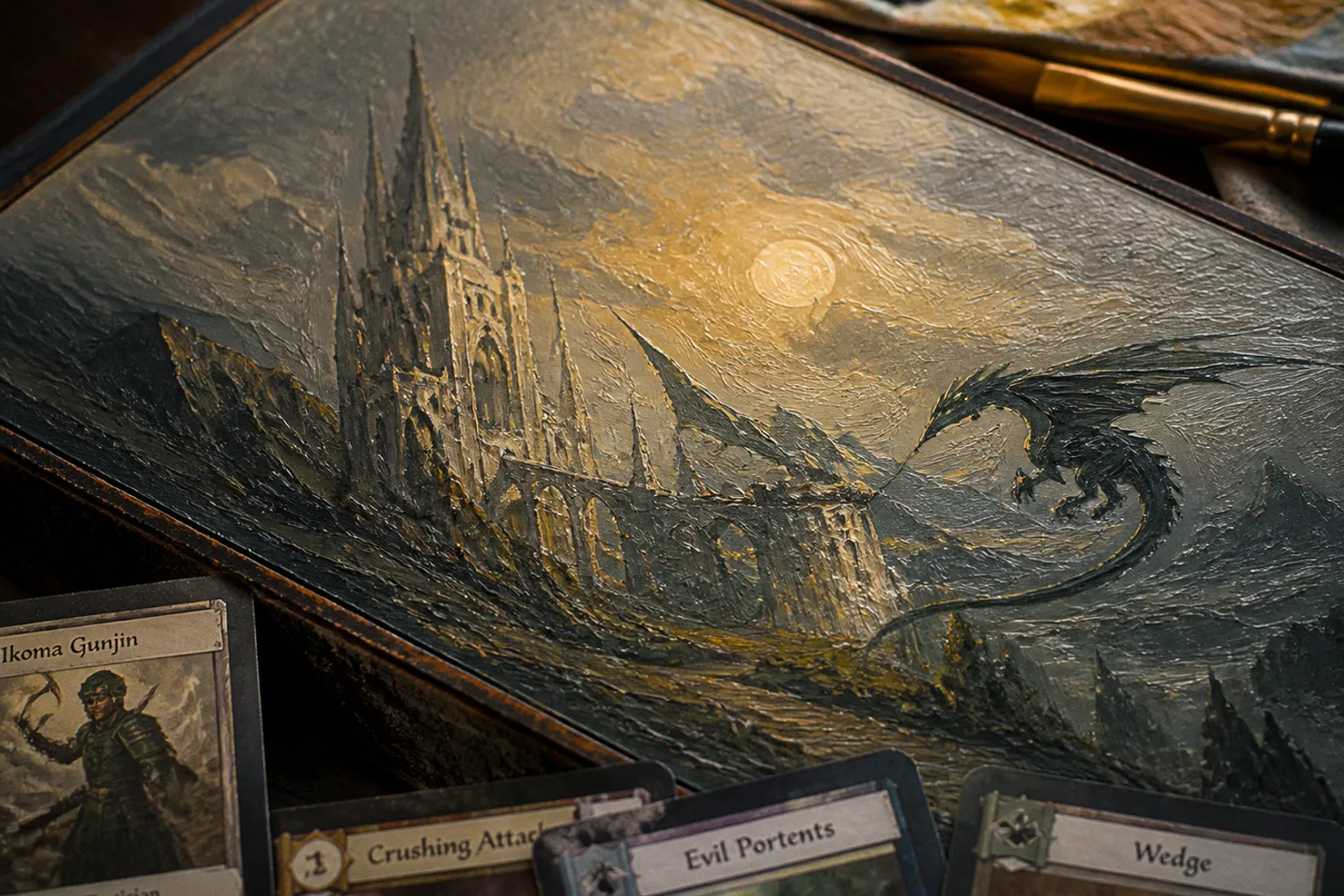
A signed trading card, a numbered print, a publication proof, and an oil painting on board may reproduce the same image. They are not adjacent categories of asset. They are different objects, with different production methods, scarcity profiles, condition liabilities, and buyer pools. Conflating them is how a nominally priced card becomes false evidence for the value of a painting.
Maher’s portfolio makes this confusion unusually easy. His work exists across early Legend of the Five Rings, Warlord: Saga of the Storm, 7th Sea, Legends of the Burning Sands, and the 78-image Tarot of the Vampires deck, published in 2023. The imagery circulated widely. The physical paintings did not necessarily circulate with it.
That imbalance is the center of the market. Reproduction is visible. Original support is scarce, inconsistently documented, and materially specific.
The image has a market. The object has a different one.
Trap one: treating every Maher image as if it were an oil painting
Maher is a traditional illustrator. That point needs precision. It does not mean every object bearing his image is a traditional work, nor does it guarantee that every commercial assignment survives as a recoverable physical painting.
Known examples establish the material baseline. Tread is identified as oil on board. His work for Warlord: Saga of the Storm included more than 30 traditionally painted card illustrations: three Warlords, an Overlord, a Medusan Lord, and challenge lords including Sir Tython and Eiael Darkfeather. A buyer examining an offered work should therefore expect the evidence of a hand-built oil surface where an original is claimed.
Oil on board has a detectable structure. Under raking light, one should see a sequence of decisions rather than a uniformly deposited image:
- Ground and support. Illustration board, hardboard, or panel should have a coherent reverse side, edge thickness, and aging pattern. A contemporary print mounted to board is not equivalent to paint applied on board.
- Underpainting. Dark masses often establish the value architecture before local color appears. In an authentic oil process, this can be visible at thin passages, especially around contour corrections and recessed shadow.
- Brush load. Maher’s traditional method should produce variable film thickness: opaque body color in focal forms, thinner passages in transitions, and occasional scumbling where a lighter, broken layer drags over a dry or semi-dry darker layer.
- Edge behavior. Mechanical reproduction gives the same edge hardness across the image. Paint does not. A physical original may move from a compressed hard edge to a lost edge within a few millimeters.
- Surface response. Oil paint has directional reflectance. Gloss changes with pigment, medium, and film thickness. A flat, identical sheen across every color family is a warning sign, not proof by itself, but a warning.
The practical distinction is not romantic. It is financial. A print may have decorative value and a legitimate secondary market. It does not contain the unique paint film, the altered edges, the buried revisions, or the hand of the illustrator as a physical event.
| Object offered | What it actually represents | What should support the price |
|---|---|---|
| Signed CCG card | Mass-produced game component with an autograph | Card condition, set demand, signature quality, collector liquidity |
| Print or giclée | Reproductive image, sometimes limited | Edition size, printer, paper, signature, condition |
| Artist proof or publication proof | Production artifact or print-stage object | Documented role in the edition process, rarity, condition |
| Oil on board / panel | Singular painted object | Provenance, material verification, image importance, condition, original-art demand |
| Preliminary drawing or color study | Developmental work | Direct connection to a finished image, medium, completeness, documentation |
The phrase “original art” should be reserved for the last two categories only when the object is genuinely hand-executed and traceable. A preliminary study can be original art. A signed card cannot become original art because the signature is original.
That distinction is basic, but fantasy art valuation mistakes repeatedly begin here. The public sees an image. The collector must inspect the substrate.
Trap two: using signed-card prices as a benchmark for the painting
Artist-signed Maher cards circulate in the secondary market at nominal prices around $18. Examples include signed Vivian cards from Warlord and signed Ikoma Gunjin cards from Legend of the Five Rings. This figure is useful only for one purpose: it demonstrates the value of a signed card in a particular collector market.
It says almost nothing about the value of the original painting.
A card is a manufactured multiple. Even when the autograph is legitimate, its economics remain constrained by several factors: print quantity, card-game player demand, set condition, card grading, and the abundance of comparable signed examples. The signature changes the individual card’s status. It does not transform the card stock into the painted source image.
An oil illustration functions under a different scarcity equation. There may be one final board. There may also be studies, sketches, transparencies, scans, or no surviving preparatory material available to the public. None of those quantities can be inferred from the price of a card.
The distinction becomes sharper with early Legend of the Five Rings work. Maher was among the original artists attached to the game after its 1995 launch, producing power cards including Evil Portents, Crushing Attack, Wedge, and Ikoma Gunjin, the Lion Clan Tactician. Those card images have cultural visibility inside a long-lived game property. But visibility is not the same thing as an available original-art supply.
For a collector buying Craig Maher paintings, the correct sequence is narrower:
1. Identify the offered object before assessing the image. Request front, reverse, edge, and raking-light photographs. A cropped glamour shot is inadequate.
2. Establish whether the work is final art, a study, or a reproduction. Sellers often use “original” loosely. The word must be tied to medium and support.
3. Separate signature provenance from artwork provenance. An authenticated signature on a card validates the autograph. It does not document the whereabouts of the painted original.
4. Locate the commission or publication relationship. A work tied directly to a named card, tarot image, or published illustration has a clearer place in the portfolio.
5. Compare only like with like. A small independent oil study should not be priced through a signed card. Nor should a major licensed card illustration be priced through a small study.
A signature authenticates a mark. Provenance authenticates an object.
There is another error embedded in the signed-card comparison: it produces false pessimism. A collector sees an $18 signed card and assumes the original cannot command serious attention. The reverse error is equally common. A seller points to the popularity of a game image and assumes any print or mounted reproduction deserves original-art language. Both positions ignore material class.
The L5R and Warlord problem: intellectual property does not automatically create a price
Card-game illustration carries an IP premium only when several elements align: recognizability of the image, attachment to a durable collector community, rarity of the physical original, and confidence that the offered board is the actual production piece.
Maher’s Legend of the Five Rings and Warlord assignments meet the first condition well. They belong to identifiable eras of collectible-game illustration. L5R began in 1995. Warlord: Saga of the Storm launched in 2001. Maher’s involvement in both places him inside a specific lineage of pre-digital and transitional fantasy game art, where physical media can matter more than it does for later all-digital pipelines.
But intellectual property is not a solvent. It does not dissolve uncertainty around ownership, condition, or medium.
A card illustration can be iconic within its player community and still be difficult to price as original art if the painting has not appeared publicly, lacks a chain of custody, or is offered without convincing documentation. Conversely, a modestly known image may attract disciplined original-art buyers if it is an unmistakable oil board with solid provenance and intact surface.
The variables do not carry equal weight.
| Valuation variable | Effect on a Maher original |
|---|---|
| Confirmed oil-on-board or oil-on-panel medium | Fundamental. Establishes the work as a unique physical painting. |
| Direct match to a published L5R or Warlord card | Strong. Links the object to a documented commission and collector base. |
| Early-era or role-defining image | Potentially strong. Historical placement can matter more than raw visual spectacle. |
| Clear artist, publisher, or prior-owner provenance | Fundamental. Reduces attribution and title risk. |
| Unrestored paint surface and stable support | Strong. Conservation problems can erase confidence quickly. |
| Signed card or loose print of the same image | Minimal relevance to the painting’s value. |
| Vague claim that the image is “rare” | No value until the object and its history are verified. |
The market for traditional fantasy illustration is thin rather than absent. That matters. Thin markets do not generate dependable public comparables every month. They generate long intervals, private transactions, incomplete sales records, and wide asking-price variation. A lack of auction data for specific Maher paintings from L5R or Warlord is not evidence that the works are worthless. It is evidence that a precise public market value cannot be responsibly asserted.
The correct conclusion is restrained: individual boards must be valued as individual boards.
Trap three: mistaking a low-priced independent work for a universal market floor
In 2016, Maher’s painting Yellow, made for the Month of Love “Fantasy” challenge, sold through Everyday Original for $150. The figure is real. It is also highly specific.
It reflects one work, one platform, one moment, one subject, one format, and one buyer event. It cannot function as a universal floor for Maher’s original paintings, particularly not for commercial card art with a known publication history.
The tendency to flatten an artist’s market into a single number is a recurrent analytical failure. It ignores scale, support, image relevance, date, finish level, framing, documentation, and the difference between personal challenge work and licensed illustration.
A small independent work may have a simpler composition, lower material cost, less production time, and no embedded collector demand from a game or deck. A published card painting may be physically similar in size yet carry a different documentary burden and a different audience. The latter is not automatically more expensive. It is simply a different market object.
The Tarot of the Vampires project provides a useful contemporary counterweight. The deck contains 78 cards, written by Charles Harrington and published by Llewellyn Worldwide on July 8, 2023. That is a substantial body of Maher imagery, but publication alone does not answer the critical ownership questions:
- Were finished originals retained by the artist, publisher, or another party?
- Were all 78 images executed as oils, or were different methods used at different production stages?
- Are originals, studies, or proofs entering the market?
- Does a particular offered painting match a published card exactly, or merely resemble it?
- Is the image being sold with publication documentation?
These are not bureaucratic details. They determine whether a buyer is acquiring a unique artifact, a preparatory object, or a decorative derivative.
The absence of an answer should reduce certainty, not invite invention. A seller unable to document a relationship to the published deck may still be offering a legitimate original work. But it should be valued as an unattributed or independently titled Maher painting until the connection is proven.
Provenance is not paperwork after the fact
With illustration boards, provenance often begins at the reverse. Labels, handwritten titles, publisher stamps, inventory codes, old gallery stickers, framing notes, and shipping inscriptions can be more informative than the front image. They should be photographed before reframing, cleaning, or restoration.
The back of the board can also reveal trouble. Fresh white backing paper can conceal a mounted print. A recently applied signature may sit on a surface inconsistent with the rest of the work. A panel may have been cut down, re-edged, or adhered to another support. None of these facts automatically disqualifies the object. They do, however, change the questions.
For Maher’s oil work, a credible provenance file should ideally contain some combination of the following:
- A direct artist sale, gallery invoice, or correspondence identifying title, medium, and dimensions.
- Publication evidence connecting the image to a specific card, deck, or assignment.
- Earlier photographs that establish the work’s condition and physical identity.
- A consistent ownership chain rather than a gap filled with “estate find” language.
- Clear dimensions of the painted surface, not merely the framed object.
- High-resolution images showing the signature, corners, edges, reverse, and paint texture.
Buyers should be careful with conservation as well. A dark fantasy image can conceal abrasion. Overcleaning is especially destructive in thin shadow passages, where a restorer may remove translucent glazing and expose a dull underlayer. Thick impasto may crack at pressure points; board can bow under poor storage; a glossy varnish can exaggerate saturation and hide uneven retouching.
These are material facts. They are more useful than broad claims that a work is “museum quality.”
What a disciplined buyer should actually pay for
The most defensible purchase case combines physical originality, a known image, and a documented chain of custody. Remove one component and the object may still be desirable, but its valuation must become more conservative.
A Maher oil study with direct artist provenance can be a sound acquisition even without card-game celebrity. A fully documented L5R or Warlord board can command attention because it joins physical originality to a specific piece of game-art history. A signed card can be enjoyable, affordable, and collectible—but it belongs in a separate column of the ledger.
Maher’s career contains enough material distinctions to defeat lazy pricing. He studied under Joe Kubert at The Kubert School, received Best in Show at GenCon, and has appeared in Spectrum: The Best in Contemporary Fantastic Art and the Infected By Art annual. Those credentials establish professional context. They do not substitute for object-level verification.
The verdict is therefore simple. Do not price a painting from an autograph card. Do not price a published illustration from a $150 independent sale. Do not call a reproduction “original art” because it carries a signature.
In this corner of fantasy illustration, the support, paint film, and provenance are not secondary details. They are the valuation.