Fantasy Artist Interviews: Pre-Prep Checklist
Most fantasy artist interviews die before the first useful sentence. The interviewer fires a softball — “What inspires you?” — and the artist lobs it back. Three paragraphs later the reader has learned nothing about the work, the technique, or the career arc.
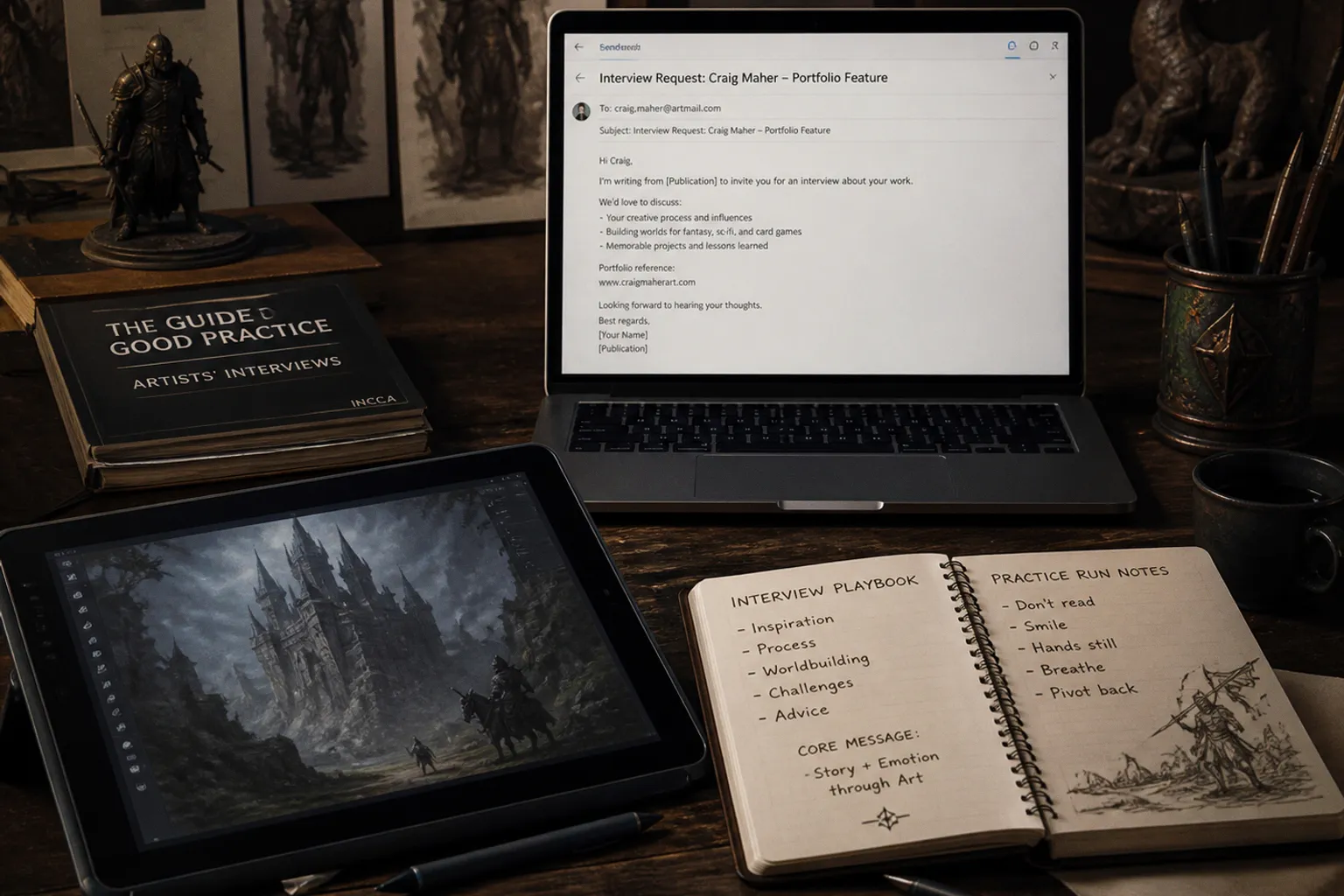
The interview reads like a Wikipedia stub with pronouns.
This is fixable. The problem is rarely talent. It is prep. Neither side — interviewer nor artist — does the homework, and the result is the same beige content that floods every artist spotlight feed. A useful fantasy artist interview preparation checklist is not about making the exchange stiff. It is about clearing away the preventable nonsense so the actual work can surface.
Treat the process as production, not a vague promise to “have a conversation.” The romance of just talking to the artist is what produces interviews nobody finishes.
Establishing Professional Rapport and Initial Outreach
The first email sets the temperature for everything that follows. A lazy cold outreach reads: “Hi, I love your work, can we hop on a call sometime?” Artists get versions of this constantly. The signal is clear: the writer did not look at the portfolio, did not find an angle, and probably sent the same template to fifty illustrators that morning.
What works instead is specificity. Reference a particular piece. State the editorial angle. Explain why this artist, this body of work, this moment. Link to the publication, ideally to a previous interview the outlet has run, so the artist can judge the house style and the audience. The outreach email is the cold open of the whole piece. Composition matters before the subject enters.
For interviewers, basic professional practice is not complicated:
- Open formally, even if the publication’s voice is casual.
- State what you are making: written Q&A, profile, podcast, live stream, recorded video, panel appearance.
- Name the angle rather than merely asking for “an interview.”
- Say how much time you are requesting and what form that time takes.
- Give a real deadline, including whether the artist will have a chance to check direct quotations or factual details.
- Make it easy to decline without turning the exchange awkward.
If the artist is busy — and most working illustrators are — a clean email with a visible ask gets a reply. A vague email gets buried.
For artists, the flip side is equally plain: be ready when the good email arrives. Maintain a compact media kit with three bio lengths, a current headshot, a portfolio link, image-use information, and a contact address that is not a personal inbox buried under sixteen newsletters. The point is not corporate polish. The point is removing friction. If an editor has to hunt for a usable image, a concise bio, or confirmation of a title, they may simply choose the artist whose materials are already in order.
A short reply can still establish the terms that matter: format, deadline, intended audience, expected length, whether questions will be supplied in advance, and whether the conversation is on or off the record. These details are not fussy. They are the frame around the work.
“Most fantasy artist interviews die the moment the recorder starts — not because the artist failed, but because the interviewer never read the portfolio.”
Curating Deep-Dive Questions from Portfolio Research
Once the interview is locked, the question list becomes the real production. Guidance for arts interviews tends to agree on the useful principle: ask simple, direct questions. Skip the scholarly fog. Skip the yes-or-no setup. But simple does not mean lazy. A simple question built from genuine portfolio research beats a clever question built from a search snippet every time.
The mechanical workflow is straightforward. Open the artist’s archive, not just the handful of images currently doing numbers on social media. Build a rough chronology. Notice where the medium changes, where the subject matter sharpens, where the palette cools or hardens, where a personal series gives way to commissioned work, where a recurring motif appears and then disappears.
Those breakpoints are where the story lives.
A portfolio is not just a gallery wall. It is evidence of decisions. A fantasy illustrator may move from crowded battle scenes toward solitary figures, or from ornate finish toward blunt graphic silhouettes. A card-game artist may learn to solve narrative problems inside a tiny frame, where a hand gesture has to carry more weight than a full landscape. A science-fiction artist may shift from polished machinery to atmosphere and scale. None of that needs to be imposed on the artist as a thesis. It needs to be noticed before the question is asked.
Avoid the dead-air prompts every interviewer defaults to:
- “What inspires you?” Generic and nearly impossible to answer without producing a list of nouns.
- “How did you get started?” Useful only if there is a specific origin point in the portfolio worth returning to. Otherwise, it produces answer fifty-one to a question answered fifty times.
- “What’s your creative process?” Too broad. It invites a broad answer.
- “What advice do you have for aspiring artists?” Often a way of abandoning the actual subject — the artist and the work on the table.
- “What is your favorite piece?” Fine as a warm-up, weak as the spine of a profile.
Replace them with questions that have a visible point of entry. “The shift between this earlier piece and the later commission is visible in how you use negative space. What changed in the way you were composing figures?” That question may take ninety minutes of looking to write. It can produce a paragraph that no other interviewer has.
The best fantasy illustrator interview questions do two things at once: they invite technical specificity and leave room for the artist to correct the interviewer’s reading. A question should not be a trap disguised as praise. If you think a piece is about grief, say what you saw in the image and ask whether that reading is useful. The artist may confirm it, reject it, or take the conversation somewhere better.
For fantasy artists, technical vocabulary is often the unlock — if it is used with care. Asking about glazing, focal hierarchy, value grouping, narrative composition, atmospheric perspective, edge control, or brush economy signals that the interviewer has actually looked. The artist stops offering the press-kit answer and starts talking about the work.
That does not mean every question needs studio jargon. “Why did you let the background disappear here?” may be more productive than “Could you discuss your atmospheric perspective strategy?” The first sounds like a person looking closely. The second sounds like an exam paper.
Research the image, not merely the reputation
A known artist can still be poorly interviewed. Name recognition creates its own kind of laziness: everyone assumes the audience already knows the career story, so everyone asks the same heroic-origin questions. Portfolio research restores texture.
Before the session, note:
- the piece or sequence you want to anchor the conversation around;
- a technical decision visible in that work;
- a career transition the artist may be willing to discuss;
- one question about constraints — format, brief, revision process, visual continuity, client direction;
- one question that gives the artist room to name what the viewer may be missing.
This is especially important in card-game illustration. The final image is often experienced as one rectangle among many, but the artist may have been solving a dense set of constraints: readable action at small scale, the mood of a faction, an established setting, a character’s prior depiction, space for game information, and a brief that arrives with more narrative than the finished card can visibly hold. Ask about the problem the image had to solve, not just the prettiness of the result.
Internal artist spotlights can be more informal than a third-party commission, and peer-generated questions can bring useful warmth. That does not eliminate preparation. It simply changes the stakes. The interviewer still needs to identify specific work worth discussing, and the artist still needs to know what kind of response will serve the collective’s audience rather than dissolve into friendly shop talk.
Logistical Planning for Video and Live Broadcasts
Video is where many fantasy artist interviews fall apart. The setup underestimates the time, the artist is rushed, the audio is bad, and the final cut looks like a hostage video conducted beside a ring light.
A recorded session needs more time than the apparent runtime suggests. Setup, sound checks, camera framing, the conversation itself, possible process footage, retakes, and wrap all occupy the same calendar block. SFMOMA’s production guidance offers a useful reminder that video is not a thirty-minute appointment just because the finished clip may be short. Budget the work honestly. A rushed artist gives shortened answers; a rushed interviewer misses the follow-up; a rushed production discovers the audio problem after everyone has gone home.
Prerecorded video has its own traps. Do not make the artist read a script unless the format genuinely requires it. The moment someone reads, the cadence flattens into the rhythm of corporate training material. A practice run is better: record one answer, watch it back, adjust the framing, lose the fidgeting, identify the verbal clutter, then begin for real.
The goal is not to scrub away personality. A pause is human. Thinking is not a defect. The target is the repeated throat-clearing, the camera angle that cuts off the hands of a painter discussing brushwork, the desk lamp throwing a hard shadow across half a face, the microphone placed just far enough away to turn a useful answer into mush.
For live broadcasts and streams, a light playbook helps. Build a one-page set of likely prompts and the few points you genuinely want the audience to leave with. “Where do you get your ideas?” and “How long does a piece take?” will appear sooner or later. Prepare answers, but do not memorize them into dust.
Live interviews drift. The artist who can gently steer the drift back to the work keeps the spotlight where it belongs. This is also where behind-the-brush material earns its keep: process footage, preparatory sketches, hands at work, a palette close-up, a glimpse of the reference wall. Visual storytelling continues between questions.
Audio-only interviews — podcasts, radio, remote conversations — live or die on the room. Convention floors, hotel lobbies, cafés, and open studios are hostile environments for a thoughtful answer. Book a quiet space or insist on a remote recording where the artist can use a decent microphone. The interview can survive a merely adequate camera. It will not survive a vocal track that sounds as if it was recorded inside a rain barrel.
Navigating Communication Styles and Written Responses
Not all interviews need to happen across a table or through a webcam. Written questionnaires, email exchanges, letters, phone conversations, recorded audio, video sessions, face-to-face interviews, and group panels all create different conditions for the artist and the editor. Treating them as interchangeable is how a strong question list turns into a weak finished piece.
Written responses are underrated. For a detailed artist spotlight preparation guide, they can be ideal when the portfolio requires slow looking, when technical language needs precision, or when the artist works in a schedule that makes a live session impractical. A written format allows the artist to check titles, remember the actual sequence of a commission, and replace a half-formed thought with a useful one.
The advantages are concrete:
- fewer transcription mistakes;
- less risk of a quote being distorted by rushed speech;
- room to name materials, techniques, and collaborators accurately;
- time for the artist to find the right language for visual decisions;
- an easier path for the editor to request a targeted follow-up rather than guessing at an unclear phrase.
The drawback is equally concrete: written answers can arrive sanded down. Artists sometimes over-edit until every sentence sounds like a grant application. The interviewer’s job is to write questions that make specificity unavoidable and to follow up when an answer is technically correct but emotionally vacant.
For video and audio, the questions may be similar, but delivery shifts. Know which question should land first. Do not spend the opening ten minutes on warm-up material if the real reason for the interview is a body of work the artist has just completed. Save the airtime for the portfolio-specific questions. Listen closely enough to abandon your next prepared question when the artist has just opened a better door.
Group panels require another kind of discipline. The artist shares airtime. The moderator controls the floor. A long, layered answer that would sing in a one-on-one interview can collapse in a room with four other speakers waiting to jump in. Prepare one or two points that matter, make them concise, and have an ending line that does not trail off into apology.
| Format | What to Prepare | Common Failure | Where It Works Best |
|---|---|---|---|
| Written Q&A | A focused question set, image references, room for follow-ups | Generic answers polished past usefulness | Profiles, blogs, retrospectives |
| Prerecorded video | Framing, sound, a practice take, visual cutaways | Robotic delivery or rushed setup | Video profiles, social channels, archives |
| Live broadcast | Likely prompts, core themes, a clean technical test | Drift, dead air, unstable audio | Streams, launches, festival programming |
| Phone or audio | Quiet room, microphone, shared notes on names and titles | Muddy sound and lost nuance | Podcasts, radio, remote interviews |
| Panel or roundtable | One or two sharp points, short examples, a closing thought | Competing for airtime with a monologue | Conventions, public programs, collective events |
“A good question is not proof that the interviewer knows art vocabulary. It is proof that someone spent time with the image.”
Managing Time and Technical Expectations for Production
The last mechanic is timing, and timing is where interviews quietly break.
There is no universal, industry-enforced rule that every artist must deliver materials a fixed number of hours before an interview. But twenty-four hours is a sensible practical minimum for routine supporting material: bio, headshot, portfolio link, titles and dates for works likely to be discussed, high-resolution images where needed, and any embargo or credit requirements. Earlier is better when the piece involves approvals, image licensing, a live production crew, or multiple people on the editorial side.
The reason is simple. If the interviewer is scrambling shortly before the session, names get misspelled, titles get guessed, images are pulled from the wrong source, and useful questions get replaced by whatever can be assembled at speed. None of that makes the artist look good. None of it makes the publication look serious.
For video, block the full session window rather than squeezing it between other obligations. Setup and lighting checks need time. The interview needs breathing room. Process shots or studio footage need a separate rhythm from the conversation. Takedown is still part of the day, whether anyone enjoys admitting it or not.
For artists, a practical prep sequence keeps the session tight without turning it into a military exercise:
1. Confirm the angle and the outlet’s audience in writing.
2. Read previous interviews from the outlet to understand what kind of answers it actually uses.
3. Send the media kit and any essential image information well before the deadline; twenty-four hours is a workable floor for ordinary sessions.
4. Write down three ideas you want the audience to retain after the interview.
5. Anticipate the likely broad questions, then find a specific example from your work for each answer.
6. Practice redirecting an off-topic question back toward the work without sounding defensive.
7. Record a brief test take for video and review the framing, sound, and pace.
8. Test the microphone, lighting, connection, and camera the day before a remote session.
9. Keep high-resolution images and accurate titles ready for every piece likely to be referenced.
10. Protect the whole session window on the calendar; do not schedule another call immediately afterward.
11. Keep water nearby. Coffee is not a substitute for a clear voice.
12. Review credit lines, embargoes, and image permissions before the recorder starts.
Most of this is obvious in retrospect. Almost none of it feels obvious in the moment, when a notification is buzzing, the camera will not connect, and someone asks whether that image was painted in oils or digitally assembled from three years of files.
There is no single mandatory protocol for interviewing speculative fiction artists. The field borrows useful practices from visual-art institutions, writer organizations, editors, broadcasters, and working studios, then adjusts them to the medium. The mechanics overlap. What changes for fantasy illustrators is the vocabulary and the visual problem set: focal hierarchy, narrative composition, value design, glazing, atmosphere, brush economy, readability at reproduction size.
An interviewer who understands that language earns the long answer. An interviewer who does not may still get a pleasant conversation, but likely receives the press-kit version.
For artists working in a classical oil tradition while handling speculative subject matter, the prep has one extra layer. The interviewer needs enough knowledge of oil craft to ask about the medium without reducing the artist to a list of pigments. The artist, meanwhile, has to translate craft into language a reader without studio experience can follow. That translation is the interview itself — the moment when brushwork becomes a paragraph and a painted decision becomes legible beyond the easel.
Treat the prep as production. Build the email like a cold open: sharp, specific, referenced. Build the question list like a storyboard: anchored in the portfolio, aimed at the moments where the work changed. Build the session like a shoot: timed, tested, and given room to breathe.
The result is not guaranteed magic. It is better than that. It is an interview with enough structure to let the artist say something real.
“A checklist does not guarantee a great interview. It guarantees you will not embarrass yourself with the obvious.”