Changeling Artist Collective: is membership right for you?
The phrase “artist collective” can mean almost anything: a loose social circle, a studio-sharing arrangement, a banner used for convention tables, a group chat with an ambitious logo.
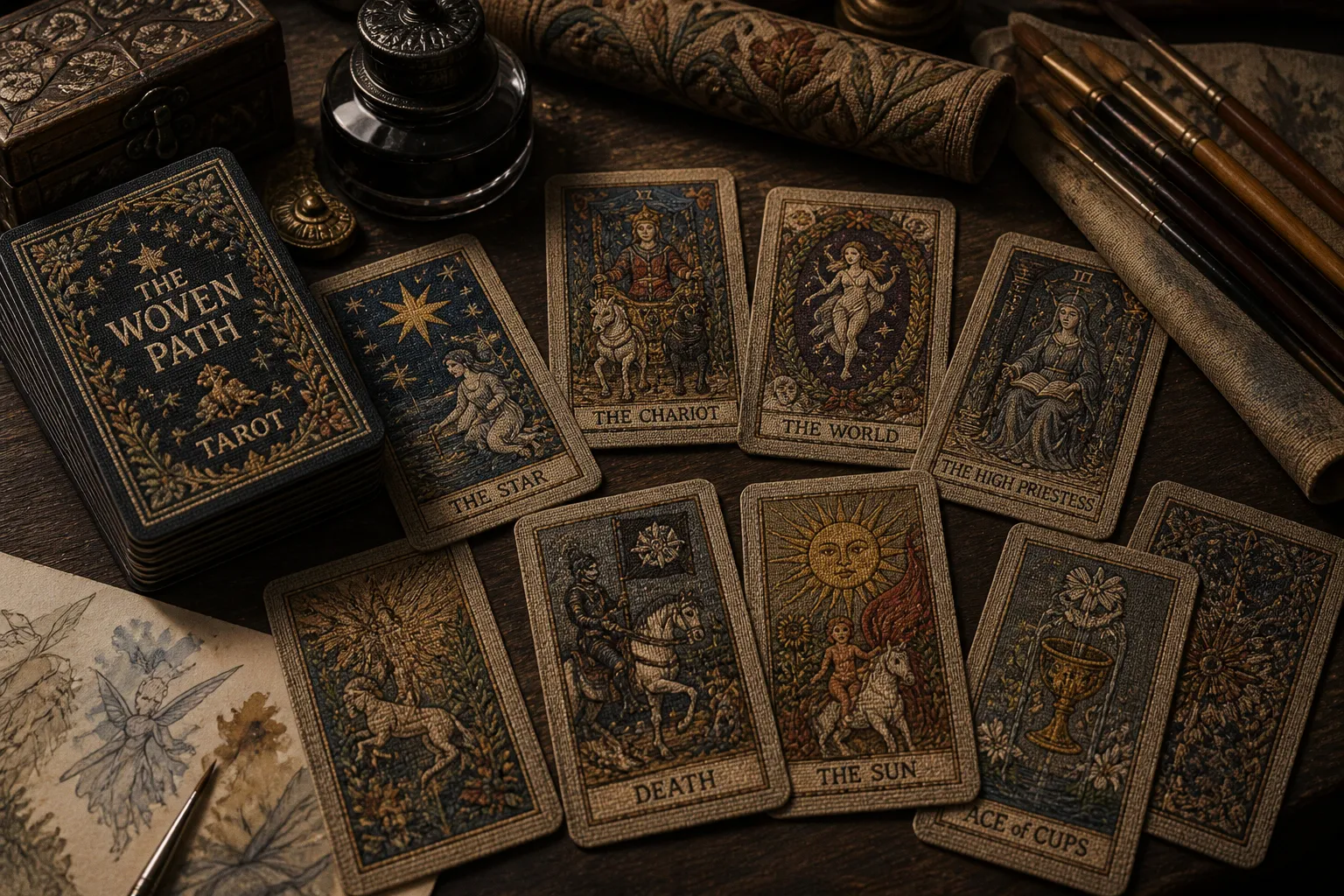
The Changeling Artist Collective has a more visible public footprint than that. Its name is attached to themed art events and to large collaborative releases including Olde Fae and The Woven Path Tarot.
That visibility is exactly why a changeling artist collective artist application draws attention from fantasy painters, card-game illustrators, and speculative fiction artists looking for a credible route into collaborative publishing. But it is worth separating what can be seen from the outside from the reassuring stories applicants tend to invent around it. A collective can create opportunity. It cannot turn a portfolio that lacks direction into a professional body of work.
The Collaborative DNA of the Changeling Artist Collective
The Changeling Artist Collective presents itself through its artists and its projects rather than through the polished corporate language of an agency. That matters. It places the group in a tradition familiar to fantasy art collectives: individual makers with distinct styles gathering around shared themes, shared releases, and an audience that already enjoys narrative illustration.
Its public identity leans toward folklore, myth, dark fairytale imagery, tarot, creatures, romantic ruins, luminous woods, and the sort of character work that suggests there is a larger story just outside the edge of the frame. That does not mean every contributor paints the same way. It means the work tends to speak a related visual language: symbolic, decorative, figurative, and built for viewers who like to linger.
The difference between a real collective and an informal art community is not simply friendliness. It is whether artists can make something together that would be difficult to make alone. A deck, card game, auction theme, anthology, or exhibition gives individual images a larger frame. The project becomes a reason for collectors to encounter artists they did not already follow.
For an illustrator considering joining an art collective, that is the useful question: does the group’s public work make your own work more legible, or would it make it disappear?
A strong collective does not require uniformity. It does require compatibility. If your portfolio moves between painterly folklore, ornamental character design, celestial animals, and narrative scenes, the connection may be obvious. If it is mostly hard-surface science fiction, contemporary editorial work, or minimalist graphic design, forcing it into a medieval-tapestry or fairytale context may only make the mismatch louder.
The point is not to paint like everyone else. The point is to make work that can hold its own in the same room.
Changeling’s projects suggest that its contributors are not being gathered merely to fill a roster. The emphasis is on images that can live inside a larger object: a game, a deck, a themed event, a collectible edition. That is a particular skill. A beautiful standalone painting is not automatically a successful card illustration. Cards need immediate silhouettes, readable focal points, strong value structure, and enough visual density to reward repeat viewing without becoming mud at a smaller scale.
From Olde Fae to The Woven Path: Anatomy of a Collective Project
The clearest way to understand a group like Changeling is to look at what it has released.
Olde Fae — A Card Game From Beyond the Veil was a collaborative, fae-themed take on the familiar Old Maid format. Its Kickstarter campaign raised $14,878 from 609 backers, and the completed project later received a Chesley Award in 2020. That is not a minor detail. Awards do not make an image good, and they certainly do not replace an artist’s own audience. But a Chesley is meaningful recognition within speculative illustration. It indicates that the work entered a conversation larger than a single launch campaign.
Olde Fae also demonstrates the particular strength of a multi-artist card project. The format invites variation. One artist’s goblin can sit beside another artist’s moonlit knight without the contrast becoming a flaw, provided the art direction gives them a common atmosphere. In fantasy illustration, cohesion is often less about matching brushstrokes than matching emotional temperature.
The Woven Path Tarot pushed that principle further. Launched on Kickstarter in October 2022, the deck brought together original work from 91 artists and used medieval tapestry as its visual touchstone. The finished object included tarot cards printed on 350 gsm stock, at 2.75 × 4.75 inches, alongside a 200-page guidebook.
That scale changes the nature of the task. A tarot deck is not simply a stack of attractive images. Each card arrives with inherited symbolism, reader expectations, narrative associations, and compositional problems that have survived for generations. The Fool must feel like possibility without becoming generic whimsy. The Tower has to communicate disruption without turning into a red-lit disaster poster. The court cards need personality, hierarchy, and enough clarity to remain readable after repeated shuffling.
| Parameter | Olde Fae | The Woven Path Tarot |
|---|---|---|
| Form | Fae-themed card game | Tarot deck |
| Creative approach | Multiple artists interpreting a shared game concept | Multiple artists working within a tapestry-inspired tarot world |
| Public campaign result | $14,878 raised from 609 backers | Large collaborative deck project |
| Scale of credited art | Multi-artist production | 91 contributing artists |
| Recognition | Chesley Award in 2020 | A substantial tarot and illustration release |
| Supporting material | Game format | 200-page guidebook |
Craig Maher contributed the Knight of Swords to The Woven Path Tarot. It is a fitting kind of assignment for an illustrator whose work is comfortable with dramatic figures, implied motion, and a scene that carries its own weather. The Knight of Swords is not a quiet card. It asks for decisiveness, velocity, confrontation, and a figure who seems already committed to the charge.
Yet the more important point is not that one card found its artist. It is that a project with 91 contributors needs every participant to understand the size of their role. An individual card can be striking, even unforgettable, while still serving a visual sequence larger than itself. That balance is a professional virtue. You are not painting to prove that you can ignore the brief. You are painting to make the brief richer.
The Mechanics of Monthly Themed Auctions and Community Sales
Changeling has also used themed Facebook auctions and community sales as part of its public rhythm. For collectors, this format has an obvious appeal: one event creates a concentrated field of work around a subject. Instead of encountering a single image in isolation, viewers can move through many interpretations of a shared prompt.
The theme matters more than it first appears to. “Stardust” does not produce one obvious picture. It can become cosmic portraiture, a celestial beast, a traveler under impossible skies, an illuminated manuscript border, a tiny creature carrying a night sky in a jar. “Bugs & Beasties” can move from children’s-book charm to gothic entomology in a few scrolls. A good prompt is a container, not a cage.
For participating artists, themed events can create a useful deadline and a useful friction. Personal work is often where illustrators discover their habits: the same profile angle, the same lighting, the same palette, the same melancholy heroine standing in the same forest. A theme can interrupt that loop. It gives an artist somewhere specific to push.
There is also a collector-facing advantage in the shared setting. Someone drawn in by a familiar artist may encounter a new name. Someone who came looking for an owl painting may leave having discovered a painter of sea witches, moth queens, or armored hares. That kind of discovery is one of the few genuinely generous things about a well-run group event.
Still, prospective artists should not turn an auction into a fantasy of automatic income. Public sales are not a guarantee of a sale, and the details of proceeds, participation terms, fees, shipping responsibilities, and internal arrangements should not be assumed from the outside. Those are practical questions to ask only if an opportunity becomes real.
The creative value is easier to identify. A themed event asks for work that can survive a crowded feed. That means making decisions with intention:
- Choose the central read first. A collector should understand the image’s emotional proposition before they can inspect its details. Is it eerie, tender, heroic, grotesque, comic, or reverent?
- Build a silhouette that survives reduction. Facebook images are often seen small. If the focal figure dissolves at thumbnail size, intricate rendering will not rescue it.
- Let the theme enter the image structurally. Do not paint your usual subject and tape a token star, mushroom, or beetle onto the corner. The prompt should affect the pose, setting, symbolism, or story.
- Finish the edges with the same attention as the center. Card and collectible audiences notice borders, textures, ornamental motifs, and the negative space around a figure. These are not empty areas; they are part of the invitation.
- Make the image recognizably yours. The group context brings viewers to the event. Your visual voice gives them a reason to remember who made the piece.
This is where fantasy art collectives can be unusually useful. They create a place where highly individual images can meet under one banner without having to become visually identical. The theme provides the bridge. The artist provides the reason to cross it.
Navigating the Submission Process for Future Opportunities
The practical answer to the changeling artist collective artist application question is modest: portfolio links may be emailed to [email protected] for future consideration.
That is the available route. There is no need to invent an application portal, a formal intake season, a guaranteed reply window, or a set of publicly stated acceptance criteria around it. Sending a portfolio link is not the same as entering a recruitment cycle. It is a way to make the work available when future opportunities are considered.
That distinction should shape the email.
Do not send a sprawling life story, a dozen attachments, or an anxious defense of why your work is “still developing.” Do not send a cloud folder that opens onto several hundred experiments, convention photos, unfinished commissions, and a folder called FINAL_final_USETHIS. The people looking at portfolios need to see the work before they need to see your explanation of the work.
A concise submission is more professional and more generous to the reader:
1. Use a direct subject line. “Portfolio for future consideration” is clearer than a cryptic title or a long sales pitch.
2. Link to a clean portfolio. A personal website, ArtStation portfolio, or tightly edited gallery is better than a social feed that mixes finished work with sketches, memes, and process photos.
3. Lead with your strongest relevant images. Put narrative fantasy, folklore, card-ready characters, creatures, and symbolic scenes near the front if those represent your best work.
4. Show sequence, not random versatility. An applicant does not need to prove they can paint every imaginable subject. They need to demonstrate a visual point of view that remains convincing across several finished pieces.
5. Include basic professional context. Your name, location or time zone if relevant, portfolio link, and social handle are enough. If you have prior published work or card-game credits, mention them briefly rather than building the entire email around them.
6. Leave room for silence. Future consideration means exactly that: the absence of an immediate response should not be treated as a verdict on the work.
The best portfolio for speculative fiction illustrators is not necessarily the most technically elaborate one. It is the one that makes an art director, publisher, or collaborator able to imagine the next assignment. Can this artist handle a figure? Can they create an object with symbolic weight? Can they compose for a vertical card? Can they make a monster feel like a character rather than a texture exercise? Can they finish a piece without sanding every strange, memorable decision away?
A portfolio link opens a door only if the work gives someone a reason to walk through it.
This is also where many artists overcorrect. They hear “tarot,” “folklore,” or “fantasy” and produce a portfolio made entirely of familiar genre furniture: moons, antlers, ravens, pointed hats, ornate swords. Those motifs are not the problem. The problem is treating them as shorthand for atmosphere. A memorable portfolio uses genre material to say something specific.
The raven should have a reason to be there. The sword should change the scene. The moon should illuminate a decision, not merely fill a circle of empty sky.
The Role of Individual Contributors in Large-Scale Tarot and Card Games
Large card projects can look glamorous from a distance because the finished deck is so satisfying as an object. It has weight, packaging, edges, ritual, and the peculiar thrill of seeing a painting reproduced as something meant to be held. But individual contributors to a collaborative deck are working inside constraints that deserve respect.
A card image is a piece of illustration, but it is also a functional surface. It must communicate at a glance. It may need to coexist with a title treatment, a number, a border, a suit symbol, or a guidebook entry. It may be printed smaller than the original art was painted. It may be viewed in dim light across a table. A dense passage of rendering that looks magnificent at full resolution can become visual static once reduced to card size.
Tarot intensifies this problem because its imagery is both personal and shared. Every reader arrives carrying references: Waite-Smith, Marseille, Thoth, contemporary decks, childhood ideas about fairytales, horror cinema, medieval art, religious iconography. An artist has room to reinterpret, but not infinite room to obscure.
For card-game illustration, the issue is slightly different. The image may need to distinguish a role, creature, faction, action, or character immediately. It may need to become legible as part of a set. A single standout image is welcome, but visual relationships matter: repeated motifs, color families, compositional echoes, and a believable shared world.
This does not require a contributor to surrender their voice. On the contrary, a successful collective project needs individual hands. Without them, it becomes an anonymous wallpaper pattern. The challenge is to bring your own mark while understanding that the object will be experienced as a whole.
Artists who are serious about card and tarot work can prepare for that kind of opportunity before any collective contacts them:
- Paint at least a few images designed to read at reduced size.
- Practice vertical compositions as well as wide illustration formats.
- Build scenes around a single decisive action or relationship.
- Use symbolism as an engine for storytelling, not as decorative clutter.
- Develop characters whose posture and props communicate before the viewer reads any caption.
- Learn to make a finished painting feel complete without overloading every inch of it.
The contribution may be one card. That does not make it minor. In a deck, one card becomes part of someone’s private language. It can be the image a reader draws on a difficult morning, the card a collector frames, the piece another artist remembers years later while assembling a future project.
Is Membership Worth Targeting?
Changeling Artist Collective membership is worth targeting if the existing projects and public-facing work already feel close to the direction you want your career to take. Not close in the vague sense of “I also paint fantasy.” Close in the practical sense that your portfolio could naturally sit alongside folklore-driven, character-rich, collectible illustration without a drastic rewrite of your artistic identity.
It is less useful as a rescue plan for an unfocused portfolio or a substitute for building your own presence. Collective work can widen an audience, create connections, and place an artist inside ambitious projects. It cannot replace the quieter work of developing a body of images that people can recognize without reading the signature.
The sensible move is not to tailor your entire practice around the hope of one future opening. Make the work you genuinely want to be hired for. Edit it hard. Put the strongest pieces in a clean portfolio. Email the portfolio link for future consideration if the fit is real.
Then keep painting.
That is the part no collective can do for you, and it is also the part that makes you worth inviting in.