Designing for Warp 99: How Small-Press Card Games Shape Sci-Fi Portfolios
As Bleeding Cool reported from Gen Con 2026, Bézier Games rolled out Warp 99 — a faster-than-light sci-fi card game built on hand management, set collection, and a race to 99 points.
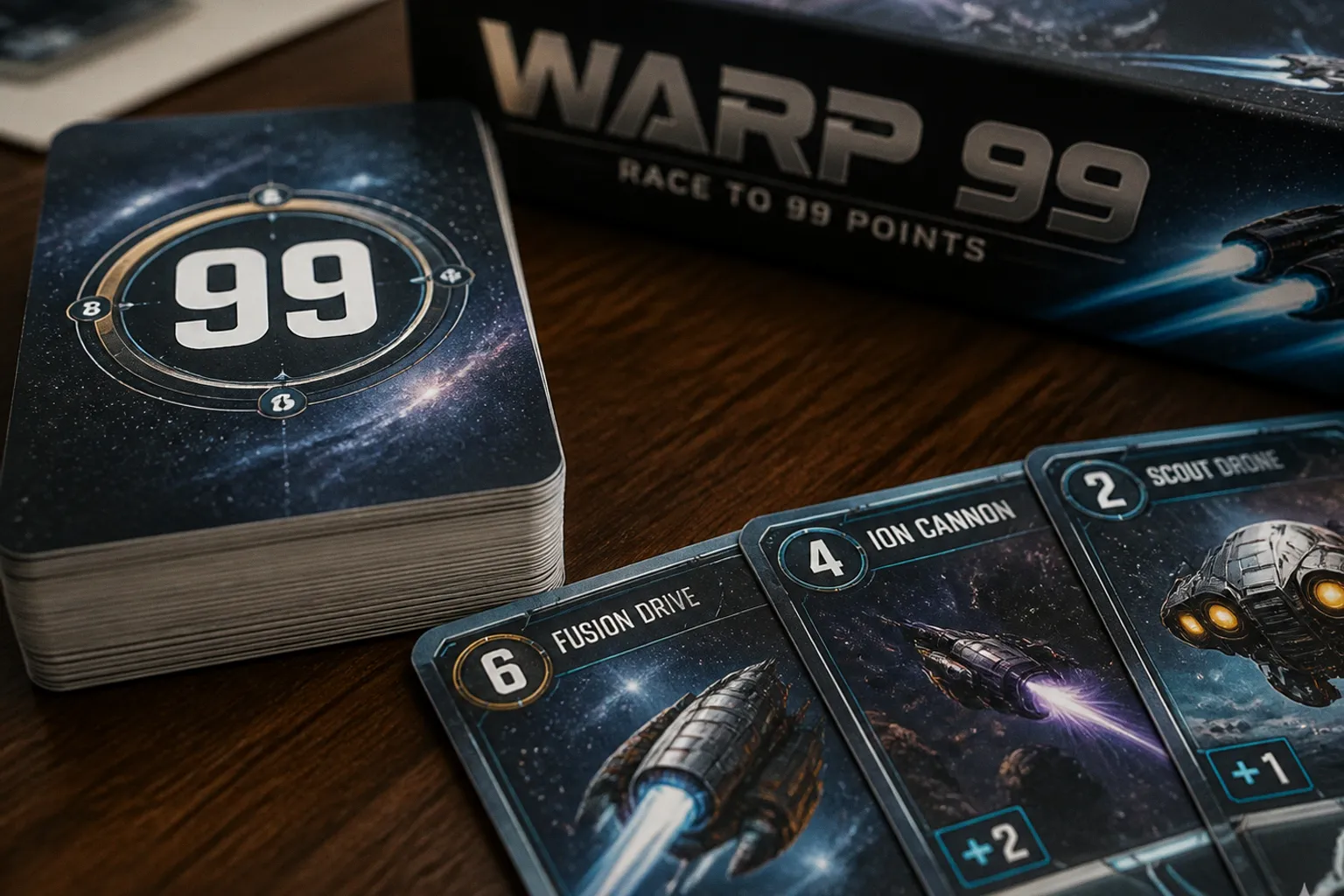
At $15 on the Bézier site, with showings locked in for Essen Spiel (October 23–26) and PAX Unplugged (November 21–23), it's a compact debut aimed squarely at the small-press TCG table — which is exactly why I want to pull it apart with you over coffee.
What the Brief Is Quietly Asking For
Read the pitch and the commissioning puzzle shows up fast. Players build "engines" — a row of cards where each new card has to beat the last in number and skip any repeated color — while three galactic rules (Same Color, Plus 1, Total 10) can be swapped in or out mid-game. So your card art isn't just decoration. It's doing three jobs at once: distinct silhouettes so a player can read their hand at a glance, disciplined palettes that hold up under the "no repeating colors" constraint, and enough flavor in your ships, worlds, and "strange new civilizations" to make set collection feel like travel. The Hyperdrive Expansion — ten double-sided rule cards that change the game state — only tightens that brief, adding more visual moments an art director has to resolve. This is the kind of project where weak art vanishes into the table and good art carries the whole experience.
What to Steal for Your Sci-Fi Folio
If you've been quietly building a sci-fi portfolio and wondering whether the genre has room for new voices, this is your answer: small-press TCGs and card games are where new illustrators break in. A few things I'd actually look at if a Warp 99-style brief hit my desk — how your spacecraft read at thumbnail size when they're laid next to strangers' cards; whether your alien life and unexplored-worlds pieces have narrative past the silhouette; whether your color stories survive the engine mechanic without flattening. Craig's sci-fi pages are a useful reference for how classical oil technique can ground speculative subjects without losing readability — study the lane, don't clone it. And if you're heading to Essen or PAX Unplugged this fall, bring a tight printed set. The publishers staffing those booths are usually the ones actually reading it.