Fantasy Art Collective: Roadmap from Concept to First Show
A fantasy art collective fails long before its first public release when its members cannot answer one hard question: what, precisely, is being built?
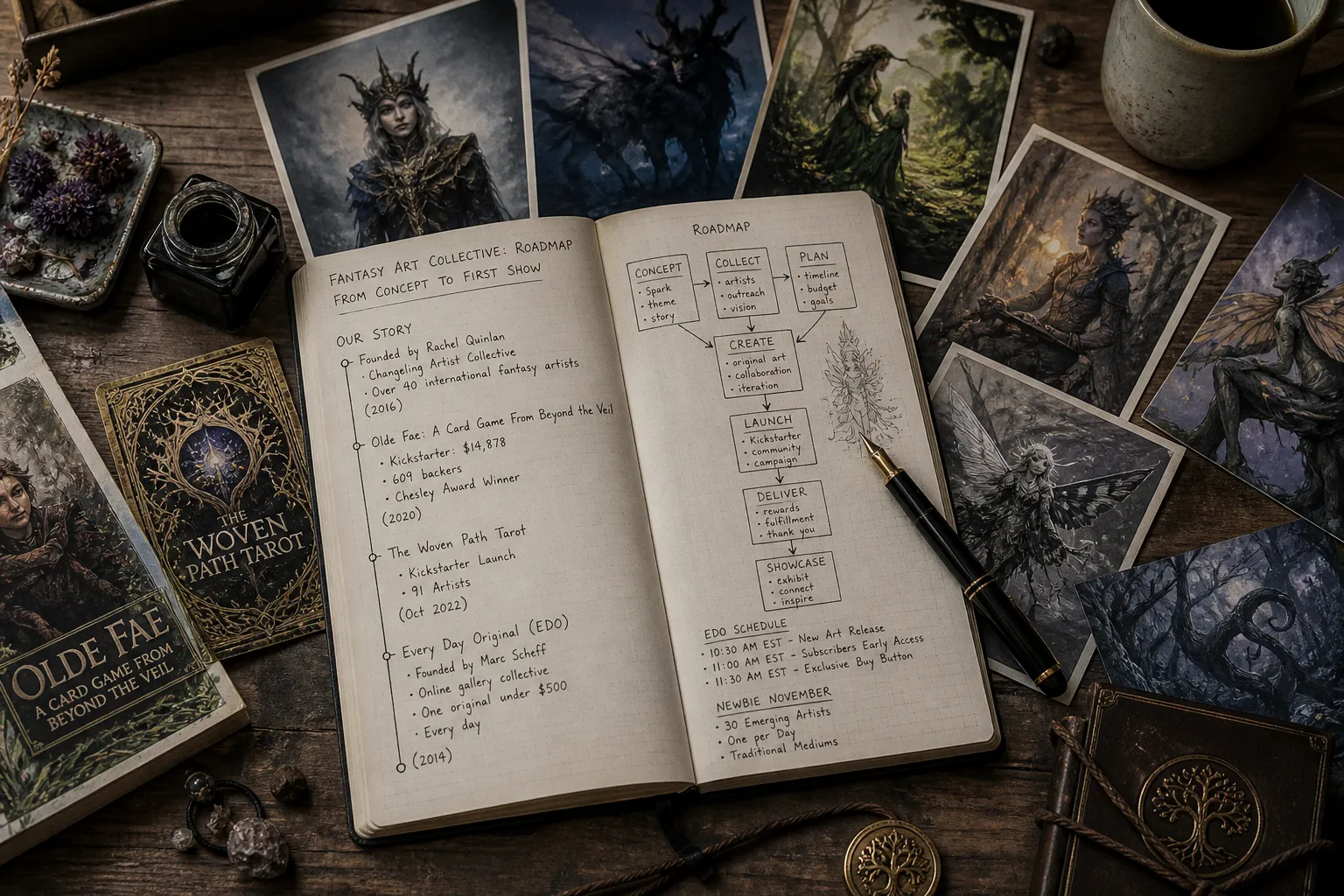
A peer group, a sales channel, a publication imprint, a card-game studio, or a rotating online exhibition are different machines. They require different tolerances, different cash flow, and different authority structures.
The usual failure is structural blur. Ten illustrators agree to “support each other,” open a social account, discuss a themed anthology, and discover six months later that nobody owns the mailing list, approves the final images, reconciles postage, or decides what happens when one artist misses a deadline. The surface looks collaborative. The support layer is absent.
A workable fantasy art collective launch roadmap begins with function, then governance, then a release format. Not the other way around. The artwork is the visible paint layer. The operating system is the underpainting.
A collective is not a style label. It is a repeatable method for selecting work, moving it to an audience, and dividing responsibility without residue.
Define the mission before recruiting the room
“Fantasy art” is not a mission. It is a category broad enough to contain oil painters, digital concept artists, card-game illustrators, sculptors, printmakers, and artists working in adjacent horror or mythic material. A collective needs a narrower load-bearing statement.
The mission should identify four elements:
- The artistic field. This can be specific: traditional fantasy illustration, folklore-based character work, tarot art, collectible card-game imagery, or independent original paintings. “All imaginative art” is too diffuse for a first launch.
- The audience. Collectors seeking affordable originals behave differently from crowdfunding backers, convention buyers, art directors, or tabletop-game players.
- The release object. A monthly online show, a themed print folio, a cooperative auction page, a card deck, or a group exhibition each creates a different production burden.
- The member obligation. Define whether members contribute finished artwork, administrative labor, promotion, a fee, voting participation, or all five.
The Changeling Artist Collective offers a useful scale model. Founded by fantasy artist Rachel Quinlan, it grew to more than 40 international fantasy artists. That expansion did not depend on putting every artist into a single visual formula. Its coherence came from a defined field—fantasy art—and from collaborative releases with a recognizable public identity.
The distinction is exact. Shared subject matter is not enough. A collective needs shared procedures.
Write the charter in operational language
Do not draft a manifesto full of adjectives. Draft a short charter that survives conflict. It should state who can join, who can vote, who can spend money, and what happens to assets when a member leaves.
A first version does not need legal grandeur. It does need clarity. Use direct clauses:
1. Membership: state the admission route, portfolio standard, probation period if any, and whether membership is capped.
2. Decision rights: distinguish artistic selection from financial approval. A person who curates an exhibition should not automatically control the bank account.
3. Labor allocation: name the jobs. Project manager, image-prep lead, social editor, fulfillment coordinator, treasurer, and client-contact lead are separate functions.
4. Intellectual property: establish that each artist retains copyright unless a written project agreement says otherwise. The collective receives only the usage rights necessary to promote and deliver the project.
5. Exit procedure: determine how unfinished projects, shared files, mailing lists, logos, and remaining stock are handled.
This is not bureaucratic decoration. It is edge control. In an oil painting, a soft edge placed in the wrong location lets one form leak into another. In a collective, vague authority does the same thing. Responsibility bleeds across the surface until nobody can identify the failure point.
Choose a release model with a visible rhythm
The first public show does not need walls, wine, or freight insurance. For a new group, an online release is often the cleaner test because it reveals whether the collective can photograph, price, schedule, communicate, and fulfill on time.
Every Day Original, founded by Marc Scheff in 2014, demonstrates how much discipline can be extracted from a narrow format. The online gallery collective sells one original artwork per day for $500 or less. It has hosted more than 275 artists. The proposition is simple, but its timing is highly controlled: art is posted at 10:30 AM EST; mailing-list subscribers receive exclusive access at 11:00 AM; the buy button activates for them at 12:00 PM; and the public sale opens at 12:30 PM.
That sequence is not merely marketing theater. It controls demand, prevents ambiguity, and gives collectors a learned purchasing habit. No bidding. No soft negotiation in direct messages. No uncertain closing time. Fixed price. First come, first served.
| Operational element | Daily-release model | Themed collective show |
|---|---|---|
| Inventory load | One original at a time | Multiple works released together |
| Collector behavior | Habitual, time-sensitive repeat purchase | Event-based browsing and comparison |
| Image preparation | Standardized daily package | Larger batch; higher risk of inconsistency |
| Fulfillment | Continuous, predictable | Compressed after launch |
| Curatorial pressure | Constant but narrow | Intense at selection stage |
| Best use | Building a dependable sales rhythm | Establishing a collective identity |
A new fantasy collective should not imitate the daily cadence unless it has the labor to sustain it. Daily releases punish weak administration. Image files must be correctly named. Dimensions must be verified. Media must be described accurately. A painting listed as oil when it is acrylic over oil-grounded panel is not a minor wording defect; it damages collector trust.
For a first show, a limited format is more stable:
- eight to fifteen artists;
- one work per artist, or a tightly controlled maximum;
- one theme with clear visual parameters;
- a single release window;
- a fixed-price policy or a clearly defined auction system, never both by accident;
- a published fulfillment schedule;
- a post-launch review date before the next event is announced.
The first show should be treated as a stress test, not a coronation.
A release schedule is a material. Handle it like paint: too thin and it will not cover; too thick and it will crack under its own weight.
Build the visual standard from files, not intentions
Fantasy artists are accustomed to evaluating finished images at thumbnail scale. Collectives need to inspect the less glamorous evidence: file integrity, photography, reproduction consistency, and description accuracy.
A public release containing excellent paintings and poor documentation still reads as amateur. Collectors cannot inspect a work physically through a feed. They read the image edge, the color balance, the glare pattern, the crop, and the stated dimensions as proxies for competence.
Set a submission packet for every participating artist. It should include:
- a full-resolution master image;
- a web-sized image prepared to the collective’s standard;
- one detail crop where surface, linework, impasto, or glaze structure matters;
- exact dimensions, medium, substrate, and completion year;
- framed and unframed status;
- shipping region and handling restrictions;
- a short description capped at a fixed word count;
- confirmation that the submitted work is available and not simultaneously listed elsewhere.
For traditional work, medium language needs precision. “Oil painting” may conceal a rapid alkyd layer beneath a slower oil passage, a solvent-heavy wash over acrylic gesso, or a panel whose absorbency alters the final surface. Not every buyer needs a conservation report. But the collective should know what it is selling.
This is particularly relevant where artists use mixed workflows: digital drawing transferred to panel, acrylic underpainting, oil scumbling, and selective gloss varnish. Such work can be excellent. It must simply be described without evasive shorthand.
A curatorial standard should also address sequence. Avoid arranging a group show as an unfiltered stream of unrelated thumbnails. Alternate high-key and low-key images. Watch repeated silhouettes. Do not place three compositions with central female figures, crescent moons, and violet backgrounds in consecutive slots unless repetition is the declared premise. The collective is curating a surface, not emptying a folder.
Use crowdfunding for a defined object, not general goodwill
Crowdfunding is valuable when the collective can name the exact object being funded. A deck. A book. A card game. A print run. A traveling exhibition with documented costs. “Help our artists make more art” is not a sufficiently engineered proposition.
Changeling’s Olde Fae: A Card Game From Beyond the Veil demonstrates the difference between a loose community and a product-bearing collective. Its Kickstarter campaign was completed in September 2019 with $14,878 from 609 backers. The project later received a Chesley Award in 2020. The numbers matter because they show a modest but real base of distributed support: not one patron, but hundreds of participants buying into a complete, identifiable release.
In October 2022, the collective launched The Woven Path Tarot, a collaborative Kickstarter involving original art from 91 artists. At that scale, artistic enthusiasm is insufficient. The project requires image specifications, card assignments, rights tracking, proof approval, correction windows, print-production decisions, and communication that does not collapse under the volume of contributors.
The crowdfunding sequence should be built backward from delivery:
1. Define the finished object. Specify count, format, production method, packaging, and whether originals, prints, or digital files are part of the reward structure.
2. Calculate the irreducible costs. Include manufacturing, proofing, packaging, payment processing, platform fees, shipping materials, storage, replacement copies, and a contingency reserve.
3. Lock the artwork pipeline before launch. A campaign should not be funded on the assumption that dozens of contributors will all deliver final files at an unspecified future date.
4. Separate audience-building from campaign-day promotion. Mailing-list signups, process images, artist introductions, and preview art belong before launch.
5. State the delivery risk plainly. Printing and international fulfillment are physical processes. They do not obey enthusiasm.
Crowdfunding is often described as community engagement. That is only half correct. It is pre-sold production with an audience attached. Treat it accordingly.
Curate emerging artists without turning the open call into noise
Open calls are useful when the collective wants fresh technical approaches, new regional perspectives, or artists outside its existing referral network. They are destructive when framed as a vague invitation to “submit anything fantasy-related.”
Every Day Original’s annual Newbie November provides a controlled example. The open call showcases 30 emerging traditional artists, releasing one new artist’s work each day during the month. The format has limits. That is why it works. The audience understands the event. The selected artists receive a defined presentation window. The organizers are not attempting to absorb an indefinite population into the permanent collective.
A good open call should state its exclusions as clearly as its ambitions. Ask for a defined number of images. Specify accepted media. State whether AI-generated or heavily AI-assisted work is excluded, accepted, or evaluated under separate disclosure rules. Establish image-resolution requirements. Give an answer date. Give a public release date. State whether non-selected artists receive feedback; in most cases, they should not be promised it.
Selection should be scored by more than visual appeal. For a first show, assess four practical variables:
| Selection factor | What the panel should inspect |
|---|---|
| Technical reliability | Consistent drawing, value structure, finish quality, and control of medium |
| Portfolio coherence | Whether the submitted work relates to the show’s stated field |
| Reproduction readiness | Clean files or competent photography, accurate colors, usable detail |
| Operational reliability | Ability to meet deadlines, provide metadata, communicate, and ship work |
The final category is routinely ignored. It should not be. A striking painting delivered three weeks late, without dimensions or a saleable image, is not exhibition-ready work. It is an unresolved production problem.
Put money, law, and authorship beneath the paint layer
Financial management is where informal groups become either durable or corrosive. Before the first sale, decide where funds land, who can view records, how reimbursements are approved, and how revenue splits are calculated.
There is no universal percentage. A collective selling original works may retain a modest commission for platform costs, promotion, payment fees, and administrative labor. A publication project may need a more complex division between production recovery, contributor payments, and future reserves. What matters is that the formula exists before money arrives.
The minimum financial record should track:
- gross sale price or pledge amount;
- platform and payment-processing deductions;
- production and packaging costs;
- shipping charged versus shipping spent;
- collective reserve;
- artist payment;
- refund, replacement, or damage costs;
- payment date and recipient confirmation.
Do not rely on a shared memory of who paid for the domain, the test prints, or the cardboard mailers. Shared memory is a solvent. It dissolves evidence.
Legal structure also deserves attention early. Depending on jurisdiction and turnover, a collective may operate as an informal collaboration at first, form a business entity, establish a nonprofit framework, or use a fiscal sponsor for particular projects. The correct path depends on local law, taxation, liability, and the kind of money being handled. The group should obtain qualified local advice before presenting itself as a formal entity or taking on substantial public funds.
The internal rule remains stable across structures: keep personal funds and collective funds separate. Maintain records. Put rights permissions in writing. Use contracts for commercial projects. Do not assume friendship is a substitute for documentation.
The first show is evidence, not proof of permanence
A fantasy art collective earns credibility through repetition. One successful release is a clean first layer, not a finished painting. The next question is whether the group can repeat the procedure without diminishing its standards or exhausting its members.
After the first show, review the actual record. Which images received attention? Which sold? Did the mailing list convert? Did shipping costs match estimates? Were artists paid on time? Did the team spend forty unpaid hours solving a problem that could have been prevented with a template?
Then remove what failed. Tighten the submission requirements. Reduce the artist count if fulfillment buckled. Expand the release cycle if the audience responded. Keep the standard high enough that membership means something.
The definitive verdict is simple: the best collective is not the one with the largest roster or the loudest launch. It is the one whose mission, selection process, release rhythm, and financial records remain intact after the first public pressure test.