Vintage CCG Art Collecting: From First Purchase to Portfolio
An artist proof is not a playable card with an unusual reverse. It is a controlled production remnant: a card printed for the illustrator, carrying the issued front and a completely blank white back. No card back. No tournament use.
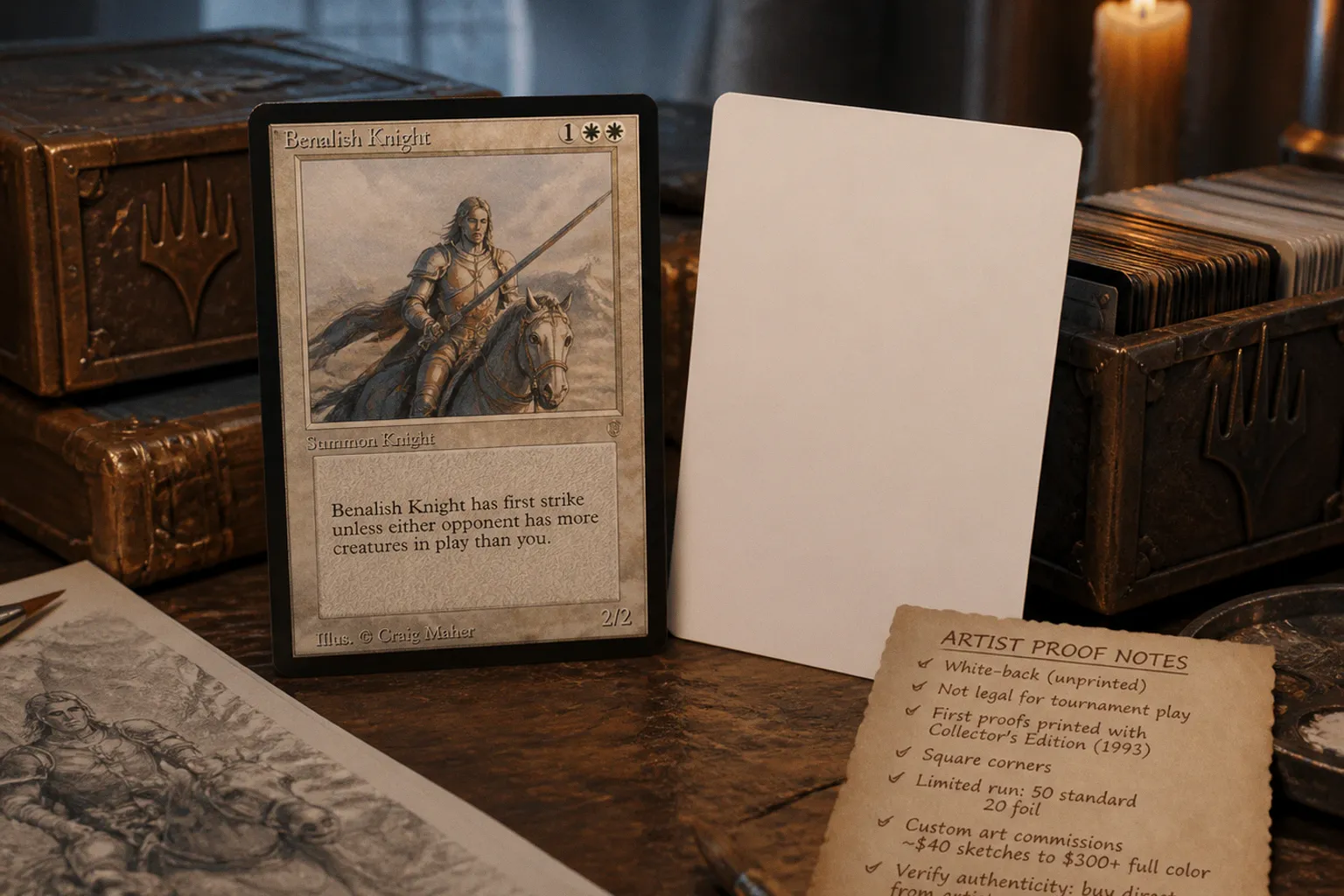
No ambiguity on that point.
That white field is the entire mechanism. It converts a standardized CCG component into a miniature support for provenance, signature, pencil work, acrylic, gouache, or a finished painting. For collectors of fantasy card game illustrations, the attraction is not merely scarcity. It is direct contact with the illustrator’s hand, on an object already tied to a published image.
A serious classic CCG artist proof collecting guide begins here: separate the print object from the altered art object. The proof has one value as a scarce issued card. A proof with a sketch has a second layer of value. A proof carrying a resolved full-color painting is no longer interchangeable with another copy from the same allocation.
The anatomy of an artist proof: white back, issued front, limited function
The front of an artist proof reproduces the published card image and card information. The reverse is unprinted white stock. Collectors commonly call these “white-backs.” The blank surface is not an error card, nor a miscut, nor a homemade proxy. It is the identifying physical feature of the format.
This distinction matters because the market has accumulated several things that resemble artist proofs from a distance:
- altered ordinary cards, painted over a standard printed back;
- proxy cards with fabricated white reverses;
- printer samples without artist provenance;
- unsigned white-back cards whose chain of custody cannot be established;
- promotional blanks or custom commissions never issued as proofs.
They are not equivalent. A legitimate artist proof begins with publisher-issued material delivered to an illustrator or an authorized representative. The artist’s signature can strengthen the chain, but signature alone is not the chain. Signatures can be difficult to verify, and unsigned proofs do exist. They simply carry more authentication friction and usually lower market confidence.
The material condition deserves the same scrutiny one would apply to a small oil panel. The white back is a recording surface. It shows abrasion immediately. A lightly handled proof may retain a clean, even white field with sharp corners and no surface burnishing. A proof that has been carried loose in a deck box often develops grey edge grime, compressed corners, and a faint polish where card sleeves or finger pressure have altered the coating.
For a commissioned piece, these traces become even more consequential. Pencil sinks into the surface differently from opaque acrylic. A heavy painted back can show edge stress if the card was flexed while wet or stacked before the film cured. Under raking light, look for cracking, lifted paint at corners, or an abrupt varnish line where a coating was applied without adequate preparation.
A white-back is not blank history. It is an issued object waiting for either documentation or intervention.
The card is small. The evidence is smaller. That is why casual buying produces expensive mistakes.
From 1993 onward: what “vintage” does and does not mean
The first Magic: The Gathering artist proofs appeared alongside the 1993 Collector’s Edition. These early examples are recognizable by square corners. They occupy a specific historical position: they are not Alpha, Beta, Unlimited, or Arabian Nights proofs, because official artist proofs were not made for those earliest Magic releases.
This is a persistent point of confusion. A famous illustration from Alpha may exist as an original painting, a print, a later card treatment, an altered card, or perhaps an artist-created object related to the image. That does not turn it into an Alpha artist proof. Collectors should reject any listing built on that false premise before discussing price, signature, or condition.
For standard Magic releases, the customary allocation has generally been limited: 50 proofs for a standard card and 20 for a foil card. Those figures explain the category’s pressure but should not be treated as a universal law across every publisher, era, or game. Classic CCG production was not one uniform system. Allocation practices varied, documentation was often informal, and records for smaller games can be fragmentary.
The practical comparison is straightforward:
| Category | Typical physical character | Supply reference | Collector risk |
|---|---|---|---|
| 1993 Magic Collector’s Edition proof | Square corners, white back | Historically early issued proof format | Mislabeling as an Alpha or Beta proof |
| Standard Magic artist proof | Normal card front, white back | Typically 50 per standard card | Confusing a proof with a custom proxy |
| Foil Magic artist proof | Foil card front, white back | Typically 20 per foil card | Surface scratching and overpricing based on foil status alone |
| Jyhad / Vampire: The Eternal Struggle proof | White-back proof tied to a classic CCG illustration | Maximum 20 per card to the artist | Thin public sales record mistaken for proof of limitless value |
| Painted proof | Issued proof plus custom art on reverse | Unique after alteration | Poor execution, unstable paint layers, unclear commission history |
The phrase “vintage” should therefore be used as a dating tool, not an adjective that automatically adds value. Early production matters. A scarce illustrator matters. A card’s role in a game’s visual history matters. But condition, provenance, the quality of any commission, and the confidence of future buyers matter just as much.
A clean, documented later proof can be a stronger acquisition than a supposedly older example with no credible source. The market rewards certainty more reliably than romance.
Why Jyhad proofs are structurally scarce
Jyhad, later renamed Vampire: The Eternal Struggle, occupies a different pressure zone from mainstream Magic collecting. Its visual program was built around distinct character work, Gothic costuming, occult props, architectural darkness, and a narrow collector base that often knows exactly which illustrators and card images it wants. Supply is correspondingly unforgiving.
For Jyhad artist proofs, the maximum known distribution was only 20 copies per card to the artist. That ceiling is not a current count. It does not mean 20 pristine copies remain. Some may have been drawn on, painted, misplaced, retained by artists, sold decades ago without records, or damaged. The available market is therefore thinner than the nominal run suggests.
This scarcity is why searches for Vampire: The Eternal Struggle signed cards often become muddled. A signed regular card is not an artist proof. It may still be a worthwhile autograph collectible, particularly when the signature is clear and documented, but it does not carry the white-back format or the same commissioning potential.
The same caution applies to other classic games. Legend of the Five Rings, Warlord: Saga of the Storm, and adjacent CCG lines can offer excellent illustration collecting routes, but their exact proof allocations should not be invented from Magic’s numbers. If a seller claims a precise run size, ask where that figure originates: publisher documentation, the artist’s own records, a dated listing from an authorized dealer, or merely repeated forum folklore.
Scarcity has three separate components:
1. Issued quantity. The number originally supplied to the artist. For standard Magic, this is commonly 50; for foil cards, 20; for Jyhad, no more than 20 per card.
2. Surviving quantity. The number not lost, damaged, permanently retained, or irreversibly altered.
3. Available quantity. The number actually offered by a source with credible provenance.
Only the first number is sometimes known. The third is what the collector encounters. Confusing them is the standard error behind inflated asking prices.
A run of twenty is not a valuation. It is a warning that each undocumented example will be difficult to replace.
For a portfolio, this can be useful rather than discouraging. A focused group of five well-chosen proofs by one illustrator, one game line, or one visual period reads as an intentional collection. Twenty unrelated white-backs purchased only because they were cheap read as inventory.
Commissioning the blank back: a card is a poor canvas, but a viable one
The blank back invites intervention. That is the central appeal and the central technical hazard.
Basic pencil sketches commonly begin around $40–$50. Detailed full-color work can exceed $300. The gap is not arbitrary. A pencil head study may require limited handling and little surface preparation. A full-color painted reverse requires planning, adhesion control, drying time, and the artist’s ability to work at card scale without turning the image into a clogged patch of pigment.
The card is approximately the size of a small color note, not a panel. Every decision is compressed. A full figure, background architecture, and dramatic lighting can become unreadable if the artist tries to reproduce a conventional card illustration at miniature scale. The strongest commissions usually select one visual problem: a portrait, a creature’s head, a weapon detail, a cropped landscape silhouette, or a continuation of the published image’s dominant shape.
Collectors should commission in this order:
1. Choose the proof before choosing the subject. Confirm the white-back is authentic and in sufficiently clean condition. A heavy paint commission does not repair a compromised proof. It merely conceals part of the evidence while leaving the structural problem intact.
2. Specify the level of finish. “Full color” is not a technical description. Ask whether the artist intends pencil plus washes, opaque acrylic, gouache, colored pencil, ink, or mixed media. Each produces a different surface and durability profile.
3. Discuss composition at actual scale. A reference file on a monitor is irrelevant if its details collapse at 63 × 88 mm. The artist should simplify the value structure and preserve a legible silhouette.
4. Ask about edge handling. Artwork that runs into the perimeter is vulnerable to corner wear. A deliberate unpainted margin can be visually cleaner and materially safer.
5. Document the transfer. Photograph both sides before shipment. Record the card name, artist, visible condition, date sent, and agreed commission. Retain correspondence and the return packaging if it carries useful identification.
In conventional oil practice, a small support needs a stable ground, a controlled absorbency, and enough tooth for the initial layer. Artist proofs are not designed as painting panels. Their surface coating may resist some media and accept others unevenly. A painter who understands that limitation will use thin, controlled layers rather than build a thick, brittle impasto that can fracture when the card flexes.
Acrylic is often practical because it dries quickly and can be applied thinly. Gouache can yield excellent opacity but remains vulnerable to moisture and abrasion if unprotected. Colored pencil preserves the graphic character of the card but may burnish or smear if handled without a sleeve. Ink can be precise, but bleeding or feathering is possible depending on the surface. Oil is technically possible only under tightly controlled conditions and is rarely the sensible choice on a flexible, coated card support; slow curing and film thickness work against the object.
The collector’s job is not to dictate an artist’s medium. It is to avoid commissioning an effect that the substrate cannot support.
Sourcing and authentication: buy the chain, not the story
Artist proofs typically reach illustrators roughly four to twelve weeks after a set’s release. From that point, an artist may retain, sell, sign, sketch, or paint them. The proof is therefore connected to the illustrator’s professional output, not normally sold through ordinary booster-pack channels.
That fact determines the best sourcing route. Direct purchase from the artist is the cleanest route. An authorized agent, established artist representative, or a dealer with a documented relationship to the illustrator can also be credible. Each additional intermediary introduces distance. Distance is not automatically disqualifying. It does, however, require records.
When learning how to buy MTG artist proofs, a collector should ask concise, material questions:
- Was this card acquired directly from the artist or an authorized agent?
- Is there an invoice, prior sales record, commission correspondence, or other dated documentation?
- Are front and back photographs available at high resolution, including corners and edges?
- Is the back entirely white and consistent with the expected proof format?
- Has the proof been signed, sketched, painted, sealed, trimmed, or altered in any way?
- If it is a painted proof, who executed the work and when?
- Does the seller guarantee the item’s identity if a credible authenticity dispute arises?
The reply is evidence. Evasive language is evidence too.
A seller who says “I was told it was an AP” has supplied no provenance. A seller who provides a clear artist-store invoice, dated photographs, and a coherent account of the commission has supplied a usable chain. These are not equivalent listings, even if the card fronts look identical.
Condition needs a separate inspection pass. Do not let the artwork on one side erase the state of the object on the other. Examine:
| Area | What to inspect | Why it changes the result |
|---|---|---|
| Corners | Compression, whitening, paint loss, inconsistent rounding | Corners reveal handling and can expose trimming |
| White back | Staining, scuffs, erased pencil, gloss variation | The white field is the format’s primary identifier |
| Printed front | Scratches, print wear, foil scuffing, surface dents | Published-card condition still affects desirability |
| Painted surface | Cracking, tackiness, flaking, excess varnish | A commission must remain stable, not merely attractive in a photograph |
| Signature | Placement, medium, legibility, comparison with known examples | Signature aids attribution but does not replace provenance |
Avoid treating third-party grading as a universal solution. Encapsulation may protect a proof, but it can also flatten the collecting experience and complicate close examination of a painted reverse. Grading companies evaluate physical condition under their own standards; they are not automatically certifying the entire history of an artist-issued object or the authorship of later painted work. For a pure, unaltered proof, a holder may be useful. For a commissioned original, archival storage and complete documentation are often more useful.
Store proofs in sleeves that do not exert pressure on painted surfaces. Do not stack painted cards face-to-back. Avoid heat, direct sun, high humidity, and abrasive binders. A proof with a pencil sketch needs protection from friction. A proof with layered paint needs protection from pressure and environmental fluctuation. This is basic conservation, not collector fussiness.
Building a portfolio rather than a pile
The durable collecting route is narrow at the start. Select a game, an illustrator, an era, or a visual type. A collector interested in the shadow-heavy portraiture of Vampire: The Eternal Struggle should not dilute the portfolio with unrelated objects merely because they carry white backs. A Magic collector drawn to a particular artist’s late-1990s output should track that artist’s cards, known proof availability, signature habits, and commission schedule.
The portfolio becomes coherent when each acquisition has a role:
- an unaltered proof establishes the issued object;
- a signed proof establishes direct artist contact;
- a pencil sketch shows process and economy;
- a full-color reverse demonstrates the artist’s handling at miniature scale;
- a rare proof from a classic game provides historical pressure, provided its provenance is intact.
Do not force every proof into a commission. The untouched white back is itself a meaningful state. Once painted, it cannot be returned to original condition. That is not a moral issue. It is a material fact. The collector should decide whether the aim is an archive of issued proofs, a gallery of artist interventions, or a deliberately balanced group containing both.
Classic CCG artist proof collecting rewards restraint. The best first purchase is not necessarily the most famous card or the most expensive painted reverse. It is the item with a clear origin, honest condition, and a place in a collection that has a defined visual logic.
Buy the proof first. Verify its route. Then decide whether the blank back should remain evidence or become a painting.