Why the Fantasticar Became a Design Failure in Magic: The Gathering
By the time a MTG illustration ships in a set, your painting is riding shotgun with a hundred other design decisions — and if one of them goes sideways, your work still ends up in the crosshairs.
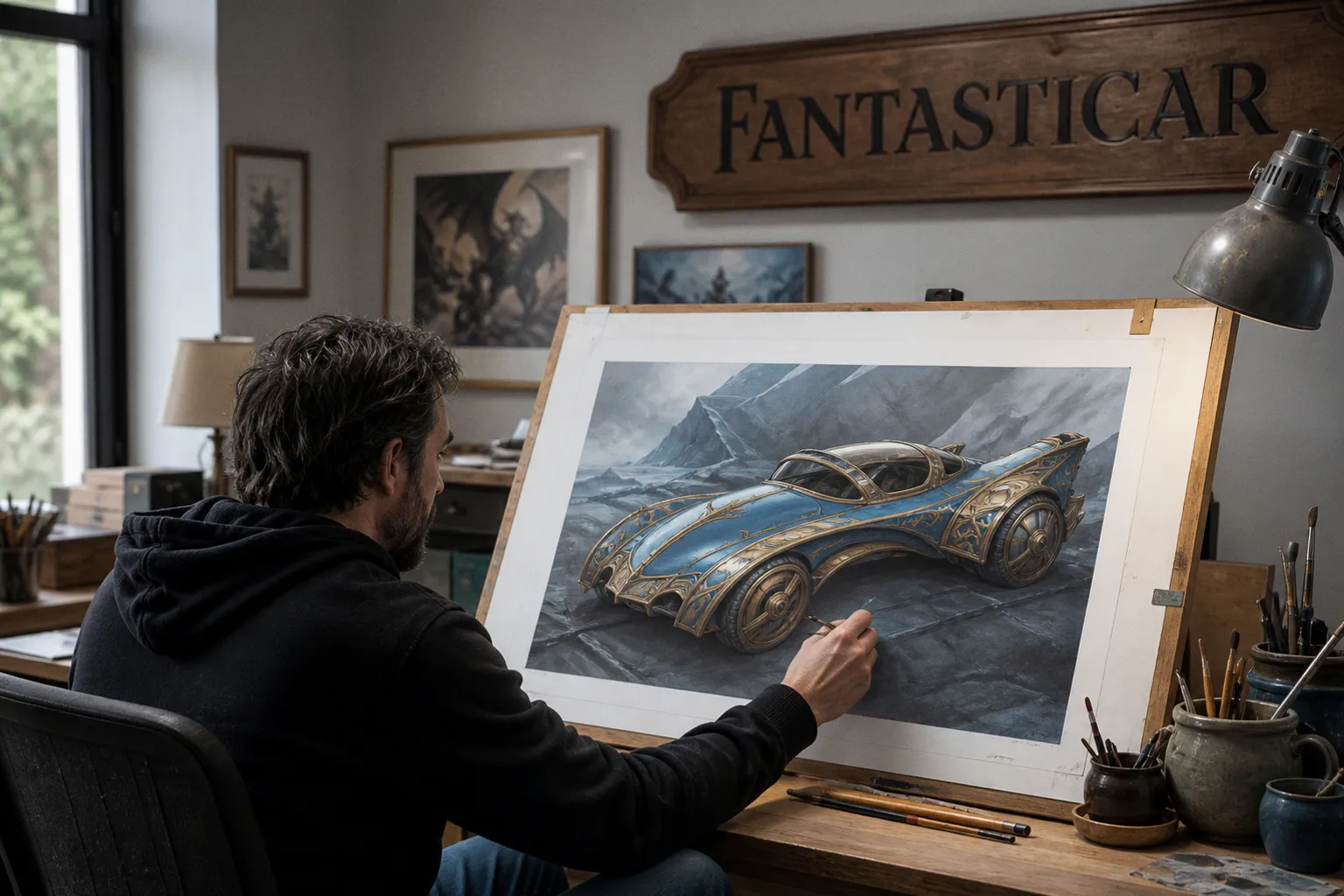
When the Card Outruns the Brief
That dynamic was on full display this week when Play Designers Jadine Klomparens and Carmen Klomparens sat down with Blake Rasmussen on the Weekly MTG stream to walk back Monday's banned-and-restricted announcement, and one card in particular dominated the conversation.
The Fantasticar, as Carmen Klomparens put it plainly, is a mistake. "It is pretty clear we made a mistake. We missed the mark on power level here," she said, walking through why the card earned a restriction in Vintage and a ban in Legacy. In Vintage, the issue was immediate: three-mana artifacts sit in a fraught neighborhood next to Mishra's Workshop, and Raker Shops — the Glaring Fleshraker-fueled archetype built around the car — shot to the top of the metagame's win rate fast enough that Play Design had no interest in letting it keep climbing.
In Legacy, the damage was broader. Carmen rattled off more than a dozen archetypes that all warped themselves around a single new artifact, stacked with fast mana and zero-mana plays. When one card reshapes that much of a format at once, it signals a failure in the brief well before any artist ever opens Photoshop.
What Play Design Learned, And Why You Should Care
If you commission or paint for TCGs, this is the post-mortem worth reading closely. Jadine Klomparens used the Standard conversation to surface a lesson that mirrors what every art director eventually learns the hard way: simplicity scales in unexpected ways. Keywords like prowess get disproportionately stronger as the card pool around them expands, and one-mana cards that keep scaling into the late game are now a flagged category in development — they should not be competing with four- and five-mana threats.
For your portfolio, the takeaway is immediate. The most "fun" single-card illustrations rarely come from the splashiest pitch in the brief. They come from the cards with the narrowest interaction windows — the utility pieces, the enablers, the one-mana role-players where restraint in the composition matters more than spectacle. When a card pushes too hard, the play environment punishes it. When a card breathes, the art gets to breathe with it.
She also reiterated what's still live for Standard post-ban. Decks built around Tablet of Discovery and Jeskai Revelation could be good or "possibly very good," but the team can't fully model what those decks look like once Badgermole Cub and Stormchaser's Talent are off the table. Translation for us: control-heavy sets need their art to hold up under shifting archetypes, not just one dominant build.
What To Watch Next
Pioneer got its own breadcrumb from William Jensen, Senior Director of Global Play Program at Wizards of the Coast. Fans should expect an RCQ run and an RC round in 2027, with a fuller schedule rolling out soon. For artists tracking the competitive scene around their work, that's the format to keep illustrating for — and the one where your pieces will actually see tabletop play at high-level events.
Watch how the rest of the 2026 Standard environment settles. If the one-mana scaling concern translates into quieter card designs for upcoming sets, expect more briefs that reward restraint over flash — silhouette clarity, readable gesture, clean focal contrast. That's the kind of work that ages well in a portfolio long after the banned list moves on, and it's exactly the kind of brief you should be practicing right now.