Where can you buy original Jody A Lee fantasy art?
Collectors looking for Jody A. Lee original fantasy art tend to arrive with the same assumption: a long career in book publishing must have left a wide, easily searchable field of paintings. It has not.
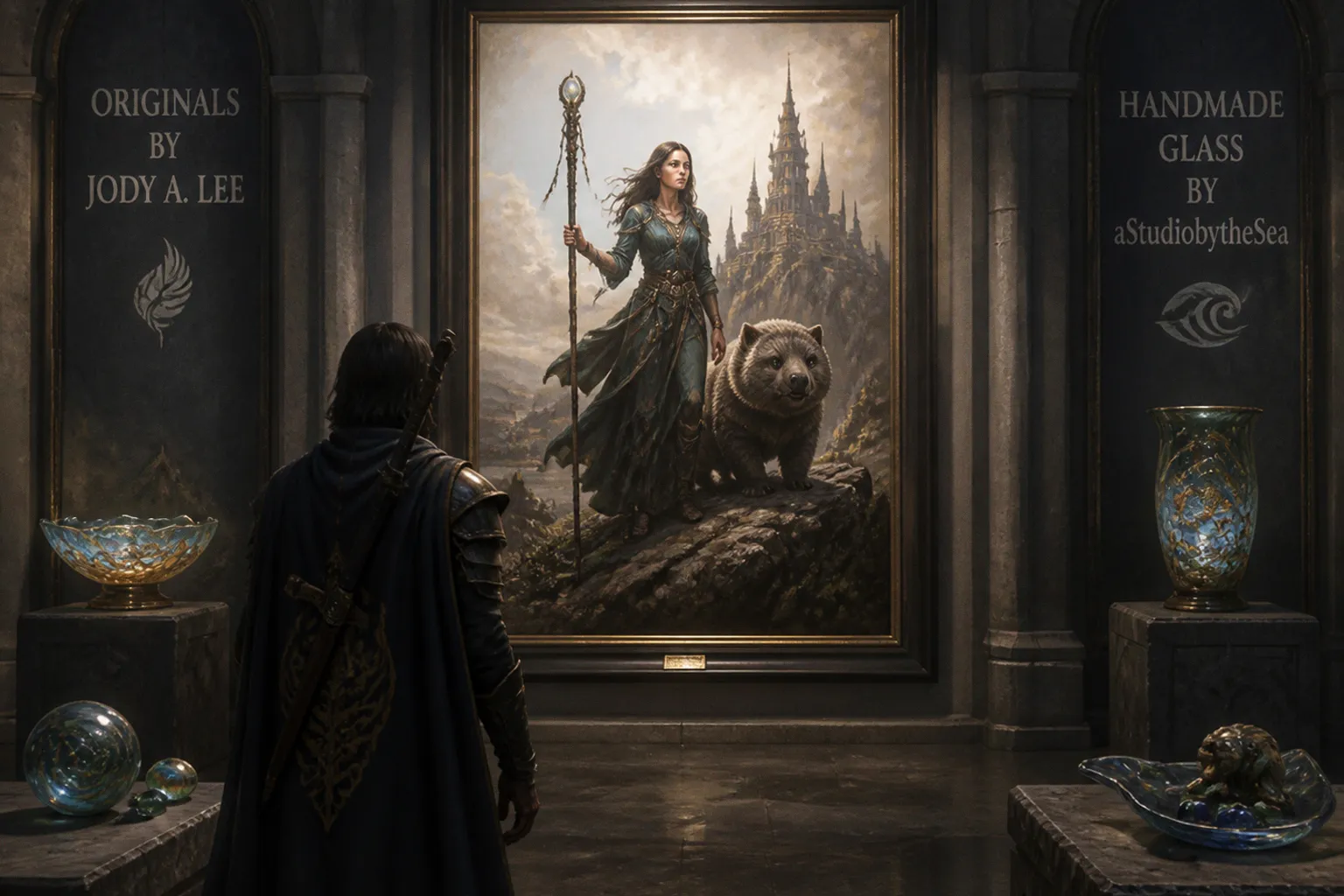
Where Can You Buy Original Jody A. Lee Fantasy Art?
Lee’s cover work is familiar to readers of fantasy novels, but the originals themselves are a smaller, more dispersed body of work—part gallery inventory, part private collection, part occasional public sighting.
That makes this less a matter of finding the one perfect storefront than learning the difference between an original painting, an authorized reproduction, and an adjacent piece of studio craft. The distinction matters. A cover image can be everywhere in print and still be nearly impossible to buy as paint on board.
Sourcing Original Fantasy Paintings via IX Gallery
IX Gallery is the clearest public place to begin when searching for original Jody A. Lee fantasy art. Its artist listings provide a useful split between work that is currently available and work that has already sold, which is more valuable than it sounds. The sold archive is not merely a graveyard of missed opportunities; it is the visible record of what kinds of paintings have entered the market, how they were titled, and how the gallery has presented them.
At the time reflected in the gallery listings, three originals provide a practical snapshot of the range:
- Closer to Home: Mags — $1,700
- Witch and Wombat — $2,000
- Silver Mage — $4,200
Those numbers should be read as listing prices for particular works, not as a fixed scale for Lee’s entire career. Original fantasy art is stubbornly individual. Size matters, certainly, but so do medium, condition, subject, whether the work has a publishing connection, and the simple visual force of the image. A solitary figure in a restrained composition can be the more memorable painting; a large, elaborate scene may be the more difficult object to place in a private home. Price is only one part of that conversation.
Silver Mage, at the upper end of this small group, is best understood as a larger commitment rather than a universal benchmark. It is a finished, original work with a presence that a thumbnail cannot fully communicate. That is enough to explain why it occupies a different tier from a smaller character piece without inventing a formula for how every detail of a painting translates into dollars.
The useful question is not “What does a Jody A. Lee original cost?” It is “Which kind of Jody A. Lee original is actually in front of me?”
The 19th IX Main Art Show, scheduled for October 21–25, 2026, is another date worth keeping in view. An IX exhibition is a natural point of attention for collectors who follow represented artists and want to see what the gallery chooses to present during its annual event. Treat the dates as a reason to watch the gallery’s announcements and listings closely, rather than as a promise that any particular Lee painting will appear or be offered in any particular way.
That distinction keeps expectations sane. Gallery inventory changes. Exhibition programming changes. The public record can tell a collector where to look and when to pay attention; it cannot guarantee access to a specific unseen painting.
How to read an original listing without talking yourself into it
A listing is the beginning of due diligence, not the end. For original fantasy book cover paintings and standalone gallery works alike, the collector should slow down around the details that survive after the initial rush of recognition.
1. Identify what the object actually is. Is it an original painting, a study, a preliminary drawing, a reproduction, or a work related to a published image? “Original” is a broad word in illustration collecting. It can describe very different levels of finish and historical connection.
2. Read the title carefully. A title that names a character or scene may suggest a narrative connection, but it does not automatically establish that the work was used as a book cover. If publication history matters to you, seek clarity before allowing the title to do the work of provenance.
3. Look beyond the image file. Dimensions, medium, support, signature placement, and condition notes shape the physical reality of a painting. A luminous image on screen may be compact in person; a subtle edge texture may be central to the work’s appeal.
4. Keep documentation with the work. Gallery invoices, artist correspondence where appropriate, exhibition information, and publication references all become part of the painting’s life after purchase. This is not bureaucratic clutter. It is the paper trail that lets a work remain legible when it changes hands years later.
5. Ask before assuming. If a listing leaves a practical question unanswered—shipping, framing, condition, or whether an image relates to a particular publication—ask the gallery. The point is not to turn a purchase into an interrogation. It is to avoid filling gaps with collector mythology.
Navigating the Market for Iconic Book Cover Illustrations
The pressure rises when the search moves from a Lee original to an image readers already know by title. Joust, Winds of Change, and Arrows Flight are not just paintings in a catalogue. They carry years of association: bookshop racks, paperback spines, rereads, the private visual language a reader develops with a series.
The listed gallery history gives a few concrete landmarks. Joust was listed at $2,000, Winds of Change at $3,200, and Arrows Flight at $2,700 before being marked sold through IX Gallery. Those figures are useful records of those individual sales listings, not appraisal instructions for a future resale. Once a recognized cover enters a private collection, its next appearance may come with a very different context, condition history, and asking price.
That is the essential difficulty of collecting speculative fiction illustrations: the best-known images are often the least available, while the available originals may be quieter, stranger, or less tied to a beloved title. Neither route is inferior. They simply satisfy different impulses.
| Collector’s aim | The better starting point | What to keep in mind |
|---|---|---|
| Owning a singular painted object | Current gallery originals | The work may be unrelated to a famous published cover, but it is still an original Lee painting |
| Chasing a familiar cover image | Gallery sold records and secondary-market monitoring | Availability is irregular, and prior listing prices are historical context rather than current value |
| Building a display collection around favorite novels | Official reproductions | The image is accessible, but it is not the original painting |
| Adding work from Lee’s broader studio practice | Handmade glass and craft venues | This is a separate body of work with its own materials, scale, and collecting logic |
The secondary market is where patience becomes more useful than urgency. Heritage Auctions, Comic Art Fans, dealer inventories, and estate-related listings can all become points of visibility, but none should be mistaken for a comprehensive index. Works may be displayed without being offered. They may change hands privately. They may appear with incomplete descriptions that require additional research.
A recognizable title also raises the stakes around attribution. If a seller describes a work as a cover original, the collector should want a coherent chain: publication identification where relevant, a credible history of ownership, supporting paperwork, and imagery that corresponds to known cover art. A familiar image is not proof by itself. In a field built on nostalgia, it is easy for a confident caption to sound more authoritative than it is.
A famous cover is not automatically the better acquisition. The better acquisition is the one whose object, history, and place in your collection are all clear.
This is also where the language around “investment” needs cooling down. Original illustration can retain cultural and personal value, but it is not a savings account with dragons on it. Buy the work because the image keeps returning to you, because the physical object matters, and because you can live with its quirks. Resale is a later question, not a substitute for conviction.
Official Print Reproductions and Fine Art America Options
For many admirers, the most realistic path to Lee’s imagery is not an original painting but an authorized print. Lee maintains a presence on Pixels and Fine Art America, where selections of her work are offered as formats such as prints, canvas pieces, and framed wall art.
This route deserves more respect than collectors sometimes give it. A reproduction does not pretend to be the original; it makes the image available to people who want to live with it. That is a different relationship to art, but not an empty one. For a reader who has carried a particular cover image for decades, a well-chosen print can be the right answer.
The practical separation is straightforward:
- An original carries the physical marks of the artist’s process: surface variation, paint handling, scale, and the irreducible fact that there is only one.
- A print gives you the composition and color image in a selected format, often with choices around size and presentation.
- A framed reproduction can be an excellent display object, but it should not be bought under the assumption that it has the same scarcity or collecting profile as an original.
- Availability, dimensions, materials, and pricing can vary by listing, so the current product page—not an old social post or a secondhand description—is the useful reference.
There is a temptation to treat prints as placeholders while waiting for “the real thing.” That can be a trap. If the original is genuinely the goal, save toward it and keep watching the proper channels. If the goal is to put a favorite Lee image on the wall, a licensed reproduction is not a compromise in moral terms; it is simply the correct object for that purpose.
The same discipline applies to resale listings. A print can be old, scarce, signed, or personally meaningful, but none of those qualities should be assumed from a blurry photograph and a seller’s adjective. Read the format description. Ask about edition information if it is claimed. Do not let the word “rare” replace evidence.
Exploring Jody A. Lee’s Handmade Glass and Craft Work
Lee’s Etsy shop, aStudiobytheSea, belongs in the conversation because it reveals another side of her practice—but it is not a back door into her fantasy illustration inventory. The shop is associated with handmade glass craft: flamework beads, tidepool-influenced objects, fused glass pieces, and related work. It is not the place to expect original fantasy paintings or official book-cover prints.
That boundary is worth stating plainly because collectors often collapse every artist storefront into one imagined stockroom. Lee’s illustration career and her glass work may speak to the same sensibility—color, surface, small worlds caught in an object—but they are different categories. A glass piece should be bought as glass, not as a speculative substitute for a painted cover original.
Physical gallery representation adds another layer to this part of the practice. The work is also associated with Monarch Gallery in Cambria and Studios on the Park in Paso Robles. For someone drawn to the tidepool forms, beads, dishes, or sculptural glass, these venues are relevant places to monitor or contact about current availability.
The pleasure here is in allowing the medium to be itself. Glass is not a lesser version of illustration. It brings its own behavior: light moving through color, a tactile edge, reflections that alter with the room. A painted dragon and a fused-glass tidepool do not need to compete for the same shelf in a collection. They can simply show the range of an artist who has worked across very different material worlds.
Community Platforms for Tracking Rare Speculative Art
Comic Art Fans is useful less as a conventional shop than as a living map of collector attention. Users build galleries, post acquisitions, identify artists and titles, and sometimes make their interests known through comments or updates. For a collector looking for rare Lee originals, that can reveal which works are publicly documented in private hands and which titles continue to draw attention.
It is a platform for observation, not certainty. A painting displayed in a collector gallery is not necessarily for sale. A quiet profile does not mean a work has vanished. A public want-list does not create a transaction. But over time, the platform can help a collector learn the names, images, and ownership patterns that do not appear in a gallery’s active inventory.
The same measured approach applies to jodylee.org, Lee’s official portfolio site. Its cover-art and children’s-book illustration galleries make it valuable as a reference point for the images themselves. It is a place to revisit when trying to distinguish a remembered cover from a similar composition, or when assembling a clearer picture of the breadth of her illustration work. If the site’s Gallery section is updated with future available work, it may also become a useful signal—but collectors should rely on what is actually posted rather than treating a site structure as an advance sales announcement.
A sensible monitoring routine is modest:
- Revisit IX Gallery’s Jody A. Lee listings and sold records periodically.
- Keep the October 21–25, 2026 dates of the 19th IX Main Art Show on your calendar.
- Follow relevant Comic Art Fans galleries for visual reference and market awareness.
- Search auction and dealer listings with exact titles as well as the artist’s name.
- Use the official portfolio and official print channels to verify imagery before pursuing a secondary-market offer.
- Separate the hunt for paintings, prints, and glass from the beginning. They overlap in authorship, not in marketplace logic.
The point is not to refresh pages compulsively. It is to develop recognition. After a while, you know which image is a cover, which is a related interior illustration, which listing language is too vague, and which work is worth pursuing with a serious question.
Buy the Work, Not the Story You Invented Around It
The market for Jody A. Lee’s fantasy art rewards attention, but it punishes fantasy of the wrong kind: the belief that every famous cover is secretly one message away from purchase, that every old print is an undiscovered treasure, or that an Etsy craft listing must be a hidden route to illustration originals.
Start with IX Gallery for currently visible originals. Use the sold listings to understand the public record, not to promise yourself a repeat. Watch the 2026 IX Main Art Show dates because exhibitions are worth watching. Use Pixels and Fine Art America when what you want is an authorized image for your wall. Visit the glass work on its own terms. Let Comic Art Fans and the official portfolio deepen your knowledge rather than inflate your expectations.
That is the durable route through this corner of classic fantasy art auctions and private collecting: fewer assumptions, sharper eyes, and enough patience to recognize the right painting when it genuinely appears.