Collectives or independent auctions for fantasy illustrators
A portfolio can be excellent and still be sold through the wrong channel. I’ve seen fantasy illustrators spend months polishing original paintings, only to discover that the sales structure around…
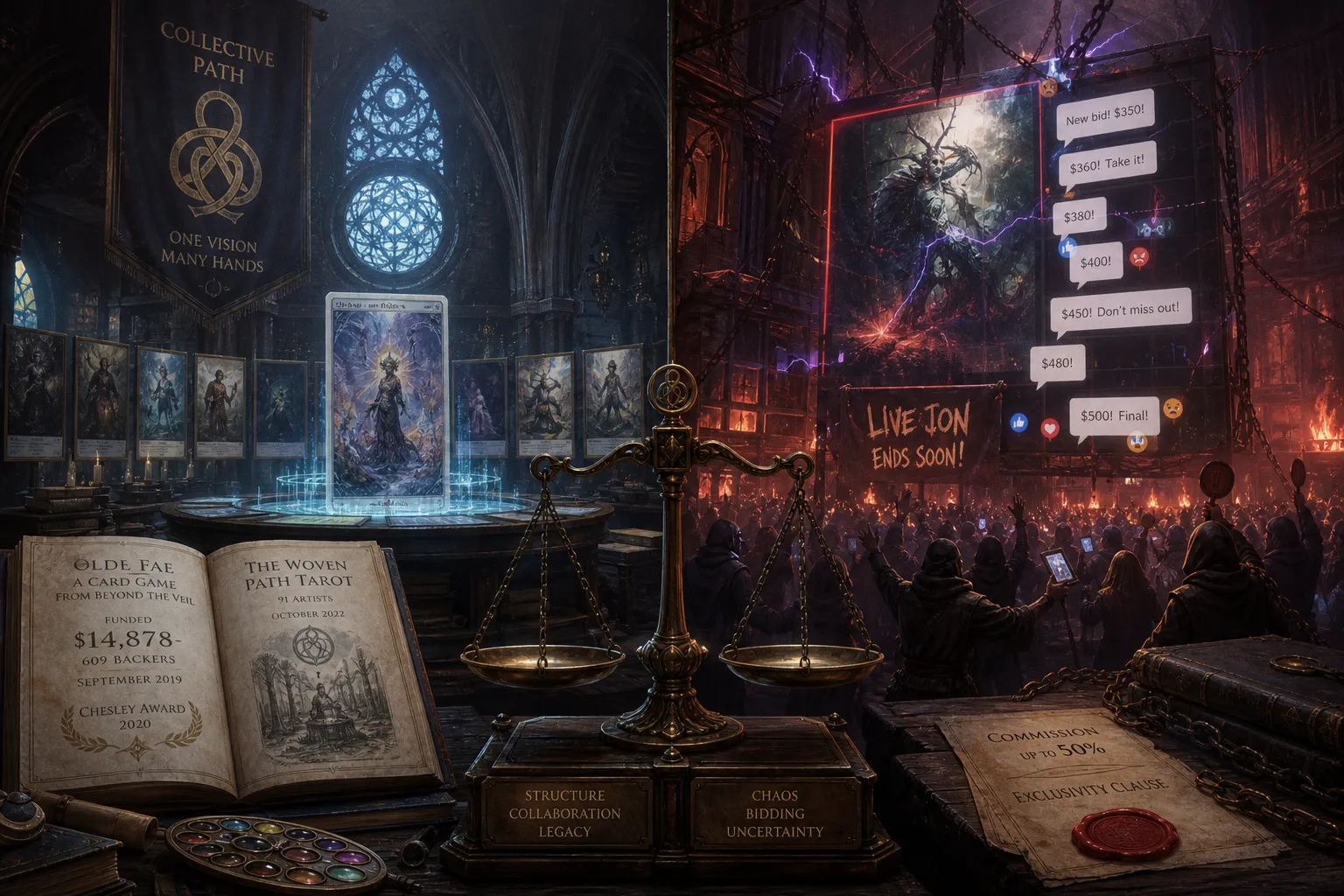
A portfolio can be excellent and still be sold through the wrong channel. I’ve seen fantasy illustrators spend months polishing original paintings, only to discover that the sales structure around the work leaves them with little control over pricing, timing, collector relationships, or even where the image can appear next.
Compare car rental deals in United Kingdom
See available offersPartner link — DiscoverCars comparisonThat is the real choice behind fantasy art collectives vs independent auctions. It is not simply a question of whether you prefer collaboration or independence. A collective may give your work a stronger context, a shared audience, and access to ambitious projects such as card games or tarot decks. An independent auction may put you directly in front of collectors, but it also leaves you responsible for the mechanics, promotion, payment, shipping, and the emotional weather of a live sale.
I would treat both as professional distribution systems. Your portfolio still has to do the selling, but the channel determines how much of the sale you control—and how much value disappears between the brush and the collector.
The economics of art collectives: shared risk, shared reach
A good fantasy art collective solves a problem that individual illustrators often face alone: discoverability.
Collectors may know they want contemporary fantasy art, but not yet know your name. A collective can place your work beside artists with established audiences, give it a coherent editorial frame, and create a reason for people to return. That matters particularly for artists whose work is highly specialized—mythic figures, fae courts, dark folklore, narrative portraiture, or traditional oil paintings that do not fit neatly into a commercial illustration category.
The Changeling Artist Collective is a useful example of the model. Founded by fantasy artist Rachel Quinlan, it includes more than 40 international fantasy artists and has focused on collaborative projects including tarot decks and card games. Its project Olde Fae: A Card Game From Beyond the Veil raised $14,878 from 609 backers on Kickstarter in September 2019 and later won a Chesley Award in 2020. In October 2022, the collective launched The Woven Path Tarot, featuring original art from 91 artists.
Those numbers tell you something important about collective work: the product is not merely a stack of individual paintings. It is a world, a release, and a shared art drop with a built-in narrative. That packaging can make the work easier for collectors to understand and easier for an audience to talk about.
But shared reach is not the same as guaranteed sales. Joining a group does not replace a strong portfolio, a recognizable silhouette language, or the ability to deliver to a brief. In a card-game or tarot project, your contribution has to function inside a larger visual system. The art needs its own pop while still belonging to the set.
What a collective can offer
The strongest collectives tend to provide some combination of:
- A qualified audience. You are not starting every release from zero. The collective’s mailing list, social following, and collector history create an initial field of attention.
- A stronger project frame. “Original fantasy painting” is broad. “A limited fae card-game release” or “a collaborative tarot deck” gives the buyer a clearer reason to engage.
- Editorial and production support. Depending on the project, someone may coordinate deadlines, image specifications, packaging, fulfilment, or campaign presentation.
- Peer visibility. Your work can be discovered through another artist’s audience, especially when the group’s styles are complementary rather than interchangeable.
- A more substantial body of work. A collective project can become a portfolio signal in itself. It shows that you can work to a brief, maintain quality across a deadline, and contribute to a larger art direction.
That last point is easy to undervalue. For an artist hoping to work in TCG illustration, publishing, or licensed fantasy properties, a collaborative project demonstrates more than painting skill. It demonstrates reliability. A commissioning editor wants to know whether you can make the brief sing without making the entire set look like a collection of unrelated personal pieces.
The catch is that the collective’s brand becomes part of the buying decision. If the project is beautifully art-directed, that is a benefit. If the release is poorly presented, visually inconsistent, or unclear about fulfilment, your work inherits some of that friction.
A collective can widen the door to your audience, but it does not remove the need for your portfolio to make a clear promise.
Exclusivity is not a footnote
The most important paragraph in a collective agreement is often the one artists skim because it sounds administrative.
Read the exclusivity language carefully.
Collectives and private galleries can charge commissions as high as 50% of a sale, and both may impose strict exclusivity clauses. The precise terms vary by project, so you should not assume that a recognizable collective automatically means a favorable split. A prestigious project can still be expensive if it controls where else you may sell the original, how long you must wait before reproducing it, or whether you can show related studies and variants.
Before committing, I would want clear answers to these questions:
- Is the commission applied to the gross sale price or after payment and shipping costs?
- Who sets the retail price?
- Can you sell the original elsewhere if it does not move during the release?
- Does exclusivity cover only the finished piece, or also prints, studies, crops, and derivative work?
- How long does the exclusivity period last?
- Who owns reproduction rights for campaign images, cards, prints, and promotional materials?
- Can you use the finished work in your portfolio and on your website?
- Who handles damaged shipments, refunds, and collector communication?
- When are artists paid?
- What happens if the project is delayed, cancelled, or substantially changed?
These are not signs that you distrust the organizers. They are signs that you understand the commercial life of an illustration.
A fantasy painting may have several revenue paths: original sale, limited print, licensing, card reproduction, book appearance, convention display, and future commission work. If a collective agreement closes all of those paths for an extended period, the headline opportunity may cost more than the commission percentage suggests.
The right collective is not necessarily the one with the biggest audience. It is the one whose project, terms, and art direction match the way you want your portfolio to develop.
Independent auctions put the collector relationship in your hands
Independent illustrator auctions offer a different kind of leverage. Instead of placing your work inside a shared campaign, you present a specific original directly to a collector audience and let demand establish the final price.
This can work particularly well when your painting has a clear hook: a recognizable character, a sought-after franchise connection, a strong narrative moment, or a finished piece that photographs and reads well at thumbnail size. It is also useful when you want to test the market without handing over long-term exclusivity.
Social-media communities can be surprisingly effective here. The MTG Art Market Facebook group, for example, has more than 10,000 members and became a primary hub for Magic-related art by 2018. Independent auctions in communities of this kind often operate with their own bidding rules, payment expectations, and moderation practices.
The mechanics matter. Many use anti-sniping rules: if a bid arrives in the final minutes, the auction window extends by 10 minutes. That prevents a last-second bid from ending the sale before other interested collectors can respond. It also changes the rhythm of the auction. The closing time is not always a hard finish; it becomes a period in which active bidders must remain attentive.
For an illustrator, that can be helpful. Your work has a better chance of reaching its actual market value rather than being won by the one person who happened to refresh at precisely the right moment. But it also means that you need to understand the rules before you announce a sale. A vague caption and an improvised comment thread are not a sales system.
What you control—and what you inherit
With an independent auction, you usually have more control over:
- The opening bid or reserve structure.
- The date and duration of the sale.
- The images, details, and process material used in promotion.
- The relationship with the winning collector.
- Whether the work is available through another channel afterward.
- The timing of future prints, studies, or related pieces.
You also inherit more work:
- Writing a brief that explains the piece without overselling it.
- Photographing or scanning the original accurately.
- Tracking bids and identifying the winner.
- Confirming payment before shipment.
- Packing the artwork safely.
- Calculating insurance and international postage.
- Handling questions about condition, dimensions, varnish, framing, and signatures.
- Following up after delivery.
That operational layer is where many independent sales lose their professional polish. Your portfolio may communicate exquisite control, but if the auction post does not state the medium, dimensions, starting bid, closing rules, shipping arrangement, and payment window, collectors have to guess. Guessing creates hesitation.
For an original oil painting, include close-ups that show surface texture without making the work look rough or damaged. State whether the piece is varnished, framed, or shipped unframed. If the image is a traditional painting intended for reproduction, make it clear whether the auction concerns the physical original only or includes any reproduction rights. Those are different assets.
Comparing the money: commission, premium, and platform fees
Artists often compare a collective’s commission with an auction platform’s fee and assume the lower percentage is automatically the better deal. That misses the cost of the work you must perform yourself.
Still, the basic mathematics are worth putting on the table.
| Sales channel | Typical stated cost or structure | What the artist gains | What the artist must manage |
|---|---|---|---|
| Art collective or private gallery | Commission can reach 50% of the sale | Shared audience, project framing, promotion, and sometimes production support | Less control over pricing, schedule, rights, and exclusivity |
| Major traditional auction house | Buyer’s premium commonly ranges from 10% to 30%; examples include a flat 20% or tiered rates such as 27.5% on the first $12,500 | Auction credibility, specialist handling, established collector base | Consignment terms, catalogue deadlines, buyer expectations, and possible loss of direct relationship |
| Independent social-media auction | Rules vary; anti-sniping extensions of 10 minutes are common | Direct access to collectors and more control over the sale | Promotion, moderation, payment, packaging, shipping, and customer service |
| eBay | Platform fees for original art commonly fall around 13%–15% of the final hammer price | Searchable marketplace, familiar checkout, broad reach | Listing quality, platform disputes, shipping, returns, and less curated positioning |
| Direct sale through your own channels | No single marketplace commission, but payment processing and fulfilment still apply | Maximum control over price, collector data, presentation, and rights | You create the audience, sales process, trust, and fulfilment system |
The buyer’s premium deserves particular attention. At a traditional auction house, the percentage may be paid by the buyer rather than deducted from the artist’s hammer price, but it still affects what a collector is willing to bid. If a buyer’s total rises sharply above the visible bid, the painting may feel more expensive than your headline number suggests.
Likewise, an independent auction is not “free” simply because it happens in a Facebook group or on your own social feed. Payment processors, broker fees, packaging, insurance, and shipping can all reduce the actual return. If you use a broker to facilitate the sale, establish the percentage in writing before the auction begins. Do not build your pricing around an assumed fee structure.
A simple internal calculation helps. Start with the amount you need to receive after costs. Add the expected commission or platform fee, then account for packing, insurance, payment processing, and any tax obligations relevant to your situation. You do not need to publish every part of that calculation to collectors, but you do need to know it before setting the opening bid.
The 50% question
A 50% commission can sound indefensible when you look only at the percentage. Sometimes it is. Sometimes the collective or gallery is providing a level of access and service you could not reproduce alone.
The practical question is not “Is 50% high?” It is “What does the other 50% buy?”
If the arrangement includes a major project, professional art direction, campaign production, fulfilment, collector service, and meaningful promotion, you are evaluating a package. If it consists of uploading your image and waiting for a sale while you remain responsible for every other task, the same split becomes much harder to justify.
I would compare the net result, not the emotional appeal of the opportunity:
1. Estimate the likely sale price through the collective.
2. Subtract commission and any project-specific deductions.
3. Value the hours you would otherwise spend on promotion, fulfilment, and collector communication.
4. Consider the portfolio and licensing value of participation.
5. Compare that with the realistic net return from an independent sale—not an optimistic one.
This is where your level of demand matters. An artist with a large collector list may be giving away margin by entering a highly commissioned channel. An emerging artist may be buying useful reach and proof of audience. Neither choice is inherently more professional.
Collaborative projects scale attention differently
The strongest argument for a collective is often not the sale of one original. It is the possibility of building a larger body of work with a shared audience.
A successful card game or tarot project can create multiple points of contact: campaign art, printed cards, behind-the-scenes posts, stretch goals, packaging, convention appearances, and collector discussion. Each artist benefits from the project’s momentum, even if the individual sales outcome varies.
Olde Fae illustrates that kind of collective scale. Raising $14,878 from 609 backers was not just a transaction for individual illustrations. It was evidence that a shared concept could gather enough interest to support a complete product. The later Chesley Award recognition strengthened the project’s visibility and gave participating artists a credible piece of professional history.
The Woven Path Tarot, with work from 91 artists, shows the opposite challenge: scale creates complexity. A project with dozens of contributors needs clear art direction, consistent production standards, and careful communication. For an artist, the value of participation depends partly on how well that system protects individual contributions from becoming anonymous components.
Ask how the finished product will credit you. Will your name appear on the card, in the guidebook, on the campaign page, or only in a buried social post? Will collectors be able to identify and find your work afterward? A project can be visually impressive and still provide weak portfolio value if the artist attribution is difficult to trace.
Independent auctions scale differently. They build your personal collector history rather than the collective’s universe. Each sale gives you data:
- Which subjects receive bids?
- How far does demand extend beyond your existing followers?
- Do collectors respond to finished oils, studies, sketches, or character pieces?
- Does a low opening bid create competition, or simply anchor the work too low?
- How much lead time does your audience need?
- Are buyers local, domestic, or international?
That information is valuable because it helps you shape the next art drop. It also teaches you whether your portfolio’s strongest selling point is the medium, the subject, the franchise association, or the story behind the piece.
A collective compounds shared attention; an independent auction compounds your own collector data.
Choose the channel according to the kind of portfolio you are building
Your sales channel should support the next professional step, not only the immediate sale.
If your goal is to move toward TCG illustration, a collective project can demonstrate that you understand visual continuity, production constraints, and art direction. A card-game brief may require a readable silhouette, controlled focal hierarchy, and enough negative space for UI or text. The work has to survive cropping and reproduction. Subtle glazing that looks beautiful on a studio wall may lose its effect when reduced to a two-inch card image, so your value is not only in rendering detail. It is in knowing which detail survives the final format.
If your goal is to build a direct collector base, independent auctions may be more useful. You can study what your buyers respond to and keep the relationship attached to your name. That is especially important for an artist whose work is not dependent on a single licensed property.
Here is the comparison I use when reviewing an artist’s route:
| Your current position | Channel that may fit | Why |
|---|---|---|
| You need qualified exposure and have limited collector reach | A well-organized collective | The shared audience and project frame can help your work get seen |
| You already have collectors waiting for originals | Independent auction or direct release | You may not need to surrender a large percentage for access |
| You want card-game or publishing credits | Collaborative card or tarot project | It can show your ability to work within a visual system and deadline |
| Your work is highly personal and difficult to fit into a group brief | Independent auction | You retain control over subject, format, and presentation |
| You dislike fulfilment and customer service | Collective, gallery, or experienced broker | The service layer may justify part of the commission |
| You are testing price and demand | Small independent auction | The bidding behavior gives you immediate market feedback |
| You need long-term control over reproduction rights | Direct sale or carefully negotiated auction | Collective exclusivity may limit future uses |
Do not confuse visibility with positioning. A crowded collective campaign can bring many impressions but leave collectors unable to remember which artist made which piece. An independent auction can have a smaller audience but create a clearer connection between your name, your visual language, and the object being sold.
The best option may also change from one piece to the next. A highly collectible fan-art original could perform well in a specialized independent auction, while a body of original work designed for a shared fae mythology may gain more from a collective release.
Hidden costs: fulfilment, rights, and the work after the sale
The sale price is only the visible part of professional art distribution. The less visible costs are often the ones that determine whether the channel remains sustainable.
Shipping and condition
Original fantasy art is vulnerable to avoidable damage. Oil paintings may need adequate curing time, surface protection, corner guards, rigid packaging, and insurance appropriate to the sale value. A framed work can become dramatically more expensive to ship than an unframed canvas or panel. International shipping introduces customs documentation and longer exposure to handling.
Decide in advance:
- Whether the buyer or seller pays shipping.
- Whether insurance is included in the quoted amount.
- Who handles a damage claim.
- What proof of condition is recorded before dispatch.
- Whether the piece is shipped framed, unframed, or rolled.
- How quickly the work must leave after payment.
If a collective handles fulfilment, ask for its process. If you run the auction, build packing time into your schedule. The collector’s experience does not end when the bid closes.
Payment and fraud
Direct sales require a payment policy that is clear before the auction begins. State the payment window and what happens if the winning bidder disappears. Do not reserve the painting indefinitely without a deposit or confirmed payment. Keep written records of the final bid, buyer information, shipping address, and any agreed terms.
A polished sales post should include the work’s title, medium, dimensions, year, condition, opening bid, closing time, time zone, bid increments if applicable, anti-sniping rule, payment method, and shipping terms. This is not bureaucratic clutter. It is what allows a collector to make a confident decision.
Reproduction rights
Selling the original does not automatically mean selling every right attached to the image. The physical painting, copyright, licensing rights, and reproduction permissions are separate commercial questions.
Collective projects can be especially complicated because the image may appear on cards, campaign pages, books, prints, or promotional material. Read the agreement for the exact scope of the licence. If the project can continue using the image after the campaign, know whether that use is limited, perpetual, exclusive, or royalty-bearing.
For an independent auction, write the rights position in plain English. For example, you may be selling the original physical artwork while retaining copyright and reproduction rights. If a collector wants exclusive commercial rights, that should be negotiated as a separate value proposition rather than silently bundled into the original sale.
If you are also developing a broader professional practice around traditional technique and speculative illustration, it can help to study how artists present their process, editions, and originals in professional fantasy art portfolio reviews. The useful lesson is not to copy someone else’s layout; it is to see how clearly a portfolio can distinguish the object for sale from the larger body of work.
A practical route for emerging fantasy illustrators
You do not have to choose one permanent identity: collective artist or independent seller. In fact, I would be wary of locking yourself into a single channel before you know what your portfolio and audience can support.
A sensible progression might look like this:
1. Use collective projects to learn production discipline. Work with briefs, deadlines, image specifications, crediting requirements, and shared art direction. Treat the project as a professional case study, not just a chance to have your painting included.
2. Run small independent releases alongside that work. Start with pieces whose pricing and shipping you understand. Keep the auction rules simple and publish them clearly.
3. Track net revenue rather than gross excitement. Record the final sale, fees, shipping, packaging, payment costs, and hours spent. A sale that looks successful on social media may be weak once the full labour is counted.
4. Build an owned audience. A mailing list or properly organized collector record is more durable than reach borrowed from a platform or group. Ask permission before adding people to any list, and keep your communication focused.
5. Negotiate from evidence. After several releases, you will know which subjects, formats, and price points have real traction. That gives you a stronger position when discussing a gallery or collective agreement.
6. Keep your portfolio legible. Separate personal work, licensed work, collective projects, and available originals. A commissioning editor should be able to see your range without having to decode your sales history.
Every Day Original offers an interesting contrast to open social-media auctions. Founded by Marc Scheff in 2014, the online gallery collective has hosted more than 275 artists and sells one original artwork per day at $500 or less. Its release schedule is tightly controlled: art is posted at 10:30 a.m. Eastern Time, mailing-list subscribers receive exclusive access at 11:00, the buy button activates for them at noon, and the public sale opens at 12:30 p.m.
That kind of schedule creates urgency without relying on a chaotic comment thread. It also shows why distribution design matters. The same painting can feel easier to buy when the audience understands exactly when it will appear, who gets access, and how the purchase works.
For your own art drop, you can borrow the principle without copying the system. Give collectors a firm release time. Show the work beforehand. Explain the purchase route. Avoid making people search through six posts to find the dimensions and price.
So which one should you choose?
Choose a collective when the project gives your work a meaningful context, the audience is genuinely relevant, and the agreement protects enough of your future rights and portfolio use. The collective should be offering more than a logo and a shared hashtag. It should provide a clear reason the project can reach collectors more effectively than you could alone.
Choose an independent auction when you have a work that can carry its own story, a reachable audience, and the capacity to manage the operational details professionally. Direct selling is not automatically more profitable, but it gives you more information and more control. That control becomes increasingly valuable as your collector base grows.
Be particularly cautious when a channel offers prestige but cannot explain its commission, exclusivity, payment schedule, crediting, or fulfilment process. Ambiguity is a cost. Sometimes it is the largest cost in the room.
For most emerging fantasy illustrators, the strongest long-term strategy is hybrid: participate selectively in collaborative projects that sharpen your production credentials, while developing independent auctions that teach you how your own market behaves. Let the collective build context. Let the independent sale build your direct relationship with collectors.
Your portfolio is not finished when the painting is finished. The sales channel becomes part of the work’s professional life. Choose one that preserves the value you are trying to build—your name, your audience, your rights, and the confidence that another collector or client will know exactly where to find you next.