Composition Secrets of the Magic: The Gathering Hobbit Scene Cards
According to Magic: The Gathering, Magic: The Gathering® | The Hobbit™ will include borderless scene cards built as larger illustrations across multiple cards—and that is precisely where a…
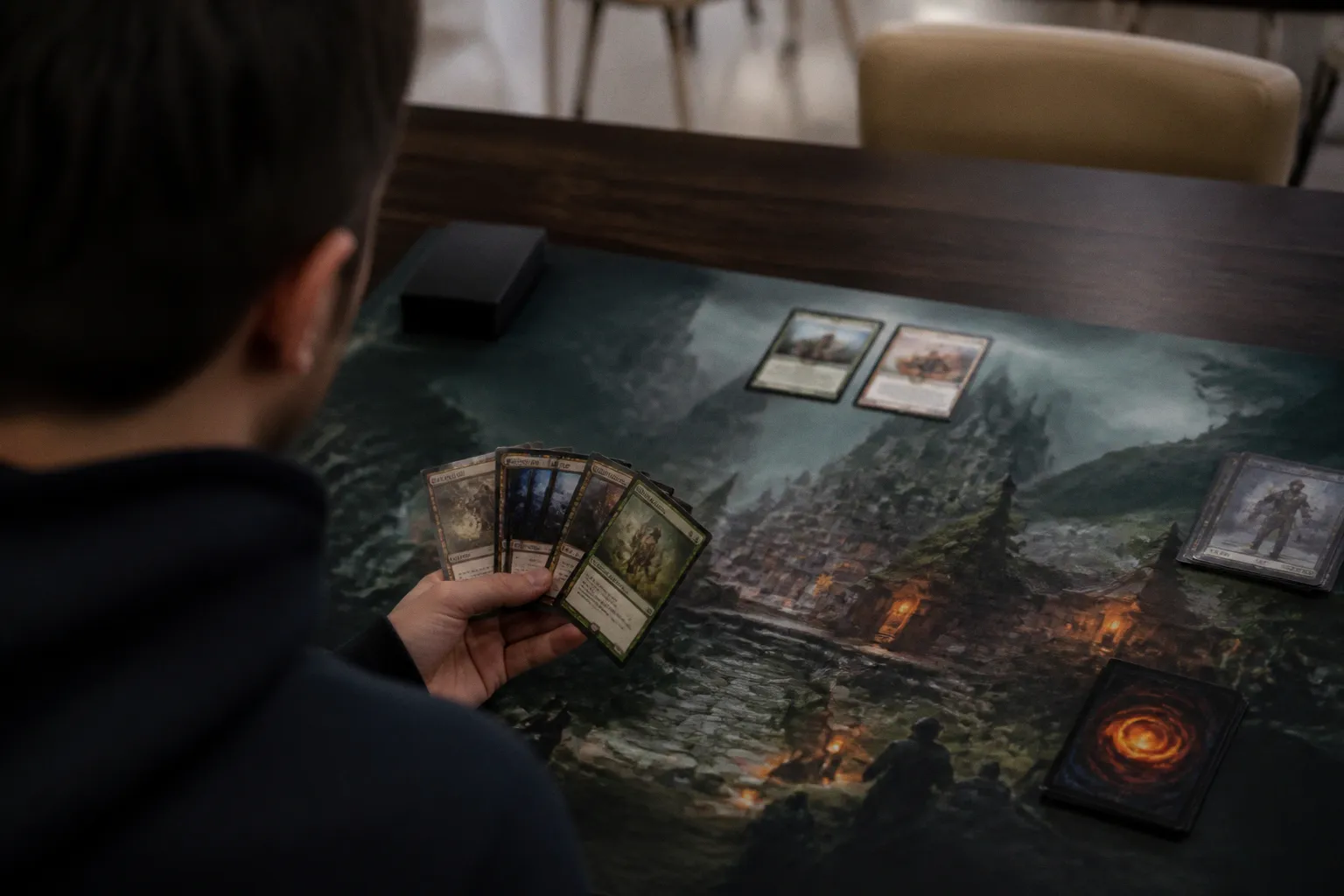
According to Magic: The Gathering, Magic: The Gathering® | The Hobbit™ will include borderless scene cards built as larger illustrations across multiple cards—and that is precisely where a small-format brief becomes much harder than it first appears. A scene can read beautifully at full spread and still lose its story when one card is isolated in a hand, binder page, or social crop. For artists building TCG portfolios, these reveals are a useful reminder: composition has to work at two scales, not one.
A nine-card battle has to read card by card
The largest announced piece is The Five Armies Clash!, a nine-card scene illustrated by Denman Rooke. It depicts the battle involving five of Middle-earth’s armies, all contesting Smaug’s hoard.
That nine-card format is not merely a wide canvas with divider lines drawn over it. Each panel needs its own readable silhouette, value grouping, and point of interest, while still serving the larger beat. A central clash may carry the narrative weight, but the outer cards cannot become decorative fog; collectors will see them separately far more often than they see the completed panorama.
That is worth pinning beside your own portfolio work. If you show a multipart piece, include the full composition—but then test every crop at roughly card scale. Does it still have pop? Is the focal action legible? Can a commissioner see that you understand the practical constraints of the product, rather than simply painting a handsome wide shot?
The scene boxes put character beats under a microscope
Wizards also announced two The Hobbit Scene Boxes, each containing six borderless scene cards that form a single moment. Fight with the Great Goblin, illustrated by Ted Nasmith, places Gandalf against the leader of Goblin-town’s forces. Crack the Plates, by Dmitry Burmak, turns Bilbo’s early gathering with his unruly visitors into its own scene, while Marta Nael’s Treasures of Smaug shows Bilbo facing the dragon.
These choices make sense as card-art briefs because they are not all trying to do the same job. One is confrontation, one is comic domestic chaos, and one is a suspense image shaped by scale and danger. That variety matters. A strong fantasy illustrator does not just paint “epic”; they can change the visual tempo while keeping the world convincing.
For your portfolio, this is the useful comparison: a battle scene proves crowd control and staging; a table scene proves character interaction and prop storytelling; a dragon scene tests scale, atmosphere, and the ability to protect a tiny human silhouette against a huge form. If all your samples solve the same problem—three-quarter heroes, misty ruins, one reliable colour script—you may have polish, but not yet range.
What to inspect before the August release
Magic says the set releases on August 14, 2026, with the scene cards available among the product’s releases. When the complete cards are in view, don’t only admire the joined-up art. Study the seams.
Look for where the artists place faces, weapons, architectural lines, and high-contrast accents relative to the card boundaries. Notice whether an important gesture crosses into the next panel or is kept intact. Check how backgrounds are simplified so the eye can travel across the spread without getting trapped in detail.
That is the professional lesson tucked inside a collector product. Great connected art is not a mural reduced into rectangles. It is a sequence of card-sized images that still knows how to become a picture when the whole story is finally laid on the table.