Fantasy art contracts: hidden traps for independent illustrators
A commissioned fantasy illustration is a controlled demolition of time, materials, and intellectual capital. The artist invests hours — sometimes dozens — into research, thumbnails, color studies, underpainting, and final rendering.
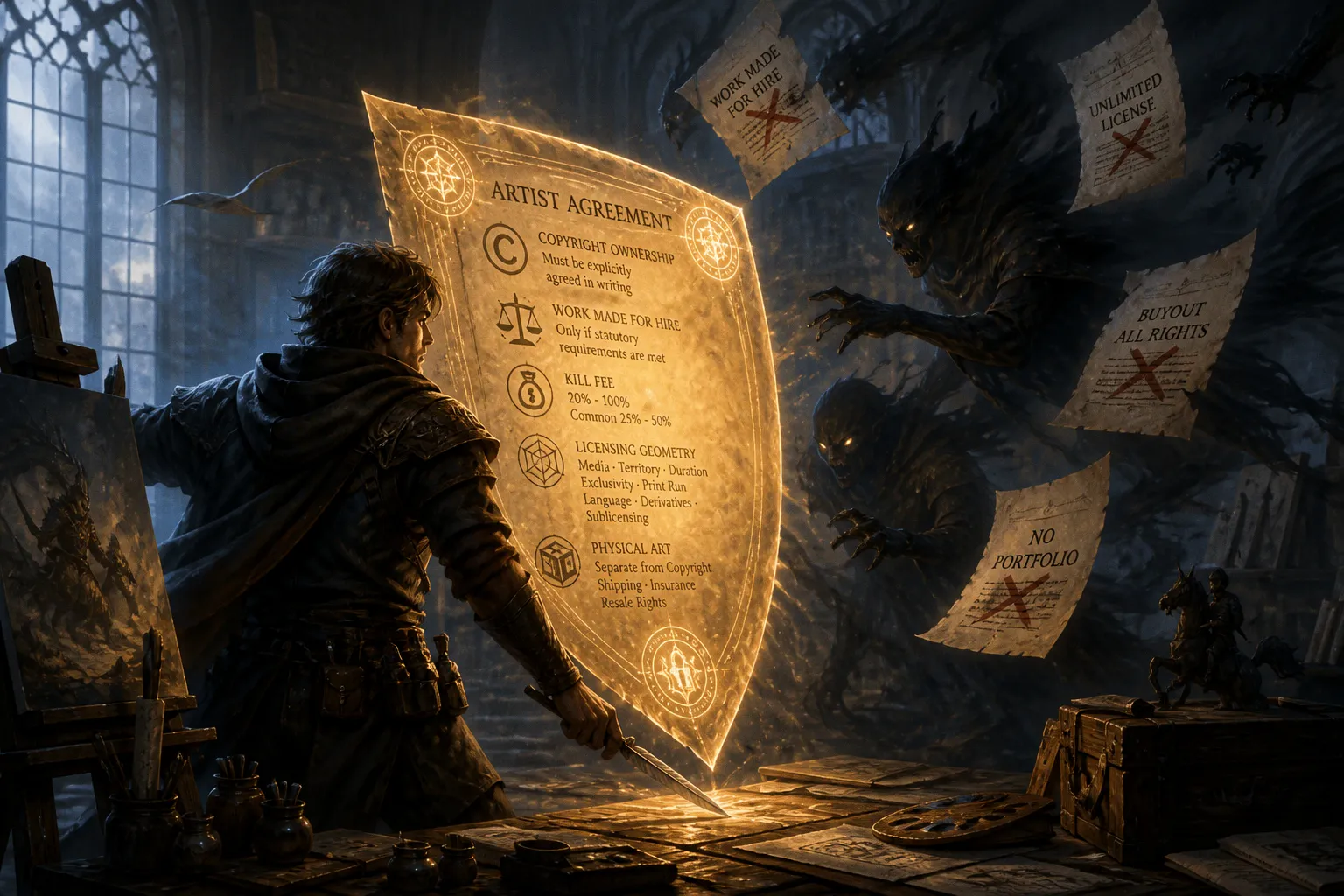
Oil on panel, digital on canvas, mixed media on illustration board: the substrate changes, but the expenditure remains fixed. And yet the document that governs this expenditure — the commission contract — is routinely signed without examination. Artists treat it as administrative paperwork, a formality between the creative act and the paycheck. That indifference is the trap.
Under U.S. copyright law, the creator of an original work generally holds the exclusive rights to reproduce, distribute, display, and prepare derivative works from it once the work is fixed in a tangible medium. This applies regardless of medium: oil on linen, gouache on hot-press paper, or pixels on a tablet. The default position favors the artist. But every contract is an attempt to define, narrow, or replace that default position, and in fantasy illustration — where a single dragon portrait may appear on a book cover, a playmat, a collector’s print, and a digital storefront — the stakes of that alteration compound across multiple revenue streams. Signing without reading the licensing geometry is the equivalent of mixing pigment without knowing its refractive index: you will get a result, but you will not control it.
Every contract is a layering system. If you do not understand the chemistry of each layer — copyright, licensing, kill fees, physical ownership — you cannot predict how the whole structure will behave under pressure.
The Myth of Automatic Copyright Transfer in Fantasy Commissions
The most persistent misconception in fantasy art commissions is that paying for the work transfers ownership of the work. It does not. Payment and copyright assignment are separate events.
Copyright ownership can be transferred through an instrument of conveyance that is in writing and signed by the copyright owner. That writing does not necessarily need to be a traditional paper contract. A qualifying electronic record and electronic signature can satisfy the writing-and-signature requirement under applicable federal and state electronic-transactions law. A signed purchase order, for example, may be enough if it clearly functions as a written transfer or incorporates terms that do so. An email exchange can also raise different questions depending on its content, authentication, and applicable law. The safe editorial conclusion is not that every digital exchange is invalid. It is that a purely verbal agreement — including a casual conversation over Discord or a phone call — generally does not accomplish a copyright assignment by itself.
The distinction matters because a client can pay in full and still receive something narrower than ownership. A tabletop publisher might pay an illustrator $1,200 for a cover painting. The publisher may receive the physical painting if that is part of the bargain, along with an express or implied license to reproduce the image for the agreed cover. Unless the parties have also executed a valid assignment or work-made-for-hire arrangement, the illustrator generally retains the copyright.
That retained copyright can affect whether the artist may sell prints, license the image to another party, reproduce it in a portfolio, or authorize a derivative use. The contract should not leave those rights to implication when they have commercial value.
The problem often surfaces months later, when the publisher decides to use the same illustration on a line of merchandise, a regional advertisement, a digital download, or a foreign-language edition. If the original agreement was silent on these uses, the publisher may not have the permission it assumes it bought. Whether the client has an implied license, and how far that license extends, depends on the language of the agreement and the circumstances of the commission. Silence is not a clean commercial strategy for either side. It creates an argument about intent after the image has already entered the marketplace.
For the illustrator, this is where protecting illustrator rights in contracts becomes practical rather than theoretical. The document should state what the client may do, not merely what the artist will deliver. “One illustration for the cover of [title]” is a much narrower commercial description than “all uses in all media, worldwide, in perpetuity.” Those phrases do not describe the same transaction, and they should not be priced as though they do.
Deconstructing the Work-Made-for-Hire Trap Under U.S. Law
The work-made-for-hire doctrine is one of the most dangerous clauses in fantasy illustration contracts, and it is also one of the most misunderstood.
Under 17 U.S.C. § 101, a work made for hire is either a work prepared by an employee within the scope of employment or a specially commissioned work that satisfies a specific statutory test. For an independent contractor, the parties must agree in a written instrument signed by both of them that the work is made for hire, and the work must fall within one of the statutory categories. Those categories include certain contributions to collective works, compilations, translations, supplementary works, instructional texts, tests, answer materials, atlases, and works made for use in motion pictures or other audiovisual works.
That list is not a decorative menu. A contract cannot transform every commissioned painting into a work made for hire simply by repeating the phrase “work made for hire.” The commissioned work must fit a qualifying category, and the relationship must satisfy the written-agreement requirement. A fantasy cover illustration may be described by a publisher as a contribution to a collective work, but that description is not an automatic answer to whether the statutory category applies. The contract’s language, the nature of the project, and the relevant case law all matter.
When a valid work-for-hire designation applies, the commissioning party is treated as the legal author from the moment of creation. The illustrator has no copyright to assign because, legally, the work is not theirs in the first place. They cannot sell prints, license the image, or reproduce it without the hiring entity’s permission. Portfolio use may also depend entirely on an express clause or the client’s goodwill.
This is why the clause deserves more attention than its familiar wording suggests. It may be a legitimate arrangement for a publisher that genuinely needs ownership of an illustration as part of a larger publishing package. It may also be an attempted shortcut: a boilerplate phrase inserted into a contract for a category of work that does not clearly qualify. The artist should distinguish those situations instead of treating every work-for-hire label as either automatically valid or automatically meaningless.
If the work-for-hire provision is ineffective, the contract does not necessarily become harmless. The document may contain a separate copyright assignment, an expansive license, or language that creates a dispute over what the client actually received. Work-for-hire analysis is only one layer of the rights structure.
| Contract element | What the publisher may intend | What the legal language must actually establish |
|---|---|---|
| “Work made for hire” language | Full authorship and copyright ownership | A written agreement signed by both parties, a qualifying statutory category, and compliance with the statutory test |
| Signed purchase order or electronic agreement | A convenient record of the bargain | A qualifying signed writing whose terms clearly establish the intended transfer or license |
| Verbal agreement on scope | Unlimited use of the illustration | Oral discussions may explain intent, but they generally do not replace a signed writing for a copyright assignment |
| “All rights” clause | A total buyout of every possible use | Clear transfer language and a commercially intelligible description of the rights being conveyed |
| Portfolio-use restriction | The artist cannot show the work | An express contractual restriction, or a valid work-for-hire or ownership arrangement that leaves the artist without the relevant right |
| “For the cover” language | All uses connected to the publication | A defined license; cover use, advertising, merchandise, and digital exploitation are not automatically the same permission |
The forensic reality is that many fantasy art contracts contain work-for-hire language that may not survive close legal scrutiny. But the artist rarely tests it, because litigation costs more than the commission. The clause functions as a deterrent even when its legal foundation is uncertain. Understanding that asymmetry is the first step in negotiating from a position of knowledge.
A practical contract can avoid some of this confusion by stating the intended structure directly. If the client wants an assignment, the agreement should describe the assignment and its effective date. If the client wants a license, it should describe the license. If the client wants work made for hire, the agreement should identify the statutory basis rather than treating the label as magic. The fewer assumptions hidden inside one sentence, the fewer common freelance art agreement mistakes are left for a future dispute.
Defining Licensing Geometry to Retain Creative Control
The alternative to a copyright transfer — and, for many independent illustrators, the superior strategy — is a licensing agreement. A license grants the client defined rights to use the illustration without surrendering ownership. The key word is defined. A license that says “the client may use the illustration” is as useful as a palette knife made of wax paper: it has the shape of the tool but none of the function.
The artist should think of a license as a set of boundaries rather than a single permission. The more commercial territory the client receives, the more the price should reflect it. At minimum, the agreement should address:
1. Media and formats. Print, digital publication, advertising, social media, merchandise, packaging, card games, playmats, and promotional video are not interchangeable uses. If a client wants to move from a book cover to a product line, that expansion should be visible in the contract.
2. Territory. The license might cover a particular country, a defined market, or worldwide use. “Worldwide” is not a neutral phrase when the client can exploit the image through international editions, online sales, and foreign partners.
3. Duration. A one-year or five-year license leaves room for renegotiation. A perpetual license may be commercially appropriate, but it should be priced as a lasting transfer of control rather than treated as a routine administrative detail.
4. Exclusivity. An exclusive license can prevent the artist from licensing the same image to competing publishers or from making certain products independently. Non-exclusive rights preserve more flexibility. If exclusivity is limited to a particular market or period, those limits should be stated.
5. Print run and circulation. A license for a small first edition is different from an unlimited right to reproduce the image. The contract can define a quantity, an edition, or a mechanism for additional compensation when distribution expands.
6. Derivative works. Can the client crop, recolor, animate, composite, or extract a detail from the illustration? Can a dragon’s head become a logo, or can the background be removed for a product variant? Those are not merely technical production choices when they alter the image’s commercial identity.
7. Sublicensing. Can the client authorize a foreign-language publisher, printer, distributor, game company, or merchandise partner to use the work? If so, for which purposes and under what limits?
8. Credit and attribution. The contract should identify whether the artist receives a credit, where it appears, and whether the client may omit or alter it in particular formats.
9. Approval and integrity. An artist may want notice before substantial alterations, especially where cropping or recoloring changes the composition. That does not require the client to submit every routine layout adjustment, but it can prevent the final use from becoming unrecognizable.
Each parameter is a vector. Together, they define the volume — the licensing geometry — of the permission granted. A fantasy book cover might warrant first North American print rights, a limited duration, exclusivity only for that title, a stated first print run, no derivative works beyond ordinary cropping for format, and no sublicensing without the artist’s written consent. That is a precise instrument. “All rights” is a blunt one.
The word exclusive deserves particular suspicion. It can mean that no one else may use the image, or it can mean that no competitor in a defined market may use it during a defined period. Those are radically different bargains. A client that wants exclusive rights for a single book cover is asking for something narrower than a client that wants the artist barred from selling prints, licensing merchandise, displaying the image, or working with any competing publisher.
The same is true of in perpetuity. A perpetual license may be workable when the fee reflects it and the permitted uses are tightly described. It becomes dangerous when it is paired with worldwide territory, all media, unlimited quantities, sublicensing, and derivative rights. That combination can resemble a buyout while being presented as a routine license.
A vague license is an underpainting with no value structure: it looks like it covers the surface, but when you build on it, the whole composition collapses.
The contract should also say when the license begins. For a staged commission, that might be upon full payment. That arrangement gives the artist leverage if the client publishes or distributes the work while an invoice remains unpaid. It also clarifies whether the client can use preliminary sketches, rejected concepts, or unused variations. Those materials should not silently become part of the client’s rights merely because they appeared during development.
Staging Kill Fees to Safeguard Your Labor and Time
A kill fee is compensation for work performed before a project is canceled. In fantasy illustration, where a single commission can involve weeks of developmental work — reference gathering, composition studies, value thumbnails, color studies, and preliminary rendering — the kill fee is not a courtesy. It is a structural necessity.
The usual mistake is to write one cancellation percentage at the bottom of the agreement and assume the problem is solved. A flat percentage obscures the real question: at what stage of production does the fee activate, and what does it cover?
The answer requires a staged structure that follows the actual labor:
- Deposit before work begins. A non-refundable deposit reserves studio time and covers early research, scheduling, and administrative preparation. It should be paid when the agreement is signed or before the project enters production, not after the artist has already committed several days.
- After thumbnail approval. If the client cancels after approving the composition, the artist has more than an appointment on the calendar. The artist has produced concepts, responded to feedback, and moved the project past the uncertain first stage. The amount owed should reflect that progress.
- After a color study or value sketch. At this point, the client has approved a meaningful visual direction. The artist has invested in the image’s structure, palette, and atmosphere, even if the final rendering does not exist.
- After final rendering begins. Once the artist has committed to the finished surface, cancellation may justify most or all of the remaining fee, particularly if the work can no longer be scheduled for another client.
- After delivery or approval. The contract should distinguish cancellation from rejection. A client should not be able to call a completed illustration “canceled” simply because they have changed their mind about the brief.
A staged schedule can be expressed in percentages, fixed amounts, or milestone payments. The specific numbers are less important than the relationship between payment and labor. A deposit is not automatically a kill fee, and a kill fee is not automatically payment for rights. If the client has already received files or intends to use preliminary artwork, those rights should be addressed separately.
The agreement should also define what happens to unfinished material. If the client pays only for the work completed at cancellation, do they receive the thumbnails, studies, or partial rendering? Not necessarily. The artist may retain ownership of those materials while the client receives only the deliverables expressly covered by the payment. Alternatively, the parties may agree that the client receives certain development files after paying an additional amount. The point is to prevent the cancellation clause from becoming an accidental transfer of every stage of the artist’s process.
A client’s delay can create a similar problem. Fantasy illustration frequently involves editorial schedules, product launches, and approvals from several people. If the client disappears for weeks and then returns with substantial changes, the artist may have lost other work while holding the project open. A strong contract can include a response deadline, a restart fee, or a provision allowing the artist to move the project back in the production queue. That is not punitive. It recognizes that time is an asset even when no brush is moving.
Without a staged kill fee, the artist absorbs the full cost of cancellation. The client walks away. The canvas — half-rendered, its underpainting still tacky — sits in the studio as evidence of uncompensated labor. A staged kill fee converts that labor into a contractual obligation, which is the only language a commissioning party is reliably required to respect.
Separating Physical Artwork Ownership from Intellectual Property
In traditional fantasy illustration — oil on panel, acrylic on illustration board, gouache on paper — there are two distinct assets: the physical artwork and the copyright in the image. They are separate forms of property under U.S. law. Purchasing the painting does not, by itself, transfer the copyright. Holding the copyright does not, by itself, grant ownership of the painting.
The distinction also matters for digital work. A client may receive a layered file, a flattened high-resolution image, a physical print, or merely the licensed reproduction needed for a particular publication. “Final artwork” is not a sufficiently precise description of the deliverable when the artist’s process includes source files, alternate crops, unused sketches, and production versions.
A contract that treats the physical object and the intellectual property as one undifferentiated package leaves several practical questions unanswered:
- Delivery and shipping. Who pays for packing and transport? Is the artist responsible for arranging insurance, or does the risk move to the client once the work is handed to the carrier? When does title pass? These provisions matter more for an original painting than for a digital upload, but the principle is the same: identify the handoff.
- Damage and loss. If a carrier damages an original, the contract should say who files the claim and how insurance proceeds are handled. A silent agreement can leave the sender exposed to an argument over a valuable object that was no longer fully under their control.
- Storage and return. If the client receives the physical original temporarily for scanning, exhibition, or approval, the agreement should establish a return date, handling obligations, and responsibility for damage.
- Reproduction access. If the artist retains copyright, they may still need access to the original to create high-resolution scans or color-accurate reproductions for prints. The contract should specify whether the client must make the work available and under what conditions.
- Resale of the original. If the client later sells the physical painting at a profit, the artist does not automatically receive a share under a general federal resale-royalty rule. The United States does not have a general federal droit de suite comparable to the resale-royalty systems found in parts of Europe. California, however, has a state statutory resale-royalty regime, commonly associated with the California Resale Royalties Act, subject to its own scope and legal limitations. The accurate contract question is therefore not “does U.S. law give the artist a royalty?” but “what law applies, and have the parties created a contractual resale provision?”
- Prints and editions. If the artist intends to sell prints after the client acquires the original, the contract should preserve that right explicitly. If the client wants the original and an exclusive right to reproduce it, those are separate commercial concessions and should be priced separately.
- Portfolio display. Ownership of the physical painting does not necessarily determine whether the artist may display an image of it. Portfolio rights, promotional use, confidentiality, embargoes, and unreleased characters should be addressed in the agreement.
The resale point is especially easy to overstate. Saying that the United States has no statutory resale royalty is false if it is presented without qualification. Saying that the United States lacks a general federal resale royalty is materially different and more accurate. California’s statute does not create a universal rule for every artist, every buyer, or every transaction, and it does not eliminate the need to draft a contract. A private resale provision may still be useful where the parties want a clear percentage, trigger, reporting duty, or payment schedule.
The same precision applies to insurance. If an original painting is being shipped from the artist’s studio to a publisher, the contract should not merely say “artist will ship.” It should identify whether shipping is included in the price, who chooses the carrier, what level of insurance is required, and when the risk changes hands. The price of the illustration and the risk attached to the object are different lines in the composition.
A contract that addresses only licensing terms but ignores the physical logistics of the artwork is half-finished. It is an underpainting left exposed: structurally incomplete, vulnerable to the first external force applied to it.
The Payment Terms That Quietly Change the Deal
Rights language attracts attention because it sounds legal. Payment language often does more damage because it looks routine.
The invoice schedule should correspond to production milestones rather than to an abstract promise to pay “upon completion.” Completion can mean the artist delivers the final file, the client approves it, the client publishes it, or the client’s accounting department processes the invoice. Those are different events. If the contract does not define the trigger, the artist may finish the work while waiting for a client-side approval that has no artistic purpose.
The agreement should identify:
- the total fee and the currency in which it is payable;
- the deposit and whether it is credited against the final balance;
- the milestones that trigger additional payments;
- the deadline for each payment;
- the consequences of late payment;
- whether the client may use the work before the balance is paid;
- which expenses, such as shipping, reference materials, rush work, or revisions, are included;
- how taxes, transfer fees, and currency-conversion costs are handled.
A “net thirty” term is not inherently abusive, but it should be understood. It may mean payment is due thirty days after invoice, thirty days after delivery, or thirty days after the client’s internal acceptance. Those distinctions can turn a predictable schedule into an open-ended wait. The phrase “upon acceptance” is particularly unstable unless the agreement defines acceptance and gives the client a limited period to raise specific objections.
Revisions also belong here. Fantasy clients may request changes to costume details, weapon design, creature anatomy, lighting, or character expression. A contract that includes “reasonable revisions” without defining the round or the point at which a change becomes a new brief invites conflict. The artist can include a set number of revision rounds, define what counts as a revision, and price substantial changes separately. This protects the client from surprise charges while protecting the artist from an endless loop of subjective dissatisfaction.
The most dangerous art commission payment terms to avoid are not always the ones with the lowest fee. They are terms that make payment conditional on events the artist cannot control: a publisher’s sales, a crowdfunding campaign, a client’s own customer paying them, or an internal approval process with no fixed deadline. If the artist is being commissioned to create the work, the obligation to pay should ordinarily attach to the agreed production milestones rather than to the client’s later commercial success.
The Verdict: Read the Contract Like You Read a Value Study
Every contract is a composition of competing interests. The publisher wants maximum rights at minimum cost. The artist wants fair compensation and retained control. The document that resolves this tension must be read with the same precision an oil painter applies to a value study — every mark matters, every omission is a decision, and the overall structure either holds or it does not.
For an independent fantasy illustrator, the most consequential questions are concrete:
1. Who owns the copyright when the work is created? Is the answer based on a valid assignment, a qualifying work-for-hire arrangement, or a limited license?
2. What exactly may the client do? Identify media, territory, duration, exclusivity, quantity, derivative uses, sublicensing, and portfolio restrictions.
3. When does the artist get paid? Tie payments to production milestones and define what happens when the client delays, cancels, or requests work beyond the original brief.
4. What happens to unfinished material? Decide who owns or may use thumbnails, studies, rejected concepts, source files, and partial renderings.
5. Who owns the physical object? Separate title to an original painting from copyright in its image, then address shipping, insurance, access, storage, and resale.
6. What happens when the commercial plan expands? A cover commission should not silently become a merchandise license, a game asset, or a worldwide advertising campaign.
The independent illustrator who signs without identifying the work-for-hire clause, the licensing geometry, the kill-fee staging, the payment triggers, and the physical-artwork provisions is working on unstable ground. The image may look finished. The payment may clear. But when the publisher uses the illustration on six product lines the artist never approved, when the project is canceled at the color-study stage with no compensation for three weeks of labor, or when the original painting is damaged in transit and the contract assigns liability to the sender, the structural failure becomes visible.
This is why the most useful response to fantasy art commission contract pitfalls is not a longer list of frightening clauses. It is a more exact description of the bargain. Copyright assignment is not the same as payment. A digital signature is not the same as a casual conversation. Work made for hire is not a magic phrase. A license is not a synonym for “all rights.” A resale royalty is not a general federal protection in the United States, though California law and private contract terms may change the analysis. The physical painting is not the copyright.
Contract review is not administrative overhead. It is the first and most consequential technical decision in the production process. Treat it with the same rigor you apply to pigment selection, substrate preparation, and edge control. The painting is only as sound as the ground beneath it.