Wet-on-wet or layered oils: which fits your fantasy art?
ells You Everything…
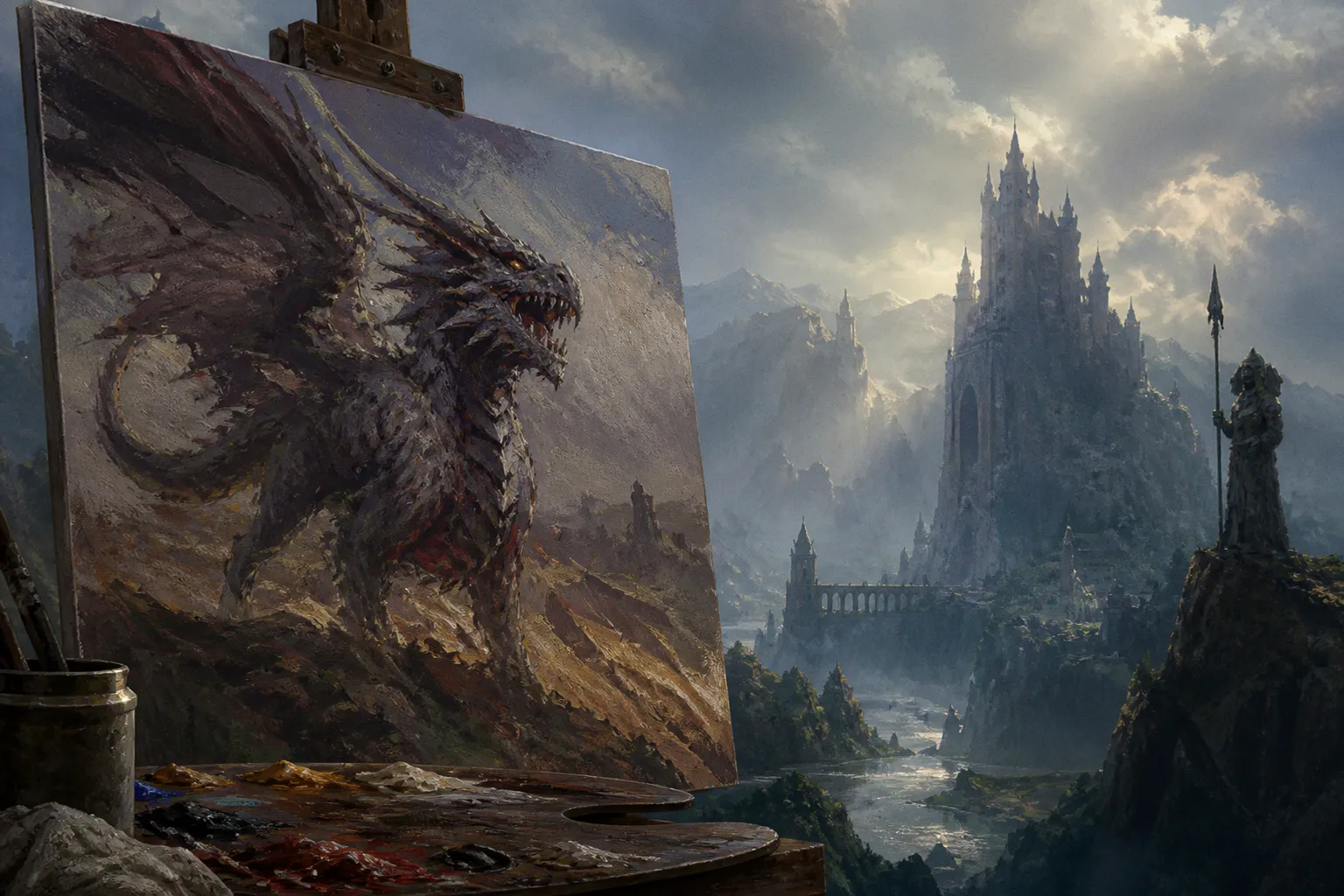
Here's a situation I see roughly every other month in my inbox: an artist sends in a portfolio full of stunning oil work for a six-card combat cycle, and the brief specifically called for the depth that only layered glazing can deliver. The technique on the screen tells me everything about whether they read the assignment. Alla prima pieces, all single-session, all fast and confident — and now I have to write back that the cards need the luminous atmosphere that only patience can buy. Or the opposite: a meticulous indirect painter who took four months on a single sky-dragon and missed the print deadline by two weeks.
Compare car rental deals in United Kingdom
See available offersPartner link — DiscoverCars comparisonThat's the real conversation around wet-on-wet versus layered oil painting in fantasy illustration. It isn't about which technique is "better." It's about which technique fits the brief, the timeline, and the specific atmospheric problem you're trying to solve on the panel. If you're building a portfolio aimed at commercial fantasy work — card art, book covers, gaming illustrations — this choice matters more than your choice of brush brand or paint manufacturer.
Let me walk you through what I've learned from commissioning both kinds of work, where each one tends to fail, and what you need to know before you commit to one approach on a piece that's supposed to launch your next commission cycle.
The Temporal Divide: From Single-Session Alla Prima to Multi-Week Layering
The first thing to get straight is the time commitment, because it dictates everything downstream.
Alla prima — what we call "wet-on-wet" in the studio — is a single-session or short-session technique. You're working into wet paint, blending wet edges, building forms while the surface is still pliable. In practice, that's a one-to-three-day painting. You block in your drawing, you push your values, you drop in color, you refine, and you stop. Some alla prima pieces can be completed in a single afternoon if the artist is fast and the composition is simple.
Layered or indirect painting is the opposite philosophy. You separate the stages: drawing and value structure first, then color, then refinement, then glazes. Drying intervals between major paint applications typically run two to four weeks. A finished layered piece can take anywhere from four to twelve weeks depending on the complexity and the number of glazes you stack.
For TCG commission work, this is enormous. When I send out a brief for a ten-card cycle, the artist has roughly six to eight weeks total. If you commit to a fully layered approach, you need to plan your layers in advance — you can't just start painting and figure it out as you go, because there's no time to re-establish a dried underpainting if you make a mistake at week three. Alla prima lets you iterate visually within a session, but it costs you in paint consumption and in the kind of optical depth you can achieve.
If your deadline is measured in days, paint wet-on-wet. If it's measured in months and your piece needs the glow of backlit stained glass, layer it.
Think about your production rhythm. Are you the artist who finishes pieces in a day and panics if a canvas sits in the studio for more than a week? You're a natural alla prima painter. Are you the artist who sketches something in February and finishes it in May because you keep walking back to study the light? You're built for indirect work. Neither temperament is superior — they just produce different kinds of finished work.
Material Economics: Why Wet-on-Wet Demands 20–30% More Pigment
Here's a number that surprises almost every artist I work with: a wet-on-wet painting consumes twenty to thirty percent more premium paint than a layered piece of the same finished size.
Why? Because layering lets you build depth through thin, transparent glazes. You start with a lean, solvent-thinned underpainting — what is essentially a wash — and you add depth gradually, with each successive layer being a thin film of pigment suspended in medium. The total paint volume is small because you don't need opacity from every layer. You're stacking light, not stacking material.
Alla prima can't do that. You're blending wet into wet, so you need enough paint on the surface to allow for that manipulation. You can't rely on a translucent glaze to establish a deep shadow because the underlying layer is still wet and would lift. So you load your brush more heavily, you work thicker, and you cover the support with more pigment per square inch.
For a fantasy illustrator working on a card piece that's roughly eight by ten inches at the final reproduction size, that twenty to thirty percent difference is real money over a year's output. If you're using artist-grade paints — Williamsburg, Michael Harding, Old Holland — a tube can run you fifteen to twenty-five dollars American. Multiplying that across the volume of work you're producing for a TCG commission cycle, the math adds up faster than most artists realize.
There's a secondary cost as well: medium. Fast-drying alkyds, which let you extend the working time of an alla prima session or speed up the drying of a layered piece, typically run fifteen to twenty-five dollars per hundred milliliters. If you're using alkyds to keep your alla prima sessions open longer, or to bridge the drying gap between layers in a compressed timeline, that expense compounds. It's not a dealbreaker, but it's the kind of thing that quietly reshapes your annual studio budget.
A quick comparison across the two approaches on the parameters that matter most to a working illustrator:
| Parameter | Alla Prima (Wet-on-Wet) | Layered (Indirect) |
|---|---|---|
| Typical completion time | 1–3 days | 4–12 weeks |
| Paint consumption | 20–30% more premium pigment | Lean base, thin glazes |
| Working surface | Stays wet throughout session | Dries between layers (2–4 weeks) |
| Best for | Gesture, energy, single-session confidence | Luminosity, glazing, atmospheric depth |
| Main rule | Maintain 1:3 to 1:5 oil-to-paint ratio | Strict fat-over-lean layering |
| Sensitivity to humidity | High (thick passages swell >7% at 83% RH) | Moderate (thin films more uniform) |
| Commission fit | Short-deadline card work, character studies | Long-lead book covers, alt-art prints |
Structural Integrity: Fat-Over-Lean and the Archival Math
This is where the two techniques most clearly stop being interchangeable, and where I've seen more portfolio-killing mistakes than almost anywhere else.
The layered approach lives or dies by the "fat over lean" rule. Each subsequent layer must contain more oil than the previous one. Lean layers — paint thinned with solvent, low oil content — go down first. Fat layers — paint with added medium like linseed oil or a thick, buttery application — go down last. This matters because lean layers dry faster and contract more than fat layers. If you reverse the order and put fat under lean, the underlying layer dries slower than the top layer, and as the top layer contracts, it cracks. The piece falls apart in a year, or two, or five, depending on the environment. I've seen beautiful commission pieces go into storage sound and come out six years later with a network of cracks that read like a topographical map.
Alla prima sidesteps this rule because you're not really building layers in the stratified sense. You're moving wet paint around on a single working surface. But alla prima has its own structural requirement: a proper oil-to-paint ratio of one to three to one to five. If you're working thick — and alla prima tends to go thick — you need that ratio to maintain archival stability. Too little oil and the paint film becomes brittle. Too much oil and the surface stays soft, can wrinkle, and will yellow aggressively over time.
I've rejected commissioned pieces where the artist clearly loaded too much medium into a thick passage. The brushwork was beautifully alla prima, confident, exactly what the brief wanted in terms of energy — but the surface was going to fail within a decade. As a commissioning editor, I have to think about the long-term stability of the original, because the original often gets reproduced and resold for years. A glowing review of your work in five years won't matter if the physical piece has turned to mud.
For layered work, the structural protocol is stricter but more forgiving over time. You wait two to four weeks between major applications. You test dry with a clean knuckle or a careful touch. You establish your values in a wash first, then build form in mid-tones, then refine, then glaze. Anyone who tells you layered oil painting is "easy" hasn't done it correctly. The discipline is the technique.
Luminosity and Depth: Glazing Techniques for Indirect Fantasy Illustration
This is where the fantasy art conversation gets genuinely interesting, because the visual goals of our genre — the backlit dragon, the glowing rune, the stained-glass cathedral, the bioluminescent deep-sea elf — are almost always about light passing through something. Whether it's literal translucency or metaphorical atmosphere, we paint light effects. And light effects are where alla prima and layered work diverge most clearly in what they can deliver.
A glaze is a thin, transparent layer of paint applied over a dry layer. The light passes through the glaze, hits the underlying layer, and reflects back through the pigment. This is what gives glazed work its luminous quality — the depth isn't in the pigment itself, it's in the optical layering. Glazing is a layered technique. You cannot glaze into wet paint because the solvent in the glaze would disturb the layer below.
A wash, by contrast, is solvent-thinned paint used for the initial underpainting or block-in stage. It's quick, lean, and meant to be dry before you start building anything serious on top of it. The wash is your roadmap; the glazes are the journey.
Alla prima gives you a different kind of magic. The light effects in alla prima work come from the wet blending itself — the soft edges, the diffused transitions, the sense that everything happened in one moment. Think of a portrait where the cheek emerges from the background in a single brushstroke. That's alla prima territory. Think of a wizard's robe where each fold of crimson silk is enriched by the glow of a candle that doesn't exist on the canvas — that's glaze territory.
For fantasy illustration specifically, the choice depends on the subject. A combat scene, a character portrait, a creature study — these often benefit from the immediacy and gestural confidence of alla prima. A magical effect, a glowing element, a translucent material, a piece meant to evoke atmosphere rather than action — these often need the depth only glazing can provide.
A practical tip I give every artist I mentor: if you're unsure which approach a piece needs, do a small value study in both techniques and see which one solves the lighting problem more convincingly. The time you spend on the study will save you from committing to the wrong approach on the final panel. And the study itself becomes a portfolio piece if you frame it right.
Three things to check before committing to a layered approach on a fantasy piece:
- Is the light source internal? Magic, fire, bioluminescence, runes — these almost always need glazing because the light has to feel as if it's coming from inside the material, not painted on top of it.
- Is the surface supposed to be translucent? Skin, fabric, gemstone, glass, water — all of these read better when there's an optical layer underneath doing the work.
- Is the brief asking for mood over action? Atmospheric pieces, alt-art prints, book covers with a single quiet hero — these benefit from the patience glazing demands.
Environmental Sensitivity: Protecting Thick Impasto from Humidity Shifts
One more thing to flag before you commit, because it ruined a piece of mine last year and I want you to avoid the same mistake.
Thick oil paint — particularly the heavy, buttery passages that alla prima work tends toward — is sensitive to environmental shifts. The pigments can swell by more than seven percent under sustained humidity levels around eighty-three percent. That doesn't sound like much, but if your painting is heavily textured and the humidity swings twenty or thirty points between seasons, the expansion and contraction stresses the paint film. Over time, you get micro-cracks, lifting, and in worst cases, cleavage from the support.
This matters more for fantasy illustrators than for portrait painters because we tend to use more saturated, high-pigment colors in thicker applications. A dragon's scale layer, a glowing rune, a magical effect — these often involve heavy paint loaded onto the brush. If you're working alla prima and producing the kind of physical surface Craig and other fantasy oil painters are known for, you need to think about the storage environment from the moment you set the piece down to dry.
Layered work, with its thin films and controlled medium ratios, is generally more forgiving of environmental swings because each layer has already gone through its initial drying phase before the next is applied. The final paint film is more uniform and less prone to differential expansion.
If you're commissioning a piece that's going to a trade show, a gallery, or a publisher's collection, ask about the storage environment. If they can't guarantee humidity control, lean toward layered work or consider using more panel than canvas, because panel is dimensionally stable in ways that stretched canvas is not. I've had artists submit beautiful alla prima pieces on stretched canvas that I had to reject for a long-running alt-art program because the publisher's warehouse couldn't guarantee consistent humidity. Switching to panel would have saved the commission.
Choosing Your Workflow
So where does this leave you? Three questions to ask yourself before you commit to alla prima or layered work for a piece:
1. What does the brief actually require? If the lighting is important and the subject has translucent or glowing elements, you'll likely need glazing — which means layered work. If the brief is about energy, gesture, and confidence, alla prima will serve you better.
2. What's your deadline structure? Single-session alla prima work fits a one-to-three-day window. Layered work fits a four-to-twelve-week window. Don't try to force layered work into a one-week sprint or alla prima into a six-month epic.
3. What's your storage and shipping reality? If your studio humidity is uncontrolled or your pieces ship to unstable climates, account for the environmental sensitivity of thick paint in your technique choice.
The honest truth — and I say this as someone who has commissioned hundreds of fantasy oil pieces — is that the best fantasy illustrators I've worked with are bilingual in both techniques. They know when to reach for the alla prima palette and when to set up a layered panel. They can read a brief and recognize that the dragon needs glazes while the rider can be painted wet-on-wet in a single afternoon. They plan their glazes the way a cinematographer plans lighting setups, and they know when to abandon the plan and trust the wet brush.
If you're early in your portfolio, pick the technique that fits your natural temperament and master it deeply before you try to be both. Build a body of work that demonstrates real fluency in one approach before you start showing me hybrid pieces. If you're mid-career and your portfolio is getting predictable, force yourself to try the other approach on a personal piece. The growth will show up in your commercial work faster than you'd expect.
And if you're sending oils to a card art director — make sure at least one of those pieces demonstrates that you understand the difference between a wash and a glaze. That single piece will tell me more about your technical fluency than any other aspect of your portfolio. It tells me you can read a brief, plan your layers, and deliver a surface that will hold up not just for the next trade show, but for the next decade of the game's reprint cycle.
Pick the technique that fits the work. Build the piece that fits the brief. The rest takes care of itself.