Kitbashing or procedural generation for sci-fi concepts?
A client asks for a believable orbital refinery, three views of a desert city, and a final keyframe by Friday. The first mistake I see in portfolios is treating the choice between kitbashing and procedural generation as a question of artistic purity.
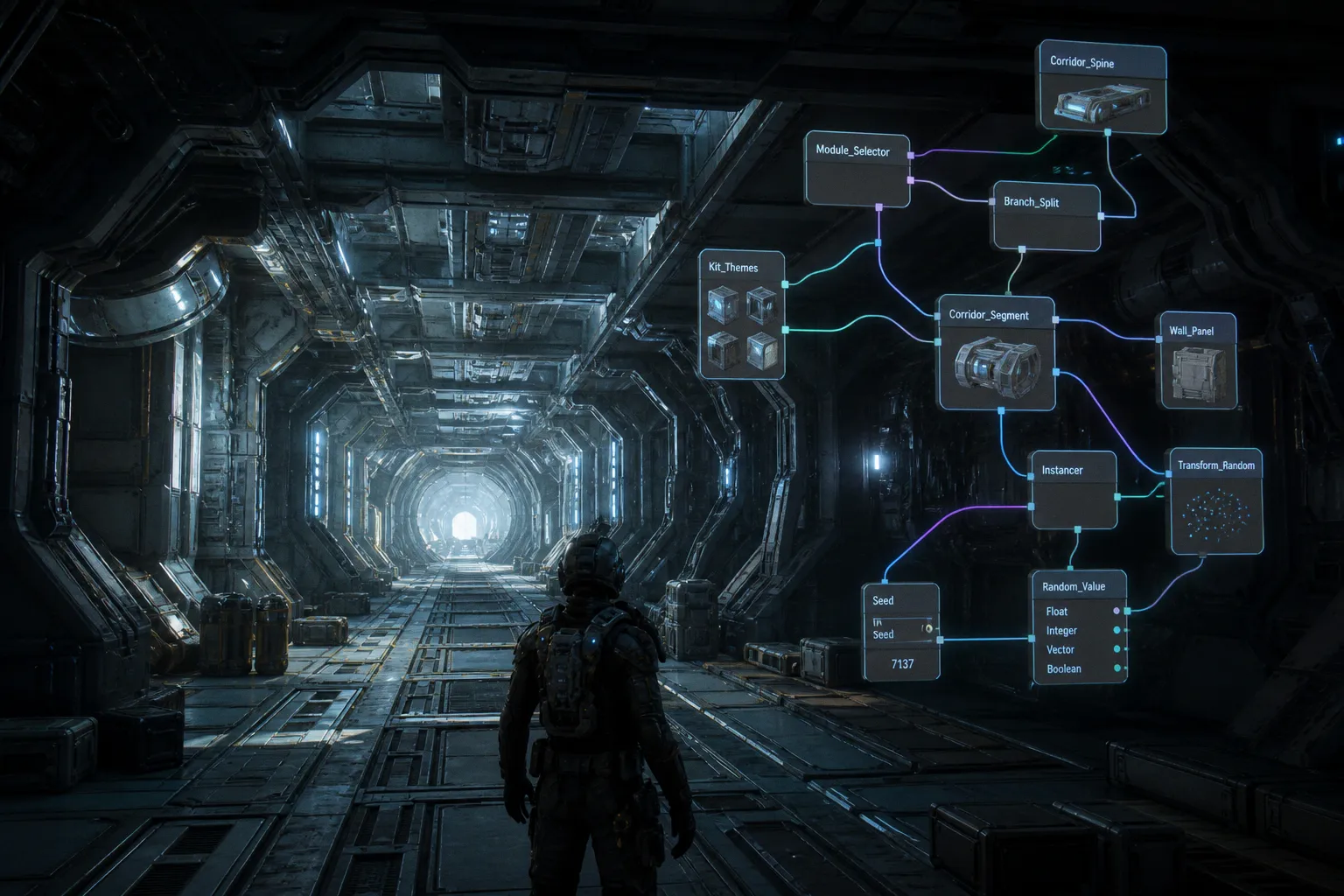
It is not. It is a production decision—and your choice changes what you can revise, how quickly you can offer variations, and whether the final image still has a readable silhouette when it is reduced to a thumbnail.
Compare car rental deals in United Kingdom
See available offersPartner link — DiscoverCars comparisonIn sci-fi concept art, kitbashing gives you immediate visual vocabulary: vents, antenna clusters, bulkheads, pressure doors, greeble panels, engines, landing gear. Procedural generation gives you a system that can keep producing a family of related designs when the brief changes upstream. Neither is automatically faster. Neither makes a weak design strong. But each fails in very different ways.
I have commissioned artists who built a compelling one-off hangar in a day from a tight asset library, then struggled for a week when the director asked for six versions with a different footprint, faction language, and degree of decay. I have also seen beautifully engineered Houdini graphs generate ten thousand technically varied buildings that all read as the same grey noise from twenty feet away.
The useful question is simpler: are you being hired to make one specific image, or to create a visual system that can survive revision?
Kitbashing gives you objects to think with. Procedural work gives you rules to revise with.
Asset-led assembly versus rule-based logic
The cleanest way I explain kitbashing vs procedural generation in sci-fi art is this: kitbashing begins with assets; procedural generation begins with relationships.
In a 3D kitbash workflow, you assemble a scene from prebuilt components. You may model a few hero pieces yourself, pull structural modules from your own archive, then combine them with licensed industrial forms, pipes, platforms, mechanical joints, or architectural shells. You work by eye. You rotate a tower, stretch a gantry, sink half a machine into the ground, and keep moving elements until the composition starts to pop.
That speed is real. More importantly, it is tactile. You can see an interesting shape, grab it, and immediately test whether it earns its place in the frame. For a cover illustration, a single splash image, or an early mood exploration, that responsiveness is often exactly what the job needs.
Procedural environment design is different. In Houdini, for example, the workflow lives in a connected node network. Each node describes an operation: scatter points, select a subset, place an object, vary a transform, assign an attribute, cull by slope, or swap an asset. Change an early selection or parameter and the result propagates through the network.
That can sound less artistic when described technically. In practice, it is very artistic when the brief asks for controlled families of images:
- a mining colony that needs to grow from 20 structures to 200 without losing its visual hierarchy;
- a fleet of ships that must feel manufactured by one civilization but not copied and pasted;
- a city block that needs versions for pristine, occupied, bombed-out, and reclaimed conditions;
- a retro-futurist settlement where wealth, elevation, traffic flow, and industrial access should visibly affect the architecture.
The procedural artist is not merely making buildings. They are deciding what makes a building belong to this world.
That distinction matters in your portfolio. A kitbashed scene demonstrates taste, composition, material judgement, and a useful command of digital asset creation. A procedural piece can demonstrate all of those things too, but it should also reveal the design logic: what varies, what remains fixed, and why.
| Production question | Kitbashing | Procedural generation |
|---|---|---|
| Best starting point | A curated set of useful objects | A repeatable rule set and a clear variation plan |
| Strongest advantage | Immediate visual density and fast composition | Fast regeneration after structural changes |
| Revision behaviour | Often requires hands-on rebuilding | Upstream edits can flow through the whole network |
| Common visual risk | A recognizable “asset pack” look | Repetitive, overly even, algorithmic results |
| Best use case | One hero frame or a small set of distinct concepts | Expanding environments, configurable architecture, variant-heavy briefs |
| What art direction must protect | Silhouette, focal hierarchy, and cultural specificity | Silhouette, focal hierarchy, and meaningful constraints |
The final row is not accidental. Both workflows need art direction. A procedural graph does not know where the eye should land. A kitbash library does not know which design language belongs to the antagonist faction and which belongs to the civilian infrastructure.
Why kitbashing still earns its place in serious concept work
There is a slightly lazy assumption that kitbashing is a shortcut and therefore somehow less legitimate than building every bolt from scratch. I would retire that idea immediately.
Concept art is communication under constraints. If a kitbashed cylinder, heat exchanger, or elevator assembly helps you establish scale and function in time for a review, it has done its job. You are not submitting an engineering drawing. You are making a visual argument: this station can process ore; this ship can enter atmosphere; this city has grown around a dangerous power source.
The issue is not whether you use premade assets. The issue is whether you transform them into design.
When I review sci-fi concept art techniques in a portfolio, I look for the decisions that move the work beyond assembly:
1. The large silhouette arrives before the detail. A massive, readable hull with three purposeful appendages will survive reduction better than a hundred randomly attached mechanical parts. If the form collapses at thumbnail size, more greebles will only make the failure busier.
2. Assets are assigned a job. A pipe cluster should suggest coolant circulation, fuel transfer, waste processing, or improvised repair—not simply “science fiction texture.” The viewer does not need a technical manual, but they do need to feel cause and effect.
3. The artist breaks the source asset’s default identity. This may mean changing scale, cropping aggressively, combining components at unexpected angles, repainting surfaces, or using the asset as a base for a new silhouette. You want the audience to remember your refinery, not recognize the same wall section from five other portfolios.
4. Materials support the story of use. Bare metal is rarely enough. Is the surface ceramic-coated because of heat? Is one wing sun-bleached? Are repair plates a different alloy because the colony cannot source original parts? These are small choices, but they turn clean geometry into worldbuilding.
5. The final paintover asserts authorship. This is where many otherwise competent kitbash pieces stall. The render remains a render: uniform edges, generic grime, equally sharp detail everywhere. A good paintover restores atmosphere, selective loss, scale cues, lighting design, and editorial control.
For a freelance artist, kitbashing can also be the most sensible first investment. Build your own modular library as you work: connectors, panel seams, engine bells, access hatches, cable looms, support struts, signage frames, roof machinery. Over time, that library becomes much more valuable than a folder full of unrelated downloads because it has already been tested against your taste and your rendering process.
But do not confuse a large library with a useful one. Twenty assets you know intimately will outperform five hundred you have never integrated into a cohesive visual language.
A kitbash library is not a warehouse. It is a vocabulary, and your portfolio should show that you know how to write with it.
Where procedural workflows change the conversation
Procedural work becomes genuinely powerful when revision is not a surprise but a certainty.
In a node-based workflow, you can create a system for placing and varying assets rather than manually positioning every component. Houdini is especially strong here because changes made upstream—different geometry, a revised selection, swapped assets, altered parameters—can update downstream results. Portions of the network can be reused or reconfigured instead of discarded and rebuilt.
That is not a promise that every concept job requires Houdini. Blender’s Geometry Nodes can already take an artist a long way, particularly for controlled scattering, instancing, and variation. Blender’s Random Value node can output float, integer, vector, or Boolean values. Its seed and ID controls are not glamorous, but they are the bones of dependable variation. If you want a settlement to regenerate without every tower jumping unpredictably, stable IDs matter.
Blender’s Distribute Points on Faces node provides built-in stable IDs for generated points. In practical terms, that means the surviving points can retain consistent identity when you deform the source mesh or alter point density. Your randomization can remain anchored instead of turning every update into visual chaos.
That is the difference between a procedural setup you can art direct and one you only hope will behave.
Build rules around design intent, not around random noise
A weak procedural graph says: “put objects everywhere, then randomize them.”
A stronger graph says: “this world builds upward near transit spines, keeps heavy utilities downwind, reserves clean facades for civic buildings, and clusters informal repairs around older service routes.”
You do not need to simulate an entire society to make this work. You need a few constraints that create visible consequences. Start with the questions a production designer would ask:
- Where does this settlement get power, water, heat, oxygen, or raw material?
- What is expensive to build, and what is cheap to improvise?
- Which spaces are public, restricted, ceremonial, dangerous, or neglected?
- What forms repeat because of manufacturing, and what forms diverge because of climate or local repair?
- At what distance will the viewer encounter this environment: satellite view, street level, cockpit approach, or editorial spot illustration?
Once you have those answers, your rules become useful rather than decorative. Taller structures near a core are not simply a height gradient. They suggest a zoning logic. More patched materials near an industrial edge are not random color variance. They suggest access to resources and maintenance history.
This is where procedural generation serves concept art rather than merely demonstrating software competence.
The hybrid workflow is usually the grown-up answer
For most professional briefs, I would not frame this as a binary choice. The strongest production setup is frequently a hybrid: a curated kitbash library feeding a procedural placement and variation system.
Houdini supports exactly this kind of approach. A procedural node network can select, transform, distribute, and swap assets. Its instancing tools can place an object on many points while varying transforms or material parameters per instance. You might create fifteen hand-authored building modules, then let a graph distribute them according to zone, height, terrain, proximity to transit, and faction ownership.
The assets preserve authorship. The system preserves flexibility.
Here is a practical route I would suggest to an artist building a portfolio piece around this idea:
1. Design a small kit with a shared grammar. Make eight to fifteen modules, not eighty. Give them common proportions, connection points, material families, and silhouette language. A dieselpunk rail depot might use riveted shells, exposed service corridors, and oversized ventilation. A lunar biotech facility may rely on pressure-safe rounded volumes and clustered sun shields.
2. Choose only a few meaningful variables. Rotation, scale, height, roof type, material wear, window illumination, and local clutter are enough to begin. Too many controls create a graph that is difficult to direct and a final image that feels indecisive.
3. Separate hero zones from background systems. Let procedural tools handle the midground mass and repeating infrastructure. Hand-place the landing pad, central reactor, command tower, crashed ship, market gate, or whatever carries the storytelling burden.
4. Lock your camera early. A procedural city can look impressive from orbit and unreadable from the approved angle. Establish the composition, value structure, and focal area before you spend days enriching geometry outside the frame.
5. Break the output manually. Pull a few structures out of alignment. Remove a module where the system would logically place one. Paint a local event into the scene: a repair scaffold, a collapsed roof, a memorial banner, a fresh blast mark. Perfect procedural regularity is usually the first thing that makes a sci-fi environment feel synthetic.
6. Save the graph as part of the deliverable logic. If the brief is likely to expand, label parameters in plain language. “Industrial density,” “roof antenna frequency,” and “civilian light activity” are kinder to a future collaborator than a stack of unnamed sliders.
This is also the part of your portfolio where process images help. Not ten screenshots of nodes for their own sake. Show one clean overview, a few controlled variations, and the final keyframe. A client wants evidence that the system is serving the image—not replacing it.
Instancing is efficient, but it does not create infinite uniqueness
There is a technical catch that artists discover late, usually after filling a scene with thousands of props: instancing is efficient because the renderer can retain one copy of an object’s geometry and output it many times. But those instances share the same underlying surface geometry.
You can vary position, rotation, scale, and often material parameters. You can make a hundred antenna towers lean at different angles, tint their panels, alter roughness, or turn different lights on and off. What you cannot do in that renderer-side instancing model is give each tower fundamentally unique surface geometry without supplying separate variations or moving the variation to the object level.
This is not a reason to avoid instancing. It is a reason to design around it.
If your environment needs more richness, prepare a small family of geometry variants: intact, patched, heavily repaired, stripped, expanded, roofless. Then distribute those variants intentionally. The difference between five considered versions and one object copied five thousand times is enormous, even before paintover.
Performance has the same practical lesson. A kit that works beautifully in a still render may need optimization in a real-time engine, especially at city scale. Some Unreal-ready commercial kits may be compatible with technologies such as Nanite and Lumen, but compatibility is not a performance guarantee. Scene size, materials, lighting, target hardware, camera distance, and the specific assets all decide whether the result holds together.
For concept art, do not let real-time technical anxiety derail a still-image brief. But if you present a workflow as suitable for game production, test it in the target environment. “It loaded on my workstation” is not a production pipeline.
Concept art speed is really revision speed
Artists often ask which approach is faster. I understand the question, but I think it points in the wrong direction.
Kitbashing is often fast at the moment of discovery. You can find a silhouette by combining parts, build a plausible space quickly, and move into lighting without having to solve a procedural architecture problem first. For a tightly framed sci-fi book cover, that can be the fastest path by a long margin.
Procedural generation may feel slower at the beginning because you are paying for the system before you see the final image. But it can be quicker when changes arrive. If the art director says the city needs wider roads, more vertical separation, fewer buildings near the floodplain, or a different class of industrial machinery, a well-built graph can absorb that direction without forcing a total rebuild.
So, when choosing a workflow, ask what kind of speed your brief demands:
| If the brief says… | Lean toward… | Why |
|---|---|---|
| “One atmospheric keyframe, final composition already approved” | Kitbashing with a strong paintover | You need visual decisions immediately |
| “Give us five settlement variants with the same cultural language” | Hybrid procedural setup | Shared rules keep the variants related |
| “The level design is still changing weekly” | Procedural systems and modular assets | Revision needs to travel through the scene |
| “This ship must feel singular and iconic” | Mostly manual design, selective kitbashing | Hero silhouette needs direct authorship |
| “We need a dense midground city behind the character” | Instancing plus curated assets | Density matters, but the city is not the primary subject |
| “We may expand this world across multiple illustrations” | A reusable kit and documented rules | You are building continuity, not one image |
Your portfolio should make this decision legible. If you show only final renders, I cannot always tell whether you can respond to a changing brief. Include enough process to reveal your working intelligence: the original modules, a variation pass, a before-and-after paintover, or a set of outputs from one rule system.
That is not about proving that you suffered for the image. It is about proving that you can be trusted with production.
Licensing is part of the workflow, not a footnote
There is one unglamorous subject that belongs in every conversation about commercial kitbashing: rights.
Using an asset library does not automatically make your final work safe to publish, sell, or reuse in any context. Licenses vary by vendor, purchase type, subscription status, organization size, intended use, and whether the work was made while your subscription was active. For example, some subscription models license use during the active term rather than transferring ownership of the assets; work created during that active period may remain licensed, while new work made after expiration may not be covered under the same terms.
Read the license attached to the exact asset source you are using. Do not rely on what a friend remembers, what another marketplace allows, or what “everybody does.”
Copyright has a parallel complication. A derivative work can incorporate preexisting material while adding original authorship, but the copyright in that derivative work covers the new additions—not the preexisting content itself. Combining, repainting, or modifying a third-party asset may be creatively substantial, but it does not erase the rights attached to the underlying asset.
For portfolio work, I advise artists to keep a simple project record:
- asset source and license type;
- date of purchase or active subscription period;
- whether the final work is personal, editorial, commercial, or client-owned;
- major modifications you made;
- files or screenshots showing the asset’s role in the larger original composition.
You may never need that record. But professional calm is built from being able to answer a producer’s question without digging through old emails at midnight.
Choose the workflow that protects the image
If you are beginning, do not postpone making strong sci-fi art until you have mastered every procedural tool. Start with a tight kitbash set, learn to make silhouette and value do the heavy lifting, and develop the discipline to paint over what the software gives you. That alone can produce work worth showing.
Then add procedural thinking—not necessarily a giant technical setup, but the habit of asking what can be parameterized, reused, and revised. A stable scatter system. A modular roof language. A controlled way to vary faction colors. A repeatable street generator that leaves room for hand-authored landmarks. Those are practical upgrades, not a separate identity.
For a single unforgettable image, I will usually back the artist who can make decisive visual choices with whatever tools are available. For an evolving world, a large environment, or a client who needs options after options, I want the artist who has built a system without surrendering their eye to it.
That is the real dividing line. Kitbashing gives you speed at the level of the object. Procedural generation gives you leverage at the level of the world. The best sci-fi concepts know when to use both—and make sure the viewer remembers the idea, not the workflow.