Michael Kaluta art: a collector's roadmap to rare works
A Michael William Kaluta art collection is not built by chasing every image with a cape, a Deco arch, or a Conan credit. That method produces a pile of adjacent material and misses the actual structure of the market.
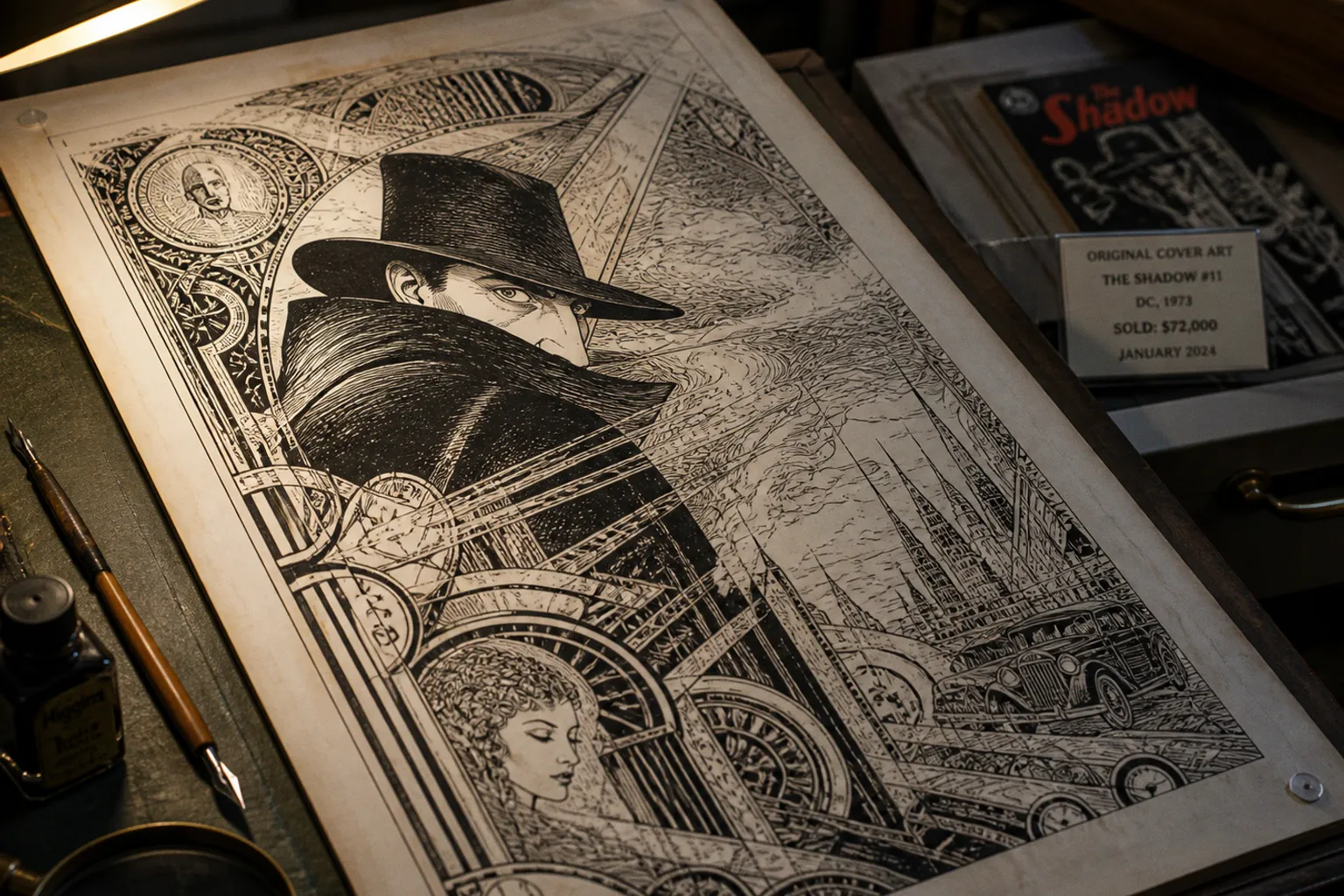
Kaluta’s collecting field divides sharply by object type: original cover art, finished fantasy paintings, signed portfolio plates, book illustration, and gaming-era monochrome work. Each has a different scarcity profile. Each carries different condition risks. Each must be priced against the correct comparables.
The gap is severe. A major original can reach five figures with little resistance. A portfolio plate may remain obtainable for a fraction of that sum, yet still provide a far cleaner view of Kaluta’s draughtsmanship than a compromised comic page. The collector’s task is not merely to locate a Kaluta image. It is to identify the physical object behind the image: its production method, edition status, paper, provenance, restoration history, and place within the artist’s working chronology.
The market begins with original cover art
Kaluta’s original cover art sits at the hard end of the market. The reason is mechanical rather than sentimental. Covers are singular objects. They were made to survive reduction, lettering, reproduction photography, editorial handling, and often considerable time in publisher files. They also carry the strongest link between image and publication. That link is what collectors pay for.
The Shadow material is the reference point. Kaluta’s cover art for The Shadow #11 from 1973 sold for $72,000 in January 2024. The Shadow: Master of Men, a 1975 painting, sold for $63,000 in September 2024. These are not interchangeable results. A collector should resist treating them as a flat price list for “Shadow art.”
A cover’s value is assembled from several layers:
- Image recognition. A central figure in an unmistakable Kaluta composition commands more attention than a secondary interior image, however accomplished the draftsmanship.
- Publication identity. Early DC Shadow work has a specific collecting constituency: comic-art buyers, pulp revivalists, and Kaluta specialists converge there.
- Format and finish. A complete painted cover usually operates at a different level from a black-and-white interior page or a preliminary layout. Mixed-media surfaces also matter. Gouache passages, opaque watercolor, ink, graphite construction, and pasted-up elements can create condition liabilities.
- Visual integrity. Staining, tape shadows, abrasion across dark passages, faded dyes, and detached overlays reduce collector confidence. A spectacular image with altered surface character is not equivalent to an untouched sheet.
- Provenance. Direct artist provenance, publisher documentation, or an unbroken history through established comic-art collections removes friction at resale.
Kaluta’s Conan work confirms that the market does not rely on one property alone. His 1977 painting In The Twinkling Of An Eye sold for $69,000 in June 2025. The cover art for The Savage Sword of Conan #91 from 1983 sold for $37,500 in September 2025. The price difference is instructive. It does not establish a rigid hierarchy between “painting” and “cover.” It establishes that title, image strength, size, finish, and rarity operate together.
A published Kaluta original is not valued as an illustration alone. It is valued as a surviving production object with a known cultural address.
For collectors entering the original-art market, the first rule is simple: do not compare a preliminary to a cover merely because both depict the same character. A pencil concept, a reproduction proof, and a finished board may share a composition while belonging to three entirely different price brackets.
Reading the physical surface
Kaluta’s line often appears delicate in reproduction. On the original, it is usually more engineered than delicate. The contour may be narrow, but it is positioned with strict pressure control. Negative space is not left over. It is held.
When inspecting a work in person, look for the following rather than merely verifying the signature:
1. The support. Identify whether the piece is on illustration board, paper mounted to board, or a composite surface. Board corners are vulnerable. So are pasted marginal elements and areas where adhesive has embrittled.
2. The black structure. Kaluta’s blacks can be deep ink masses, layered wash, or dense opaque passages. If a black area has gone grey or fractured, determine whether this is a photographic artifact, abrasion, or prior restoration.
3. Opaque additions. White bodycolor, gouache, and correction fluid can sit proud of the surface. Small losses are common. Broad cracking across those highlights is not cosmetic.
4. Editorial residue. Pencil notes, crop marks, acetate overlays, printer instructions, and lettering guides can either support provenance or create handling damage. They should not be erased casually.
5. Frame concealment. Never assume a framed work is clean beneath the mat. Foxing, light lines, and adhesive staining often appear exactly where the object was hidden.
A collector who cannot inspect the sheet should demand recto and verso images, close views of corners, raking-light photographs where possible, dimensions of the image and support, and a precise account of any conservation. “Excellent condition” is not a condition report.
The Studio era is a provenance field, not a brand label
From 1976 to 1980, Kaluta shared a New York workspace with Jeffrey Jones, Bernie Wrightson, and Barry Windsor-Smith. The group became known as The Studio, and its activity culminated in the large-format The Studio book published by Dragon’s Dream in 1979.
This period is routinely flattened into a romantic label. That is unhelpful. The Studio did not make the four artists stylistically identical, and its name should not be treated as a premium stamp applied indiscriminately to any work dated from those years.
What the period does provide is context. Kaluta’s compositions of the late 1970s often show an intensified sensitivity to ornamental rhythm, architectural framing, and controlled figure placement. The line becomes less like descriptive scaffolding and more like an active material. It locks shapes together. It creates tonal density without requiring a heavy oil-like impasto or broad painted modeling.
That distinction matters to buyers. An authentic work from the 1976–1980 Studio period may be highly desirable, but its value still depends on the individual image. A minor unpublished sketch from the shared-workspace years is not automatically stronger than a later, fully resolved book illustration. Conversely, a finished work with direct publication in The Studio orbit carries a coherent historical position that many isolated commissions lack.
The collector should separate three questions:
| Question | What it establishes | What it does not establish |
|---|---|---|
| Was the work made between 1976 and 1980? | Chronological proximity to The Studio | Membership in a specific publication or project |
| Is it documented in The Studio book or related material? | A concrete publication trail | Superior condition or automatic market value |
| Does it resemble the Studio-era visual language? | A useful stylistic observation | Authenticity or exact date |
| Did it come from a credible original owner or estate chain? | A stronger provenance basis | That the work is a major finished image |
Do not let a seller substitute atmosphere for documentation. “Studio-era” is a useful descriptor only when the date, medium, and history can bear it.
Portfolios are the rational entry point
For most collectors, the serious entry to Michael William Kaluta art collection is not original cover art. It is the portfolio. A portfolio gives access to coherent sequences of imagery, often produced under the artist’s supervision, without the price escalation attached to unique boards.
The essential issue is edition hierarchy. A portfolio is not one thing. It may include a standard unsigned edition, a signed and numbered edition, variant plates, and later separated sheets circulating without their original folders. These are not equivalent objects.
Children of the Twilight
Published by S.Q. Productions in 1979, Children of the Twilight was released as a signed and numbered edition of 1,000 copies. The portfolio contains four full-color offset lithograph plates. The signed and numbered issue also includes a fifth black-and-white plate.
That fifth plate is not a trivial bonus. It identifies the more complete signed configuration. If a seller offers four color sheets without the folder, without a number, and without the monochrome plate, the item may still be attractive. It is simply not the same collecting unit.
Offset lithography must also be described accurately. These are printed plates, not original paintings and not hand-pulled fine-art lithographs. Their appeal lies in the period imagery, the controlled reproduction, the edition context, and the survival of complete sets. The paper surface should show a stable printed ink layer rather than the variable deposit and plate mark one expects from a traditional lithographic impression.
Examine color plates for:
- edge yellowing from poor storage;
- offsetting, where a printed surface has transferred to the facing sheet;
- pressure dents from stacking;
- color shift caused by light exposure;
- trimmed margins, particularly when individual plates were framed;
- missing title pages, folders, or edition identifiers.
A complete, clean portfolio remains more desirable than a group of attractive but disassociated sheets. The folder is not packaging. It is part of the object’s bibliographic identity.
Starstruck
The signed and numbered Starstruck portfolio followed in 1980, also from S.Q. Productions. Its edition was limited to 2,000 copies and contains six 11 by 14 inch character-portrait prints, released during the initial run of the Starstruck stage play.
This is a larger edition than Children of the Twilight, but edition size alone does not solve the comparison. Starstruck is a compact portrait suite. Its appeal lies in serial design: repeated format, costume differentiation, line hierarchy, and character separation. The six sheets need to be judged as a set. One missing plate makes the portfolio incomplete even if the remaining five are clean.
The practical hierarchy is clear:
| Object | Edition structure | Collector advantage | Common trap |
|---|---|---|---|
| Children of the Twilight signed/numbered | 1,000 copies; four color plates plus one black-and-white plate | Smaller numbered edition and fuller plate count | Buying a four-plate group as if it were the signed complete issue |
| Starstruck signed/numbered | 2,000 copies; six 11x14-inch character prints | Coherent complete suite tied to a specific production moment | Accepting missing or separately framed plates without discounting for incompleteness |
| Single portfolio plate | Detached from original issue | Lower-cost acquisition and framing flexibility | Confusing it with a complete portfolio |
| Modern reproduction | Varies | Decorative only | Misrepresentation as period signed material |
Completeness is not a sentimental preference. In portfolio collecting, it is the object’s structure.
Prints, books, and gaming work occupy different lanes
Kaluta’s rarities do not stop at comic originals and portfolios. They extend into small print editions, illustrated books, and role-playing-game material. The mistake is to group all of this under “prints” and compare only image size.
The Ayisha photo-print, drawn from Kaluta’s work for Robert E. Howard’s The Swords of Shahrazar in the FAX Collector’s edition of 1976, was issued as a signed and numbered edition of only 100 copies. That is a materially tighter limitation than either major portfolio. It does not automatically mean it is more expensive or more liquid. It means that genuine examples are structurally scarce, and documentation becomes more important.
A signed number should be inspected, not assumed. Look for consistency between the signature medium and the printed surface. A signature sitting too evenly on a glossy photographic surface can be perfectly legitimate, but it should be examined under magnification for ink skipping, pressure, and natural variation. An edition number that appears mechanically reproduced is not an edition number at all.
The 1988 illustrated edition of Thea von Harbou’s Metropolis, released by Donning Company Publishers, is another category entirely. Kaluta’s Art Deco-meets-steampunk visual language is central to the book’s appeal, but a book is not a portfolio and not a loose-print suite. Collectors should seek a structurally sound copy: square binding, no detached gatherings, no mold odor, no moisture cockling, and no amateur tape repair. The 1998 trade paperback reissue may offer the images, but it does not occupy the same bibliographic position as the 1988 edition.
Then there is the 1994 Michael Wm. Kaluta Mage Portfolio: Images of Ascension, published by White Wolf Game Studio. It contains ten full-page black-and-white portraits of mage characters, each printed on individual card sheets and housed in a folded envelope with an artist biography. This is ephemera with a specific failure mode: separation.
The cards are easily removed, handled, traded, framed, and lost. The envelope is easily crushed. The biography sheet disappears. A complete set should contain all ten portrait sheets and its original enclosure. Buyers should not conflate this portfolio with later Mage products, and should not assume that every Mage: The Ascension collectible includes Kaluta imagery.
For collectors of classic fantasy illustrators, this division of categories is productive. It permits a collection built around visual method rather than only market prestige: a Studio-era portfolio, a Metropolis first edition, a complete Mage set, and one carefully selected signed print can map Kaluta’s range more honestly than several unrelated low-grade comic pages.
Where to buy Michael Kaluta prints without buying problems
The purchase channel determines the type of due diligence required. Auction houses supply public comparables and usually better transaction records, but their premiums and competition are substantial. Specialist comic-art dealers can provide established provenance, though inventory may be narrow. Book dealers are stronger for Metropolis and portfolio material. Private sellers can produce genuine finds, but they also produce incomplete sets described with confidence.
The working procedure should be methodical:
1. Identify the exact issue before discussing value. Ask whether the item is a complete portfolio, a signed print, a loose plate, an original illustration, or a later reproduction. These labels are not interchangeable.
2. Count every component. For Children of the Twilight, that means distinguishing the four color plates from the signed issue with its additional black-and-white plate. For Starstruck, count all six portraits.
3. Request condition images before payment. Front, back, corners, signatures, edition numbers, folders, and any defects. A general gallery image is insufficient.
4. Separate published association from artistic attribution. “Used in a Kaluta-related publication” can mean an original drawing, a printed image, or an unrelated later reproduction. Demand precision.
5. Record the transaction. Keep invoice, seller correspondence, photographs, edition details, dimensions, and condition notes. This is not bureaucracy. It is future provenance.
6. Frame only after documentation. If a loose plate is to be displayed, photograph it fully first. Use acid-free mounting methods and ultraviolet-filtering glazing. Adhesive dry-mounting converts a collectible print into a damaged decorative object.
Collectors often overpay because they are buying an image from a screen. The screen suppresses paper tone, gloss differences, trimming, signature placement, and foxing. It also suppresses scale. An 11 by 14 inch Starstruck sheet has a very different physical presence from a large original cover board. Neither is inherently superior. They are simply different objects requiring different expectations.
Auction records are signals, not guarantees
The public sales of 2024 and 2025 establish that top-tier Kaluta originals have serious market depth. They do not establish that every Kaluta original is a five-figure asset, nor that every signed print will rise with major cover-art results.
Original art is illiquid. Portfolio material is condition-sensitive. Small edition prints can be scarce but thinly traded. Auction headlines favor exceptional lots and obscure the broad middle of the market, where incomplete portfolios, faded prints, unattributed preliminaries, and compromised book copies actually change hands.
There is no reliable current fixed value for a complete unsigned Children of the Twilight portfolio. Secondary-market prices move with condition, completeness, and the presence or absence of its original material. There is also no established basis for predicting new Kaluta portfolio releases. Collect from the documented field, not from imagined future scarcity.
The strongest collection is not necessarily the most expensive one. It is the one in which every object has a legible identity. A Shadow original with reliable provenance. A complete numbered Children of the Twilight. A six-print Starstruck suite with its folder. A clean 1988 Metropolis. Ten intact Mage portrait cards in their envelope.
That is the proper roadmap. Acquire fewer pieces. Inspect them harder. Preserve the evidence.