Mozarthaus Vienna Tickets: Booking Traps and Extra Fees
The main booking error at Mozarthaus Vienna is not choosing the wrong day. It is purchasing the wrong product.
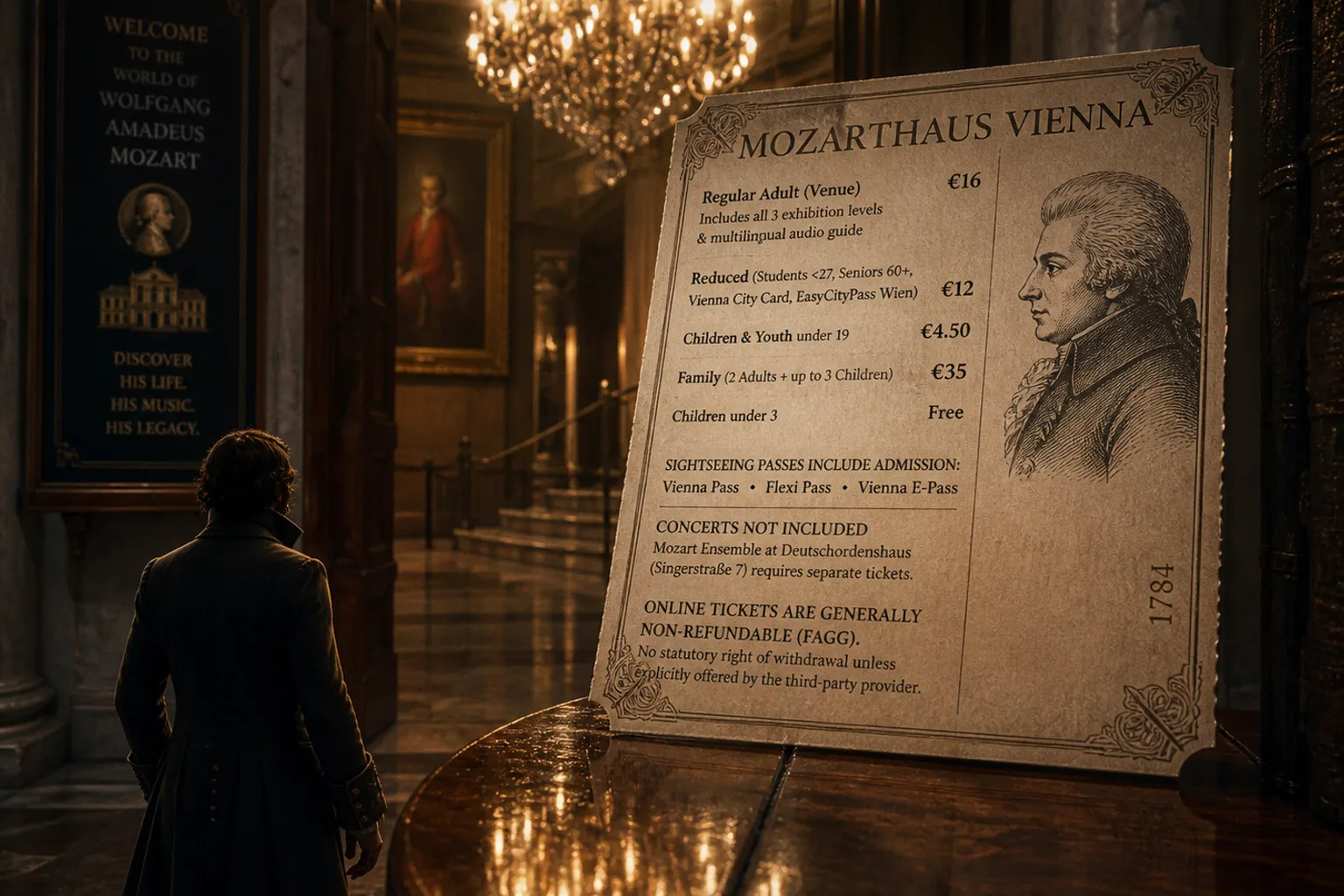
The museum at Domgasse 5 preserves Mozart’s only surviving original Vienna apartment, the rooms in which he lived from 1784 to 1787. It also contains three exhibition floors and an included multilingual audio guide. Nearby, however, concert organizers sell evening performances using Mozart’s name. Those events may appear in the same search results, on the same booking pages, and sometimes in the same travel itineraries. They are not the same admission.
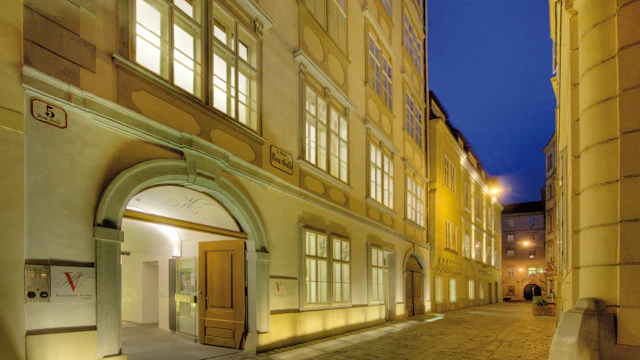
Mozarthaus Vienna
- Guided tour — Themedguided tourfrom€21
- Concert — Summerotherfrom€33
Prices checked on August 20, 2026 · current price on the partner page.
Official website — mozarthausvienna.at
- Time to spend: 2–3 h
- Best time to visit: morning
Prices are indicative and may change — confirm the price and availability on the partner page.
Partner link — GetYourGuide ticketsThe distinction is structural. A museum ticket grants access to the apartment and exhibitions. A concert ticket covers a separate performance, usually held at a nearby venue such as the Deutschordenshaus on Singerstraße. Booking one does not automatically secure the other.
The first decision: museum admission or concert attendance?
Search results for Mozart-related activities in Vienna frequently combine several products:
- entry to Mozarthaus Vienna;
- guided or themed museum tours;
- evening classical concerts;
- combined sightseeing products;
- city passes that include museum admission;
- third-party packages with additional booking services.
The subject matter overlaps. The logistics do not.
Mozarthaus Vienna is a museum visit at Domgasse 5. The concert venues used by Mozart Ensemble-style performances may be elsewhere in the historic center, including Singerstraße 7. A listing that uses “Mozart,” “Vienna,” and “Mozarthaus” in its title is not sufficient evidence that it includes museum access.
The product description must be read as an inventory of deliverables. Look for the actual venue, the duration, the admission object, and the time of access. If the booking refers to a seated evening performance, an ensemble, a concert hall, or a start time after the museum’s closing period, it is almost certainly a concert product rather than a museum entry ticket.
The name “Mozart” is not the admission category. The venue and the service are.
This is where the first layer of the booking process fails. Travelers assume that a Mozart concert near the museum is an extension of the museum visit. In ticketing terms, it is a separate transaction governed by separate conditions. A museum admission can be used during the museum’s operating hours. A concert ticket is tied to a performance date and often to a specific time slot.
The safest sequence is simple:
1. Identify whether the primary objective is the apartment museum, the concert, or both.
2. Confirm the physical address printed in the booking details.
3. Check whether the ticket includes museum entry, concert entry, or only a guided service.
4. Treat separate venues as separate admissions unless the product explicitly combines them.
5. Keep the museum visit and the evening performance as independent calendar items.
A combined tour may exist, but it should be evaluated as a package, not inferred from proximity or branding.
Official booking versus third-party checkout
The official venue channel is the cleanest reference point for admission categories, opening hours, accessibility information, and what the standard museum ticket includes. Third-party platforms can be useful when they offer a guided format, a themed tour, or a broader itinerary. They can also add another layer between the visitor and the venue.
That layer has consequences.
A third-party checkout may display:
- a service or booking fee;
- a different cancellation policy;
- a modified meeting-point instruction;
- a voucher that must be exchanged for entry;
- a tour component that is not part of ordinary museum admission;
- a price structure that bundles several services into one product.
The museum’s own admission system and a reseller’s package should not be compared by headline price alone. The correct comparison is between the final service delivered and the conditions attached to it.
For museum admission, the standard ticket includes access to all three exhibition levels and a multilingual audio guide. A reseller may sell the same basic entry while adding a processing charge. Another may sell a guided experience with a higher total because the guide, meeting arrangement, and reservation handling are included. These are not identical products with arbitrary price differences. They are different layers of service.
The practical comparison looks like this:
| Booking route | What it usually provides | Main point to inspect |
|---|---|---|
| Official museum channel | Direct museum admission and the venue’s own ticket conditions | Whether the selected ticket covers the intended visitor category |
| Third-party museum ticket | Entry arranged through an external platform | Service fees, voucher instructions, and cancellation terms |
| Guided museum tour | Entry combined with an explanatory or themed tour | Meeting point, language, duration, and whether admission is included |
| Sightseeing pass | Museum access under the pass’s participating-attraction rules | Reservation requirements and pass validity |
| Evening concert booking | Admission to a separate classical performance | Venue, performance time, ticket conditions, and refund policy |
The key phrase is whether admission is included. Guided-tour pages are particularly prone to ambiguity because some products are tours inside the museum, while others are city walks or Mozart-themed excursions that stop outside the building. A tour mentioning Mozarthaus is not necessarily a ticket to Mozarthaus.
Why third-party fees are easy to miss
The initial display may not represent the final payable amount. A platform can place taxes, service charges, or booking fees later in the checkout process. The exact markup varies by seller and product, so no universal percentage should be assumed. The only reliable comparison is the final total immediately before payment.
This is also where ticket terminology becomes unreliable. “Skip-the-line,” “priority access,” “reserved entry,” and “instant confirmation” may describe different operational advantages. They do not automatically mean that the museum itself has a separate fast lane or that a visitor can bypass every queue. Read the operational instruction, not the promotional label.
If the booking generates a voucher, determine whether the voucher is the admission document or merely a reservation confirmation. Some products require the visitor to present a mobile voucher at the entrance. Others may require a meeting with a guide before entering. Those are materially different arrival procedures.
What the museum ticket actually covers
Mozarthaus Vienna is not a single-room memorial display. The address contains Mozart’s original apartment along with three exhibition floors devoted to his Vienna years, his professional environment, and the musical culture around him.
The apartment is the physical anchor. The exhibition levels provide the interpretive framework. A visitor who treats the ticket as access to one preserved room will misjudge the time required and may select an unnecessarily compressed itinerary.
The period of Mozart’s residence at Domgasse 5 was 1784–1787. That historical fact matters because the apartment is presented not merely as a generic Mozart site but as a specific Vienna residence associated with a defined phase of his career.
The standard museum admission includes an audio guide available in multiple languages. Adult visitors can select from a broad language range, while a children’s version is also available in several languages. The guide is not an optional premium add-on attached to the basic ticket. It is part of the normal museum admission.
That changes the calculation for travelers who are deciding between a basic ticket and a guided product. A paid guided tour may still be preferable for visitors who want a live specialist, a fixed narrative, or a themed interpretation. But buying a guided tour solely because the basic admission might not contain explanatory material would be a false assumption.
The ticket categories are generally divided by visitor status:
- standard adult admission;
- reduced admission for eligible students, older visitors, and holders of selected Vienna discount cards;
- child and youth admission for visitors under 19;
- family admission for two adults traveling with up to three children;
- a separate reduced category for people with disabilities;
- free entry for children under 3;
- admission through participating sightseeing passes.
Eligibility is not a decorative detail. Reduced tickets depend on documentation or possession of the relevant card. A visitor who selects a discounted category without being able to demonstrate eligibility may face a correction at the entrance. The booking screen is not a substitute for the required identification.
The family ticket is also a distinct product rather than a simple mathematical combination of individual admissions. Families should compare the available category against the actual group composition, including the number of adults and children covered by the defined conditions.
Sightseeing passes: useful, but not automatically frictionless
The Vienna Pass, Flexi Pass, and Vienna E-Pass include admission to Mozarthaus Vienna under their attraction networks. This can eliminate the need to buy a separate museum entry ticket. It does not mean that every passholder can ignore the operating rules.
A pass is an access instrument, not a universal reservation bypass.
Before arrival, passholders should establish:
- whether Mozarthaus Vienna requires a separate time reservation;
- whether the pass must be activated before use;
- whether entry is counted as one attraction visit;
- whether the pass covers only the museum and not an evening concert;
- whether the pass is valid on the chosen date;
- whether a physical card, mobile pass, or additional voucher is required.
The distinction between included admission and included reservation is the important one. A sightseeing pass may cover the entrance fee while still requiring the visitor to follow the museum’s admission procedure. The conditions can change by pass type and by the venue’s current operating arrangements.
The same principle applies to city discount cards. A Vienna City Card or EasyCityPass Wien may provide access to a reduced ticket category, but the discount is not identical to free admission through a sightseeing pass. The visitor must select the correct product and present the relevant card.
This is a common source of checkout mistakes. A traveler sees that a pass is accepted and assumes that no ticket action is required. Another sees a reduced price and assumes the card has already been applied. In both cases, the booking interface still needs to be read carefully.
The concert trap: separate venue, separate terms
The most expensive booking error is usually not a small service fee. It is paying for a concert while believing that the purchase includes the museum.
Classical performances associated with Mozart are commonly advertised in central Vienna venues near Domgasse. One recurring location is the Deutschordenshaus at Singerstraße 7, where Mozart Ensemble performances are held. The venue is close enough to create confusion and separate enough to require its own ticket.
Concert categories can begin in the lower range and rise substantially depending on the seating or package selected. The museum admission is not bundled into those concert categories by default. A concert ticket should therefore be treated as an evening event, not as an upgraded museum ticket.
The wording used by booking platforms deserves forensic attention:
- “Mozart concert in Vienna” refers to a performance unless museum entry is expressly stated.
- “Mozarthaus experience” may refer to a museum visit, a tour, or a combined product.
- “Concert at Mozarthaus” may use the museum’s name as a historical or commercial reference even when the performance is held at a nearby venue.
- “Museum and concert” should identify both admissions and both locations.
- “Guided tour with concert” should specify whether the tour enters the museum and where the concert takes place.
There is also a legal and practical difference between museum admission and dated event tickets. Under Austrian distance-selling rules, dated concert and event tickets generally do not carry the ordinary statutory withdrawal right that applies to many other online purchases. Refundability may be offered by a third-party seller, but it should never be presumed.
For a museum visit, the operational risk is usually an incorrect ticket type or arrival instruction. For a concert, the risk includes a fixed date, fixed performance time, seat category, and restricted cancellation terms. The second product demands more commitment before payment.
Museum entry is a daytime access ticket. A concert is a dated event contract. Treating them as interchangeable is the original booking error.
Opening hours and arrival at Domgasse 5
Mozarthaus Vienna is open daily from 10:00 a.m. to 7:00 p.m., with last admission at 6:30 p.m. The closing time is not the real planning boundary. The final entry time is.
A visitor arriving at 6:25 p.m. has technically reached the museum during its opening window but has almost no useful margin for the apartment and three exhibition floors. The ticket may be valid; the itinerary is still defective.
The better approach is to position the museum visit earlier in the day and use the evening for a separate concert only if that event has been booked independently. This keeps the two admission systems from contaminating one another.
Domgasse is in Vienna’s central historic district, close to major landmarks and pedestrian routes. That central location reduces the transport problem but increases the navigation problem: the surrounding area contains multiple cultural venues, concert rooms, restaurants, and historic addresses. Visitors should follow the exact museum address rather than relying on a generic “Mozart concert” map pin.
Arrival planning should account for four separate tasks:
1. Reaching the correct building at Domgasse 5.
2. Presenting the correct ticket, pass, or voucher.
3. Establishing whether a reduced category requires proof.
4. Leaving sufficient time for all three exhibition levels rather than arriving near final admission.
Visitors holding third-party vouchers should also inspect the instructions before leaving their accommodation. If the voucher requires a guide meeting, exchange, or validation, going directly to the museum entrance may not be the correct procedure.
Current queue conditions for walk-up purchases cannot be reliably predicted in advance. Advance booking can reduce uncertainty, but it does not eliminate the need to verify the product. A reserved error is still an error.
A clean booking route
For most visitors, the booking process can be reduced to a controlled sequence.
First, select the experience. If the objective is Mozart’s apartment and the museum exhibitions, choose museum admission or a museum tour. If the objective is live classical music, choose the concert separately. If both are desired, reserve both and record both addresses.
Second, select the visitor category. Standard, reduced, youth, family, disability, and pass-based admissions have different conditions. Do not choose a lower category merely because the interface offers it.
Third, inspect the delivery method. Determine whether the purchase produces a mobile ticket, a printable voucher, a reservation confirmation, or a guide meeting instruction.
Fourth, examine the final checkout amount. This is where third-party service fees may become visible. Do not compare only the first price shown in a search result.
Fifth, read the cancellation rule. Museum tickets and concert tickets may be governed by different conditions. Dated performance tickets are particularly restrictive.
Sixth, preserve the details offline. The essential data are the venue, date, entry window or performance time, ticket category, and redemption procedure. A screenshot is useful when mobile reception is unreliable in dense historic districts.
A compact record should contain:
- Museum: Mozarthaus Vienna, Domgasse 5.
- Opening window: 10:00 a.m.–7:00 p.m.
- Last admission: 6:30 p.m.
- Museum content: original apartment, three exhibition levels, multilingual audio guide.
- Concert warning: separate ticket and potentially separate venue.
- Pass warning: inclusion does not automatically confirm reservation procedure.
- Third-party warning: check service fees, voucher use, and cancellation terms.
That is enough to prevent the major failures without turning a museum visit into an administrative exercise.
Final assessment
Mozarthaus Vienna is straightforward to visit once its products are separated correctly. The museum ticket covers the Domgasse apartment, the three exhibition floors, and the included audio guide. Reduced and family categories exist, and several sightseeing passes include museum admission. None of that automatically extends to an evening Mozart concert.
The booking traps arise from proximity, shared branding, and layered sales channels. The cure is not more browsing. It is product identification: venue first, service second, ticket conditions third.
Book the museum as a museum. Book the concert as a concert. Treat third-party fees and cancellation terms as part of the purchase, not as footnotes discovered after payment. That method leaves no ambiguity in the itinerary and no false assumption at the entrance.
Practical info
Currency: EUR
Driving: on the right
Emergency number: 112