Graphite fixative under oil paint: when is it safe?
“Dry to touch” is not a conservation standard. It is a label milestone. The spray has stopped feeling wet; it has not signed a binding contract with your oil paint.
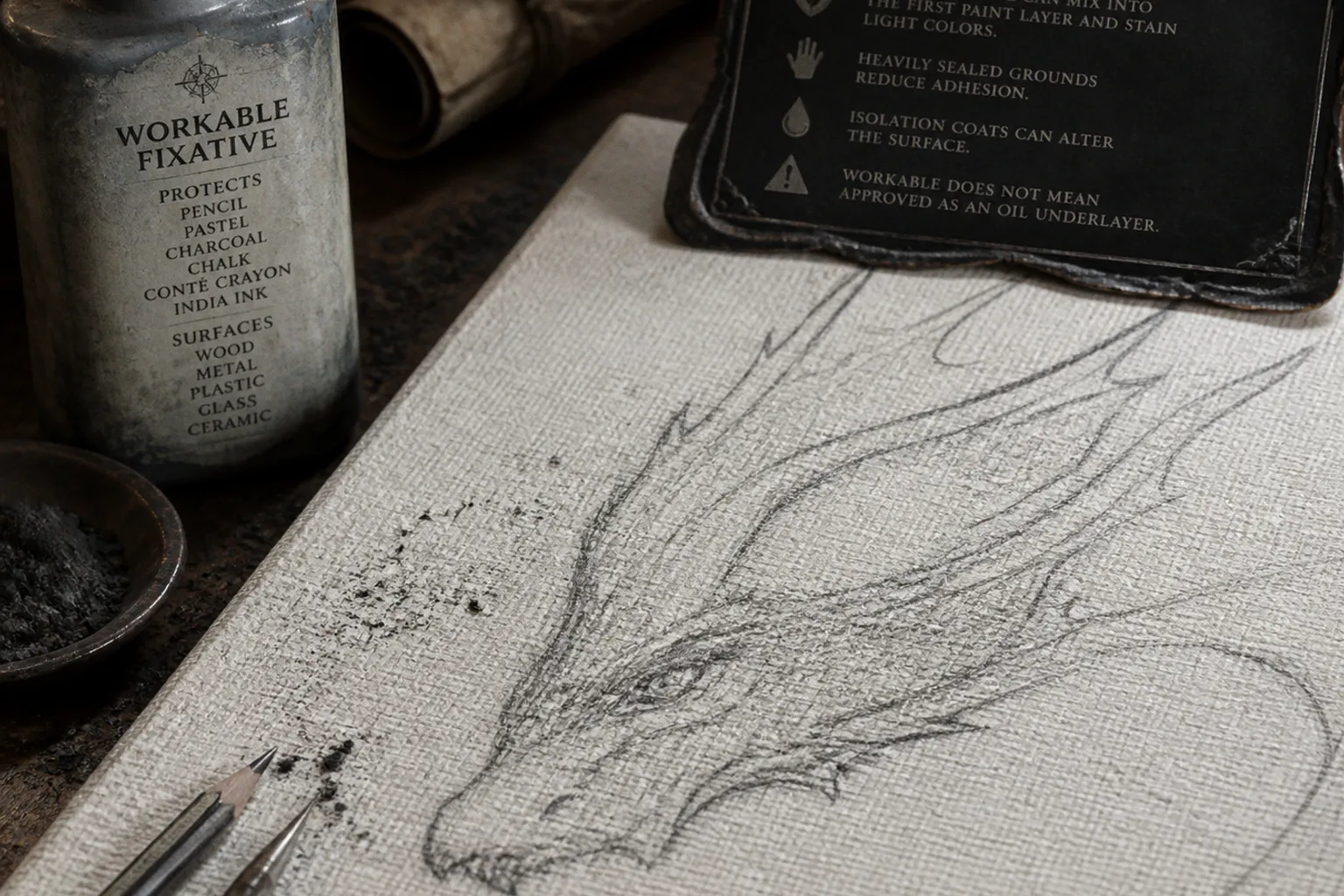
This matters because a graphite drawing under an oil painting creates a small but consequential technical junction: drawing material, fixative resin, priming layer, then paint film. If one layer refuses the next, the failure will not announce itself during the satisfying first session. It may show up later as poor paint grip, odd beading in a wash, a surface that feels plasticky, or an underdrawing that dirties every pale mixture it touches.
The blunt answer to “can you paint oil over graphite fixative?” is: sometimes, with a product specifically approved for it, applied in a thin film and tested on the exact ground you use. A generic workable spray is not a magic passport into oil painting.
“Workable” does not mean “safe beneath oil paint”
The word workable has done a lot of damage because it sounds reassuring. In drawing terms, it usually means the sprayed surface can receive another layer of pencil, charcoal, pastel, or similar dry media. That is a very different job from receiving oil paint.
Oil paint is not merely another layer. It is a drying oil system that must establish mechanical and chemical attachment to the surface beneath it. A fixative may be excellent at locking down charcoal on paper and still be a questionable interface between an acrylic-primed canvas and a lean umber wash.
This is where artists get trapped by product language. A can says it protects pencil, pastel, chalk, charcoal, Conté, perhaps India ink. Fine. It may even list “canvas” among supported surfaces. Still not enough. Unless the manufacturer explicitly says the product can sit beneath oil paint, we have no reason to convert a drawing claim into an oil-paint adhesion claim.
Krylon’s Fine Art Fixatif, for example, is marketed for dry media on canvas and paper. Its stated drying time is 15 minutes to touch and two hours to handle under recommended conditions. Those numbers tell us when handling is less likely to leave fingerprints. They do not establish a proven interval after which an oil layer is safe to apply.
That distinction is tedious. It is also the entire game.
A fixative can be dry, clear, and perfectly useless as an oil-paint foundation.
The same warning applies to spray varnish. Artists sometimes reach for whatever aerosol is already in the studio: clear varnish, “archival” coating, even hairspray in the more desperate corners of the internet. None of these products becomes a graphite fixative for oil painting because the label has the word clear on it. Varnish is engineered as a surface layer, not automatically as a buried interface beneath a paint film. Different role. Different chemistry. Different risk.
The real adhesion problem is usually too much spray
Graphite itself is not the villain. A light pencil drawing on a properly prepared canvas or panel is usually manageable. The trouble starts when the artist tries to make the drawing disappear under a lacquer-like barrier.
A dense fixative film changes the ground. It can reduce absorbency, smooth away useful tooth, and leave oil paint sitting on a more closed, less receptive surface. This is especially unforgiving when the next move is heavy, opaque paint or early impasto. The paint needs something to grab. A heavily sealed ground gives it a slick stage and asks it to dance anyway.
The risk is not necessarily dramatic delamination next Tuesday. It may be subtler: a first wash that crawls or separates, paint that feels oddly reluctant under the brush, or a later layer that has less reliable attachment than it would have had over the original ground.
The variables are not decorative details:
- The ground matters. Acrylic-primed canvas, oil-primed linen, aluminium composite panel, and a traditional glue-and-oil ground do not offer the same absorbency or surface energy.
- The drawing density matters. A few construction lines are not a fully rendered graphite portrait with compressed darks and polished highlights.
- The fixative film thickness matters most. One restrained dusting is a different material event from three wet passes until the surface visibly shines.
- The first oil layer matters. A thin, lean oil wash interacts differently from a dense titanium-white passage or a loaded impasto stroke.
- The solvent system matters. Some oil paints and mediums may disturb or partially re-wet certain fixatives. That is not a feature. It is an uncontrolled collision.
There is no universal waiting time that solves all of this. Twenty minutes, two hours, overnight, three days: these are only meaningful when attached to a specific product, a specific application thickness, and a manufacturer’s explicit guidance for oil overpainting.
Here is the practical distinction artists need to make before spraying anything.
| Situation | What it tells you | Sensible response |
|---|---|---|
| Fixative is dry to touch | The surface is no longer visibly wet | Do not treat this as approval for oil paint |
| Fixative is dry to handle | It can likely be moved without immediate marking | Still not a long-term adhesion guarantee |
| Product says “workable” | It accepts further dry-media layers | Check whether oil paint is explicitly named |
| Product lists canvas | It may be suitable for drawing media on canvas | It does not automatically approve an oil layer above |
| Product explicitly states use under oil paint | The manufacturer has made a specific compatibility claim | Apply lightly and test on your own ground |
| Surface looks glossy after spraying | You likely built a substantial film | Stop. Do not solve anxiety with another coat |
The ugly little irony: the more aggressively an artist fixes graphite to prevent smudging, the more likely they are to manufacture the adhesion issue they feared they were avoiding.
Graphite does not migrate through oil paint. It can still ruin your lights.
One persistent studio myth says graphite will “rise” or migrate through an oil film over time. An intact oil-paint film does not work like a haunted house wall. Graphite particles do not march upward through it.
But dismissing the migration story does not mean graphite is harmless. The practical problem is direct contamination during painting.
Loose graphite can mix into the first paint layer, particularly in thin passages. It can cool or grey a pale mixture. It can drag into a skin tone, a moonlit cloud, a bone plate, a white tabard, or any other area where fantasy illustration suddenly needs clean value architecture rather than accidental soot. And as oil paint becomes more transparent with age, a dark, heavily drawn line may become more visible—not because it travelled, but because the paint above it changed optical behavior.
That is why graphite discipline matters before the fixative question even begins. A narrative illustration often needs a sharp value plan, but it does not need every contour engraved like a technical blueprint. Overdrawn graphite is a trap: it encourages the artist to spray too much, then paint too opaquely to bury the evidence, then wonder why the image has lost air.
For a fantasy oil sketch, keep the drawing functional:
1. Place the framing first. Establish the silhouette, major diagonals, and the focal point. If the monster’s head, the hero’s hand, and the artifact all compete at thumbnail scale, no fixative will save the composition.
2. Reserve dense graphite for genuine decision points. Use it around overlaps, perspective hinges, facial placement, armor seams, and the edge that directs attention. Do not shade every stone in the ruin before the paint has arrived.
3. Lift excess graphite before painting. A kneaded eraser used with restraint removes loose dust without burnishing the ground into a polished skating rink.
4. Let the first oil wash do some drawing. A lean transparent wash can clarify forms faster than another hour of pencil rendering—and it belongs to the oil system rather than sitting between systems.
5. Protect only what must survive. If a delicate architectural drawing or a complicated costume pattern genuinely needs fixation, use the least material capable of doing the job.
That last point is the professional habit. Not “seal everything.” Not “never use graphite.” Use the minimum intervention that preserves the visual information you actually need.
Product claims: read the narrow sentence, not the friendly label
When selecting a spray fixative under oil paint, the manufacturer’s wording has to be painfully specific. We are looking for an actual claim about graphite or drawing media under oil paint, not a vague promise of permanence or versatility.
SpectraFix Degas Spray Fixative is one of the clearer examples in this narrow category. It is marketed as a casein-, water-, and alcohol-based product for graphite, charcoal, and coloured pencil beneath oil and acrylic paint. The manufacturer states that it prevents smudging of the underdrawing and bonds with oil layers.
That is meaningful because it is product-specific. It does not prove that every spray fixative behaves similarly. It does give an artist a rational starting point: a product whose declared purpose matches the layer stack they intend to build.
By contrast, Krylon Workable Fixatif is described around dry-media protection and continued workability. Its published supported-surface information does not make a corresponding promise about oil paint overcoating. Krylon Fine Art Fixatif is listed for dry media on canvas and paper, but its drying guidance should not be inflated into a cure schedule for oil painting over the product.
The difference is not brand snobbery. It is evidence discipline.
A studio test that is actually worth doing
Manufacturers can only describe broad use conditions. Your painting method is narrower. If you work wet-into-wet with soft, solvent-rich passages, that behavior may differ from a painter who begins with a dry-brush imprimatura and builds slow opaque layers on panel.
Make a test panel that imitates your real sequence. Not a ceremonial scrap with one timid brushstroke. A real miniature battlefield.
- Prepare the same ground you use for finished work.
- Draw with the same graphite grade and pressure.
- Apply the fixative in the same number of passes and at the same distance you would use on a painting.
- Let it dry according to the product’s instructions, without inventing extra certainty from the clock.
- Paint several test zones: a lean wash, an opaque light mixture, a darker transparent passage, and a thicker stroke.
- Let the panel sit, then assess brushing behavior, beading, scraping, and whether the paint film seems integrated or merely perched on top.
If the first layer behaves badly, do not negotiate with it. The test has already done its job. Change the method.
In traditional painting, a test panel is cheaper than a ruined focal point and less dramatic than pretending the problem is “just the surface.”
Better options than spraying the whole drawing
Often the most reliable answer is not finding a more magical aerosol. It is changing the drawing workflow.
Paint directly over a light graphite layout
For many oil painters, this remains the cleanest route. Keep the pencil drawing light, erase loose residue, and begin with a controlled oil wash. Graphite can remain visible where useful, while paint gradually takes over the structure. There is no extra resin film between ground and paint. Fewer interfaces. Fewer surprises.
This works especially well for traditional fantasy illustration, where the initial block-in needs to establish hierarchy quickly: dark mass, light break, focal face, weapon glint, creature silhouette. The drawing is there to steer the shot, not to become a permanent underlayer with its own legal status.
Use an oil wash on top of the drawing
If the concern is losing the design, reinforce it with a thin oil drawing. A restrained transparent earth colour, wiped back where necessary, gives you a more durable roadmap for subsequent painting. It also lets you correct the composition before the rendering phase turns every change into surgery.
Avoid treating this as an excuse to flood the surface with medium. Lean, controlled, and deliberate is the point. The first pass should clarify the image’s visual hierarchy, not drown it in amber gloss.
Transfer the drawing rather than render it in graphite
For complex compositions—crowded card-game scenes, architectural science-fiction interiors, figures with overlapping props—a transfer can deliver accurate placement without leaving a thick graphite field. The exact method depends on your ground and drawing process, but the principle holds: transfer only the information that needs precision, then develop the forms in paint.
This is less romantic than making a beautiful graphite drawing on the final support. Good. The final support is not a sketchbook page. It is the structure that has to survive the painting process.
Use a compatible drawing medium from the start
Some artists prefer coloured pencil, water-soluble drawing media, or a very thin paint-based sketch where product compatibility has been established. The choice depends on the desired handling and the surface. Again, the material must be judged as part of a stack, not as an isolated tool.
The workflow is never “Which product is archival?” in the abstract. The real question is: “What happens when this exact drawing, on this exact ground, receives my first oil layer?”
A practical route through the decision
If the graphite drawing is light and you can paint without smearing it into the first wash, skip the fixative. That is not negligence; it is often the technically simpler route.
If the drawing is complex enough that it must be secured, choose a product with an explicit manufacturer claim for use beneath oil paint. Apply a light, even coat rather than trying to embalm the canvas. Follow the product’s stated application conditions—temperature, humidity, ventilation—and do not confuse touch-dry status with long-term compatibility.
If the product only says “workable,” “fine art,” “archival,” or “for canvas,” treat it as unproven for this use. It may work in your process. It may not. That is what a dedicated test panel is for.
And if the surface becomes visibly slick after spraying, the solution is not to force thicker paint onto it. The solution is to stop before you build a painting on a compromised interface.
Oil painting rewards physical honesty. The focal point needs a clean value edge. The wash needs to bite. The paint layers need a ground that accepts them. Graphite fixative can belong in that system, but only when it is selected for that job and used like a thin technical layer—not like a security blanket in an aerosol can.