Grisaille underpainting: a roadmap for fantasy figures
The primary failure in a complex fantasy figure is rarely the color. It is the value structure beneath the color.
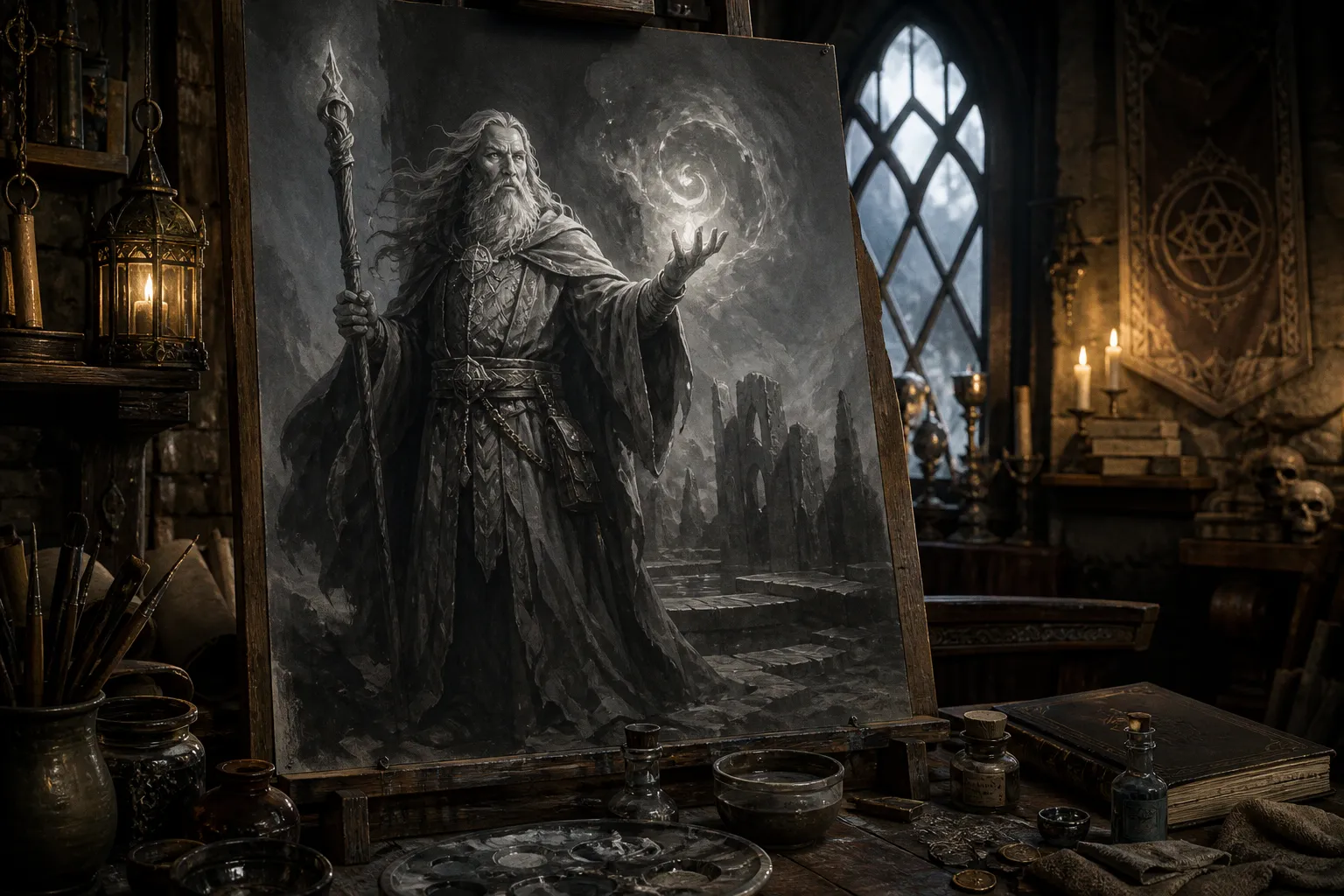
A demon lit by a torch, a wizard struck by blue spell-light, or an armored figure emerging from a black hall can carry dozens of local colors and still collapse into a flat arrangement if the light hierarchy was never solved.
Grisaille underpainting for fantasy oil painting addresses that failure at the structural stage. The image is reduced to a controlled monochromatic range—gray, black, white, or a single earth pigment—before chromatic decisions are introduced. This is not decorative preparation. It is an architectural map for the painting.
The method isolates the problems that color tends to conceal: the size of the key light, the depth of the shadow mass, the shape of cast shadows, the amount of reflected light, and the hierarchy of edges. Once those decisions are fixed, glazes and opaque passages have a stable surface to modify rather than a composition they must rescue.
Architectural Mapping: Solve the Light Before the Color
Fantasy illustration creates a specific technical problem. The lighting is often invented rather than observed directly. A torch may illuminate a figure from below. A magical source may cast green light against a red garment. A character may occupy a dark interior while the face receives a narrow, high-value accent.
In such conditions, color is a poor first diagnostic tool. Saturated passages attract attention even when their value is incorrect. A violet cloak can appear visually dominant simply because it is chromatic, not because it belongs to the primary light structure. Grisaille removes that distraction.
The underpainting should establish five related systems:
- The dominant light mass. This defines where the image is most open and where the eye is directed.
- The core shadow. This is the section of the form turned away from the source, not merely the darkest available paint.
- Cast-shadow geometry. A hand, helmet, horn, or weapon should project a shadow consistent with the source position.
- Reflected light. This prevents the shadow side from becoming a dead black wall, but it must remain subordinate to the key light.
- Edge hierarchy. Hard edges reserve attention. Lost edges compress forms into the surrounding dark.
A grisaille method for fantasy art is successful when these systems remain legible without any hue. If the figure reads only after the application of flesh color, red leather, and metallic blue, the underpainting has not solved the actual image.
Choosing the monochromatic range
A neutral black-and-white grisaille produces a clear value study. It is useful when the lighting is theatrical and the figure contains complex planes: cheekbones, armor plates, folded fabric, claws, and irregular anatomical structures. The risk is equally clear. The result can become mechanically gray, with every passage treated as a neutral observation rather than a material decision.
A single earth pigment produces a more unified field. Raw umber, burnt umber, or another stable earth color can provide a warmer base and reduce the sterile appearance of a purely neutral study. The pigment choice affects the later color only through the visual and physical behavior of the layers above it. It does not replace a value plan.
The underpainting is not required to imitate the final local color. It must establish the correct relative lightness and darkness.
| Underpainting approach | Primary function | Main advantage | Main risk |
|---|---|---|---|
| Neutral black-and-white grisaille | Value and lighting analysis | Maximum separation between light and dark | Warm flesh may become cold if covered by thin paint |
| Earth-pigment grisaille | Structural map with warmer optical ground | More compatible with muted fantasy palettes | Dark earth passages can become heavy if overworked |
| Transparent imprimatura | Color key and glare reduction | Establishes a broad temperature from the start | Does not solve complex value or cast-shadow structure |
| Acrylic or casein wash | Fast preparatory block-in | Dries before oil layers and accelerates the workflow | Thick applications require substantially longer drying |
Grisaille and imprimatura are not interchangeable. Imprimatura is a thin, transparent color layer used to reduce the glare of bare gesso and establish a general color key. Grisaille is a monochromatic value study. One sets temperature. The other solves structure.
Grisaille is not a gray filter placed beneath the painting. It is the first complete statement of the light.
Compressing the figure into value groups
The most efficient working sequence begins with large masses. Ignore individual scales, hair strands, embroidery, and reflected color. Establish the figure as a small number of connected value groups.
A practical order is:
1. Block the background field. Decide whether the figure is separated by a lighter or darker surrounding mass.
2. Place the main silhouette. The contour must read before internal modeling begins.
3. Establish the largest shadow shape. Treat the shadow as a connected design, not a collection of isolated dark spots.
4. Locate the light family. Keep the major illuminated planes related in value.
5. Separate the focal plane. The face, hand, weapon, or other narrative focal area requires controlled value contrast.
6. Add secondary modeling. Planes inside the light and shadow masses should support the larger arrangement rather than fracture it.
This is the value study for oil illustration in its most useful form: not a finished monochrome painting, but a complete decision about where the image can and cannot spend contrast.
The temptation is to render too early. A grisaille can become polished while remaining structurally wrong. Smooth blending does not correct an incorrectly placed shadow. Impasto does not repair a weak silhouette. A refined error is still an error.
The Graphite Migration Problem: Seal the Underdrawing
Graphite is a precise drawing material. It is also a poor substance to leave exposed beneath a long oil-painting process. Under pressure from brushing, wiping, glazing, and repeated solvent exposure, graphite can move into subsequent layers. The effect is subtle at first: pale passages acquire a dull gray haze. Over a period of five to ten years, that migration can become more visible, particularly in light passages and thinly painted areas.
The correction is not to apply more white. The correction is to isolate the drawing before the paint film is built.
A thin, even layer of acrylic matte medium or a similar isolating wash can seal the graphite. The layer should be uniform. A heavy coat creates its own surface problems, including uneven absorbency, pooling, and altered brush drag. A thin coat that leaves unsealed graphite is not a reliable barrier.
Clear acrylic gesso may also serve as a preparatory ground when the surface requires additional tooth, but it changes the working surface more aggressively than a very thin isolating medium. The choice depends on whether the artist needs to preserve the existing drawing with minimal alteration or create a more absorbent painting ground.
The sequence is straightforward:
- Complete the graphite drawing and remove loose particles without abrading the surface.
- Apply a thin, even isolating layer.
- Allow it to dry fully rather than judging dryness only by surface gloss.
- Test a small passage with the intended underpainting medium.
- Proceed with acrylic, casein, or oil according to the compatibility of the layers.
The barrier is particularly important when the drawing contains dense dark construction lines beneath pale armor, gray skin, fog, or illuminated fabric. In those areas, graphite contamination can reduce the apparent value range before the painting has even reached the glazing stage.
Why direct oil over graphite is a weak solution
Oil paint may appear to lock graphite in place once the surface is covered. That appearance is misleading. A transparent or semi-transparent film does not create a permanent chemical barrier merely by lying on top of the drawing. Graphite can remain mobile at the interface, especially where the paint layer is thin or repeatedly disturbed.
The problem is archival, but it is also immediate. Migrating graphite interferes with color judgment. The artist compensates for a gray haze by increasing saturation or raising the value of adjacent paint. The final image then contains corrections to a contamination problem rather than decisions made from the intended palette.
For a professional fantasy illustration, the underdrawing should be treated as a separate material system. It must either be removed, fixed, or isolated. “Covered” is not a technical category.
Modern Media: Acrylic and Casein for Faster Underpaintings
Traditional oil grisaille has a significant logistical weakness: drying time. A dense underpainting may remain mobile for an extended period, especially in humid conditions or when the medium is rich in oil. Modern illustrators often use acrylic or casein washes to construct the monochrome foundation, then apply oil paint over the dry surface.
This is a valid adaptation of the classical sequence because the later oil film is placed over the leaner, water-based layer—not the reverse.
Acrylic and casein differ in handling. Acrylic dries by water evaporation and can form a relatively sealed film depending on the product, dilution, and surface. Casein produces a more absorbent, matte surface and can accept subsequent oil passages with a different degree of drag. Neither should be treated as a universal substitute for oil. The surface must be tested, especially when the underpainting is heavily loaded or built over an unusually slick ground.
The practical advantage is speed, but speed does not mean immediate readiness. Thin acrylic or casein washes should dry for at least three days before oil is applied. Thick applications may require several weeks. The surface must be dry through its body, not merely dry to the touch.
Managing absorbency
Acrylic and casein underpaintings can pull oil from the first glaze or scumble. The result is a dead, chalky passage with reduced saturation and inconsistent handling. This is not necessarily a failure of the medium. It is often a surface-absorbency problem.
The first oil layer should be observed carefully:
- If the glaze sinks in immediately and loses its color, the surface is highly absorbent.
- If the brush skips and the paint breaks into small islands, the surface may be too dry, rough, or contaminated.
- If the film remains slick and mobile, the previous layer may not be fully cured or the surface may contain excess medium.
- If adjacent passages dry at visibly different rates, the underpainting has uneven density or absorbency.
A controlled oil medium can stabilize the transition, but excessive medium produces a separate problem: weak, mobile films that remain vulnerable beneath firmer upper layers. Stand oil, for example, levels well and increases the gloss and flexibility of a mixture, but it is not a universal remedy for an underpainting that lacks a coherent surface.
For a monochrome underpainting oil tutorial, the relevant principle is simple: the foundation should be lean, stable, and optically subordinate. It should not compete with the glaze or remain so oily that the upper structure loses mechanical integrity.
Oil wash versus oil block-in
An oil wash is not the same as a fully modeled grisaille. A wash can place the general temperature and mass rapidly, but excessive solvent can leave a weak, underbound film. A more substantial block-in uses a controlled paint-to-medium balance and establishes the main values with opaque or semi-opaque passages.
The decision depends on the final painting:
- Use a lean wash when the image needs a transparent stain and the drawing remains the main structural guide.
- Use a more opaque grisaille when the lighting contains multiple planes and cast shadows that must be physically described.
- Use scumbling over a dry monochrome layer when the surface needs broken, dry-brush texture rather than transparent color.
- Use impasto selectively after the value structure is stable, primarily on high-light accents or material transitions.
Cadmium red light, for example, has a powerful covering and tinting presence. It can dominate a thin underpainting quickly. It should not be used to conceal an unresolved value design. The same applies to high-chroma blues and opaque titanium white. Strong materials increase the speed at which structural mistakes disappear from view—and reappear in the finished image.
The Corpse-Like Chill: Managing Skin Tones in Monochrome
Grisaille has a known weakness in fantasy figure work. A gray foundation beneath warm flesh can produce a corpse-like chill when the final skin layers are thin, cautious, or too transparent. This is not an abstract color-theory issue. The underpainting remains optically active through the flesh passages.
The effect is most obvious in cheeks, ears, knuckles, lips, and other areas where the final image requires blood warmth. A neutral gray beneath those passages can suppress the red and yellow components of the flesh mixture. The result is not necessarily pale skin. It is skin that appears refrigerated.
This can be useful. Vampires, revenants, winter sorcerers, dead kings, and other figures requiring a controlled lack of warmth may benefit from the effect. For living flesh, the grisaille must be managed rather than blindly preserved.
Three methods for controlling the chill
1. Use a warmer monochrome foundation.
An earth-pigment grisaille can reduce the distance between the underpainting and the intended flesh palette. It does not create warm skin automatically, but it reduces the amount of chromatic correction required in later layers.
2. Increase opacity in the flesh passages.
If the flesh must be warm and solid, the color layer needs enough body to control the foundation beneath it. Thin glazes are not inherently superior. They are appropriate when the underpainting is already compatible with the target temperature and the artist intends to preserve its modeling.
3. Reserve neutral grisaille for selected planes.
The entire figure does not need identical treatment. A neutral foundation may be effective in armor, stone, smoke, and cold reflected light. Warm areas can receive a modified underpainting that carries more red, umber, or ochre influence.
The technical mistake is assuming that transparency is a virtue in every passage. A glaze reveals the layers below. If those layers carry the wrong temperature, the glaze faithfully reveals the wrong temperature.
A gray foundation can describe flesh accurately and still make it look dead. Value correctness does not guarantee temperature control.
Edge control in the shadow areas
The shadow side of the figure requires particular discipline. Grisaille makes it easy to over-model dark passages because the artist wants to prove that every form has been understood. The result is a shadow mass divided into numerous small edges. The figure becomes noisy, and the light loses authority.
The shadow should contain variation, but not equal emphasis. Keep the broad mass connected. Use softer transitions where planes turn gradually. Reserve sharper edges for structural changes, occlusion, or reflected shapes that need to be read. The deepest accents belong to the places where forms meet or overlap: beneath a brow, inside a gauntlet, between armor plates, or at the junction of a hand and weapon.
Reflected light must remain below the primary light in value. If it rises too high, the figure receives a second key light. Fantasy compositions often need dramatic illumination, but dramatic does not mean arbitrary. Every secondary light must support the dominant source.
Structural Integrity: Glazing and the Fat-Over-Lean Rule
Once the grisaille is dry, color can be introduced through glazes, scumbles, opaque passages, or a combination of all three. The physical order matters.
The lower layers should not remain substantially more mobile than the layers above them. This is the practical meaning of the fat-over-lean rule in this workflow. Leaner passages belong below. More oil-rich and flexible films belong later. If a mobile layer is trapped beneath a less flexible layer, differential movement can contribute to cracking and structural failure.
This rule is not a slogan to be applied mechanically. It is a way of controlling the relative behavior of the paint films.
A stable layer sequence
A controlled fantasy oil painting may proceed through the following structure:
1. Prepared support and isolated drawing.
The graphite is sealed with a thin, even acrylic matte medium or similar barrier. The support must be free from loose particles and unstable residue.
2. Lean monochrome foundation.
Acrylic, casein, or a restrained oil grisaille establishes the value structure. The layer must dry thoroughly before the next stage.
3. Initial color passages.
Transparent or semi-opaque color begins to alter the temperature without destroying the major value groups.
4. Opaque corrections.
Forms that require greater coverage—skin, armor, pale cloth, or focused highlights—receive paint with sufficient body.
5. Glazes and scumbling.
Glazes deepen or shift color. Scumbling breaks the surface with a lighter, more opaque film dragged across the texture beneath.
6. Final accents.
Impasto, sharp highlights, and small dark accents are applied only after the structure and color relationships are stable.
The exact number of layers is not a quality metric. Six layers can be structurally sound or badly designed. A single carefully built grisaille with controlled color passages can outperform a complex stack of poorly bound films.
Glazing without flattening the drawing
A glaze should modify the value structure, not erase it. Transparent color over a dry grisaille can unify a passage and produce depth, but repeated glazing can compress the value range if every layer darkens the surface. This is especially common in red cloth, black armor, and blue night scenes.
The solution is not to keep glazing indefinitely. Re-establish opaque light passages when necessary. A light plane that has become too dark must be rebuilt with body. The grisaille remains a map, not a prison.
Use glazing when the existing value design is correct and the problem is temperature or chromatic depth. Use opaque paint when the value relationship itself has changed. Use scumbling when the surface needs a broken veil of light, dust, haze, worn fabric, or mineral texture. Use impasto when the physical relief of the paint contributes to the material description or controls a focal accent.
Medium discipline
The specific ratio of turpentine, linseed oil, and stand oil should not be guessed from a generic recipe. The correct mixture depends on pigment, support, absorbency, drying conditions, and the desired film behavior. A medium that handles correctly over one acrylic ground may remain slick over another.
Several material behaviors are predictable:
- Excess solvent can produce a thin, underbound stain.
- Excess linseed oil can increase gloss, wrinkling risk, and drying complications.
- Stand oil improves leveling and flow but can create a more enamel-like surface if used heavily.
- Too much medium in highlights reduces body and weakens the physical contrast between opaque light and transparent shadow.
- Repeated oily glazes can create an unstable, glossy stack that is difficult to correct without disturbing lower passages.
The paint should do most of the work. Medium is an adjustment, not a substitute for proper viscosity, brush pressure, and pigment selection.
A Working Route for Fantasy Figures
The most reliable grisaille oil painting steps are not a rigid recipe. They are a sequence of inspections. Each stage must answer a specific question before the next material is introduced.
Stage one: inspect the drawing
The drawing must carry the gesture, silhouette, proportion, and major overlaps. No underpainting technique can compensate for a weak figure construction. Graphite lines that will remain visible should be deliberate. Lines intended only as scaffolding should be reduced before sealing.
Stage two: identify the light source
Write the light logic in physical terms. Torch below. Spell source at left. Moonlight from above. Reflected red from a nearby banner. Avoid vague descriptions. The light must have a position, direction, and relative intensity.
Stage three: establish the shadow design
Paint the primary shadow as a connected shape. Do not begin with facial modeling or ornament. The shape of the shadow is the first major compositional decision after the silhouette.
Stage four: separate material groups
Metal, skin, cloth, wood, and stone do not need separate colors yet, but they need different surface behavior. Metal may require abrupt value changes. Skin usually needs more continuous transitions. Cloth can accept broader, softer modeling. The grisaille should anticipate these differences without becoming a finished rendering.
Stage five: inspect at a distance
The figure should remain legible when reduced in size or viewed from across the room. If the focal point is unclear, increase contrast selectively. Do not raise every light. If the whole image becomes equally sharp and bright, edge hierarchy has failed.
Stage six: introduce color selectively
Begin with the passages where temperature is most consequential. Warm flesh, magical light, blood, painted metal, and colored reflected light may require different degrees of opacity. Do not apply a uniform color veil across the entire image unless the intended effect genuinely requires it.
Stage seven: verify the dry structure
After the major oil passages have dried, inspect the painting under neutral light. Check whether the glaze has reduced the value range, whether the shadow has become too transparent, and whether the focal edges still dominate. Corrections at this stage should be targeted. Repainting the entire surface usually indicates that the underpainting was not sufficiently resolved.
Where Grisaille Performs Best—and Where It Should Be Modified
Grisaille is especially effective when the image depends on complex theatrical illumination. A demon in a torchlit hall, a wizard struck by spell-light, or a figure framed by a bright portal all benefit from solving the value design before color introduces competing visual signals.
It is less efficient when the painting depends primarily on luminous, warm flesh and restrained value contrast. In those cases, a warmer underpainting or a modified color ground may provide a more direct route. The method should serve the image. It should not be preserved as a ritual after its structural advantage has disappeared.
The same caution applies to highly transparent fantasy effects. Ghostly cloth, smoke, spectral light, and thin atmospheric veils can be built over grisaille, but the value beneath them must be controlled. Transparency reveals every unresolved decision. It does not conceal them.
For artists studying traditional media illustration, the useful lesson is not simply “paint gray first.” The useful lesson is to separate tasks:
- Drawing establishes proportion and design.
- Grisaille establishes value and light.
- Color establishes temperature and material identity.
- Glazing establishes depth and chromatic modification.
- Scumbling establishes broken surface and optical variation.
- Impasto establishes selected physical accents.
When one layer is forced to perform all six tasks, the paint film becomes confused and the image loses hierarchy.
The Definitive Verdict
Grisaille underpainting is a disciplined solution to a specific problem: complex light in a complex figure. It provides a monochrome map of value groups, shadow geometry, reflected light, and edge control before hue begins to distort judgment.
Its limitations are equally specific. Neutral gray beneath warm flesh can produce a corpse-like chill. Graphite beneath oil can migrate unless isolated. Acrylic and casein can accelerate the workflow, but only after adequate drying—at least three days for thin applications, and potentially several weeks for thick ones. Glazing can deepen color, but only within a stable fat-over-lean structure.
The method succeeds when the artist treats it as an architectural stage, not as a gray version of the final painting. Build the silhouette. Connect the shadow masses. Control the edges. Seal the drawing. Allow the underpainting to dry. Introduce color only after the light logic survives without it.
That is the route. The rest is pigment management.