Roman Forum tickets: how to book for sketching trips
Most sketching trips to the Roman Forum fail before the first line hits the page. Not because the ruins are difficult to draw.
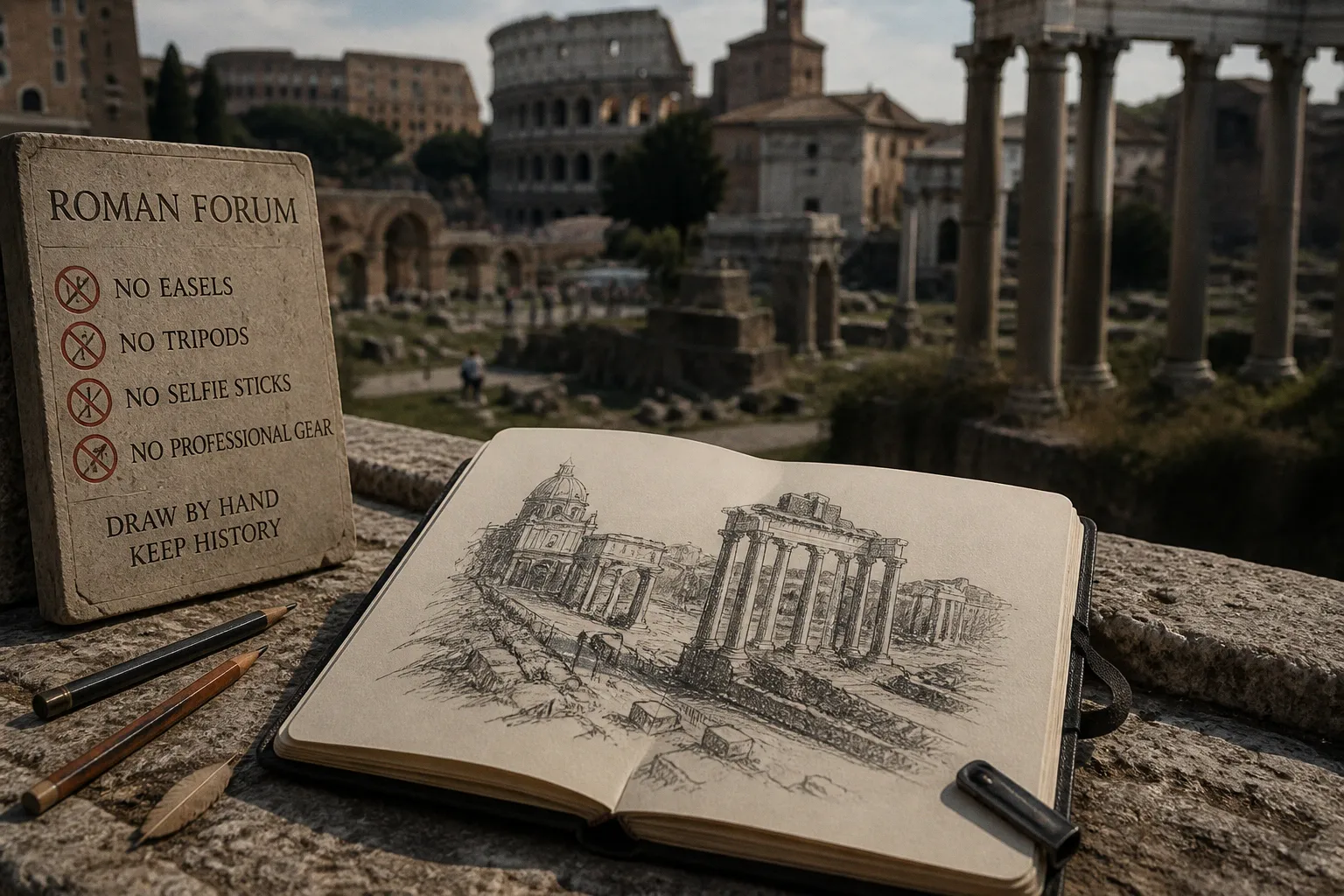
Because the visitor arrives with the wrong ticket, the wrong bag, or an easel that security quite reasonably refuses to admit.
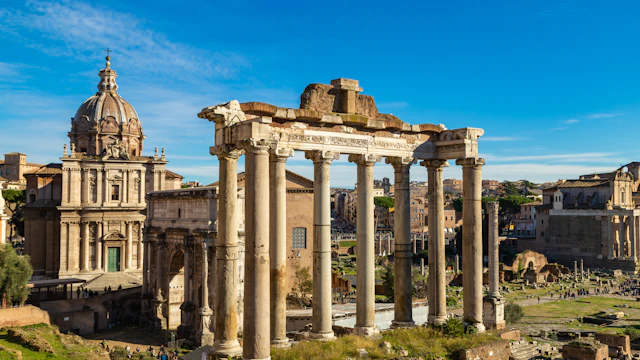 Rome
RomeTickets and prices
Roman Forum
Entry ticket with audio guide · 1.5 - 3 hours
from€32−27%
Book onlineEntry ticket with audio guide app
from€29
Book onlineGuided tour
from€49
Book onlineGuided tour with arena floor access
from€35
Book onlineThe booking process is not complicated, but it is unforgiving. Roman Forum tickets are nominative, released only 30 days ahead, and tied to an identity document. The archaeological park also treats professional art equipment as equipment, not as a charming extension of your creative soul. Hand-held sketchbooks are acceptable for personal drawing. Tripods, monopods, selfie sticks, professional photography gear, and easels require formal authorization.
That distinction determines the entire trip. You are not planning a mobile studio. You are planning a controlled drawing session inside a crowded archaeological site with marked paths, security restrictions, limited space, and no cloakroom.
Start with the ticket, not the sketchbook
The official booking platform releases tickets on a rolling 30-day basis. If you want to visit on the 18th, start checking availability around the 19th of the previous month. There is no advantage in planning six months ahead and then discovering that the actual inventory does not exist yet. The system does not reward romantic patience. It rewards calendar discipline.
For most artists, the standard 24-hour ticket is the sensible starting point. It costs €18: €16 admission plus a €2 booking fee. It includes one entry to the Colosseum and one entry to the combined Roman Forum, Palatine Hill, and Imperial Fora area. The 24-hour validity begins with the first entry, so the ticket is not a vague “Rome archaeological zone” pass. It has a clock attached.
That matters when building an itinerary. A visitor entering the Colosseum in the morning may still use the same ticket for the Roman Forum and Palatine Hill within the validity period, subject to the conditions of the chosen ticket and available entry slots. A visitor who treats the pass as a single casual admission may waste the most useful light before reaching the Forum.
The standard ticket is usually enough for a short sketching trip because the Forum itself offers more visual material than one afternoon can absorb: elevated views toward the temples, compressed layers of columns and walls, long axial routes, fragments framed by modern Rome, and the Palatine slopes that turn the site into a vertical composition rather than a flat field of ruins.
Other passes change the itinerary rather than simply adding prestige.
| Pass | Price | Access | Best use for an artist |
|---|---|---|---|
| Standard 24-hour ticket | €18 | One Colosseum entry plus one entry to the Roman Forum, Palatine Hill, and Imperial Fora | A first visit combining a Forum study with the Colosseum |
| Forum Pass Super | €18 | Roman Forum, Palatine Hill, and SUPER sites; no Colosseum | A dedicated archaeological drawing day without the amphitheatre |
| Full Experience ticket | €24 | Expanded access associated with the Full Experience route | A longer visit focused on additional monuments and interiors |
The reduced ticket is listed at €4 for EU citizens aged 18–25. Eligibility depends on the applicable rules and identity documentation, so do not build a budget around the reduced price unless you qualify and can prove it at entry.
There is also a practical transaction limit: individuals can purchase up to eight tickets in one online transaction. That is useful for a small group of artists, but every ticket remains tied to a named person. One buyer does not turn seven anonymous companions into a compliant expedition.
The safest Roman Forum sketching kit is the one that looks least like a production kit.
Nominative tickets mean your name is part of the admission
When booking, enter the visitor’s first and last name exactly as they appear on the physical identity document that will be shown at the entrance. The ticket is nominative. The name on the booking must match the passport or accepted ID.
This is not the place for abbreviations, nicknames, creative punctuation, or the familiar administrative strategy of hoping that nobody looks closely. They do look. A mismatch can turn a paid reservation into an expensive lesson in precision.
For international visitors, the passport is the obvious reference document. Use the spelling shown there, including the order and form of the name where the booking system requests it. If several people are travelling together, check every ticket separately after purchase. One incorrect character can create more trouble than an entire week of weather forecasting.
Keep the booking confirmation accessible on the phone, but do not rely on a dead battery. A charged device, the matching ID, and a screenshot or offline copy of the reservation make the entrance less theatrical. The Forum does not need another improvised performance.
The nominative system also affects transfers. If one member of a group cannot attend, do not assume the ticket can simply be handed to another person. The admission document belongs to the named visitor. Any change or correction must be handled through the official booking process, where available, rather than negotiated at the gate.
For artists, the key point is simple: booking is not complete when the payment goes through. It is complete when the name, date, access type, and identity document all agree.
Pick the first entry time around the light
The Forum is not a neutral white box. Light decides what the ruins say.
Morning light can separate columns, edges, and broken masonry with hard directional shadows. Later light may flatten some surfaces but open longer views across the valley and toward the Palatine. If the trip is primarily for drawing, select the first entry with the visual sequence in mind:
1. Enter early enough to make the most exposed viewpoints before heat, crowds, and harsh overhead light take control.
2. Use the first hour for broad compositional sketches rather than details. Establish the major axes, skyline, and dominant masses while the site is still readable.
3. Move into tighter studies after the initial crowd pressure builds. Fragments, capitals, stair edges, and wall joints are less dependent on a clear view.
4. Reserve the final portion of the visit for notes, alternate crops, and corrections. Do not leave every decision until the last twenty minutes, when the site has become a moving queue.
The booking system determines whether this sequence is possible. A late Colosseum slot followed by a rushed Forum visit is a poor arrangement for anyone who needs time to observe. A Forum-focused pass may be better if the Roman Forum is the actual subject rather than one stop between major attractions.
What artists can bring into the Roman Forum
Personal sketching with a hand-held notebook is permitted. That is the useful rule. It allows drawing, but it does not create a loophole for setting up a full painting station.
Professional equipment, including easels and tripods, is prohibited without formal administrative authorization. The same restriction applies to monopods, selfie sticks, and professional photography or filming equipment. If the object is designed to stand on its own, extend, stabilize, support, or organize a production setup, assume it will attract attention.
Bring tools that remain in your hands and can be packed away immediately:
- A compact sketchbook that does not obstruct movement or resemble a display board.
- Graphite, charcoal, colored pencils, or other dry media suited to quick handling.
- A small pencil case rather than a spread of loose materials.
- A kneaded eraser, sharpener with a contained reservoir, and a few clips if they do not create a rigid setup.
- A phone or compact camera used within the site’s rules, without adding prohibited support equipment.
- A water bottle and sun protection, because Roman stone is not obligated to provide shade.
Wet media require caution. Do not assume that oils, acrylics, solvent-based materials, water containers, palettes, or portable painting systems are allowed simply because a sketchbook is. The visitor regulations support personal hand-held drawing; they do not grant permission to conduct an oil-painting session among ancient masonry and passing visitors.
An easel is not “just a small easel” once it is assembled in a narrow route. It occupies space, changes pedestrian flow, and signals a professional setup. The Roman Forum is a functioning visitor site, not a private atelier with columns.
A formal roman forum sketching permit may be possible for professional work, but the exact processing time is not established in the available visitor information. That uncertainty is operationally important. Do not book a flight for tomorrow and expect an administrative authorization to materialize because the subject is historically significant. Contact the relevant archaeological park administration well in advance, explain the intended equipment, purpose, dates, and media, and wait for written confirmation before travelling with production gear.
If the permit is not confirmed, leave the easel behind.
The bag is part of the equipment decision
Large bags, suitcases, trolleys, and camping backpacks are prohibited inside the archaeological park. There is no on-site luggage storage or cloakroom. This creates a blunt but manageable rule: arrive with a compact day bag that can pass security and does not need to shelter an entire studio.
The stated standard maximum bag size is 40 × 35 × 15 cm. Treat that as a real limit, not a suggestion to test with a swollen backpack and optimistic posture. A bag that technically matches the dimensions can still become a problem if it is overstuffed, difficult to inspect, or packed with gear that looks professional.
Pack for the site rather than for every hypothetical drawing emergency. A second sketchbook, three additional graphite grades, and a backup eraser are reasonable. A full wet-media kit, folding chair, broad portfolio case, and camera rig are not.
Do not arrive at the Forum directly from a train or hotel checkout carrying luggage. There is no reliable on-site solution waiting at the gate. Store larger items elsewhere before the visit. The archaeological park is not a luggage service that happens to contain the remains of Republican Rome.
Drawing inside the archaeological park: movement is part of the composition
Roman Forum entry rules for painters are also movement rules. Visitors must stay on marked pathways. They may not sit on ruins or steps, and they must not block pedestrian traffic.
That affects where and how you draw. A promising viewpoint is irrelevant if reaching it means stepping outside the permitted route. A perfect angle is not worth sitting on a surviving stair. The site is protected, crowded, and uneven; the most visually dramatic position is often the least practical one.
The best working posture is usually standing or pausing briefly at the edge of a permitted route. Keep the sketchbook close to the body, make the first marks quickly, and move when the flow of visitors requires it. This is not a failure of concentration. It is a different kind of discipline.
A portable sketching stool deserves special caution. The available regulations do not establish a clear universal permission for small folding stools, and enforcement may vary. Even a lightweight stool can obstruct a path or appear to be an unauthorized setup. Unless the administration has explicitly confirmed that the specific stool is acceptable, treat it as a risk rather than a comfort item.
The practical drawing method is therefore built around short stops:
1. Frame before rendering. Decide whether the composition is about an isolated ruin, a corridor of structures, a distant skyline, or the collision between ancient stone and modern city.
2. Lock the horizon and major diagonals. The Forum contains enough broken architecture to punish vague perspective. Establish the ground plane before chasing details.
3. Use value masses. A quick dark-light map will survive crowd movement better than a detailed contour drawing abandoned halfway through.
4. Record the view in words. Note the direction of light, the order of overlapping structures, and what sat outside the frame. A written cue can recover a composition later.
5. Move before the drawing becomes territorial. If other visitors need the path, the path wins.
Inside the Forum, observation has to be portable. If the drawing cannot move, the drawing is badly designed for the site.
Why the Forum rewards framing over detail
The Roman Forum is visually overqualified. It offers too many columns, too many fractured walls, too many historical labels, and too many competing monuments. The common failure is to draw everything because everything appears important.
It is not.
A successful field sketch needs a narrative hook. Decide what the viewer should notice first. The broken arch? The vertical thrust of the surviving columns? The recession toward the Capitoline direction? The relationship between the temple platform and the modern city beyond it? Once the focal point is chosen, the rest becomes supporting architecture.
This is where a painter’s habits can work against the visit. Traditional technique often rewards patience, layering, and sustained attention to a single surface. The Forum may offer no stable conditions for that process. Crowds shift. Light moves. Security and access rules constrain the body. A hand-held dry-media sketch has to capture hierarchy before texture.
Build the image in three passes:
- Pass one: framing. Define the outer crop, horizon, and largest masses.
- Pass two: hierarchy. Strengthen the focal point and reduce secondary structures to simpler values.
- Pass three: evidence. Add only the architectural details that support the story: a capital, a cornice, a broken stair, a figure for scale.
The figures are useful, but not as decorative extras. They establish scale, movement, and the present-day pressure of the site. A tiny visitor crossing a large stone platform can make the architecture legible. A dense crowd can destroy the same composition. Use people as compositional signals, not as random clutter.
Choosing between the main ticket options
The right pass depends on what the trip is trying to produce.
If the objective is one broad study of the Forum combined with the Colosseum, the standard 24-hour ticket is efficient. It gives access to both major destinations and allows the archaeological zone to function as one part of a larger day.
If the Colosseum is irrelevant and the trip is specifically about Roman Forum, Palatine Hill, and additional SUPER sites, the Forum Pass Super is cleaner. Paying for an entrance you do not intend to use is not a better itinerary. It is merely a more expensive one.
The Full Experience ticket makes sense when the route includes additional access that supports the project: interiors, specialized spaces, or a longer architectural study. It is less useful if the artist plans to stand in one Forum viewpoint for three hours and has no interest in the expanded route.
Consider the difference between collecting access and using it:
| Planning question | Standard ticket | Forum Pass Super | Full Experience |
|---|---|---|---|
| Is the Colosseum part of the visual project? | Yes | No | Potentially |
| Is the Roman Forum the primary location? | Yes | Yes | Yes |
| Does the plan require extra interiors or expanded sites? | Limited | Focused on included SUPER access | Better suited |
| Is one concentrated drawing day the priority? | Good if paired with a sensible slot | Often the most direct choice | Useful only if expanded access will be used |
| Does the ticket remove equipment restrictions? | No | No | No |
No pass authorizes an easel. No pass overrides the path rules. Ticket type controls access, not artistic privilege.
A workable sketching itinerary
A drawing trip needs fewer ambitions than a sightseeing trip. Trying to cover every monument, every viewpoint, and every historical period produces a portfolio of hurried fragments. Better to choose a route with a visual argument.
A compact itinerary can run like this:
First phase: establish the whole site
Use the opening section of the visit for orientation. Find a viewpoint where the Forum reads as a sequence of spaces rather than a pile of isolated stones. Make several thumbnails with different crops. One should emphasize verticals; another should flatten the scene into horizontal bands; a third should include the city beyond the ruins.
Do not render. This is framing work.
Second phase: select one architectural anchor
Choose a monument or fragment that can carry the image. It might be a column group, a temple platform, a surviving arch, or a wall with a strong perspective line. Study its silhouette and its relationship to the surrounding void.
The anchor should be visible enough to draw without trespassing into restricted areas or stopping in the middle of a route. If the composition depends on a position that cannot be occupied safely, redesign it. The site does not owe the sketch a perfect angle.
Third phase: move toward detail
Only after the major structure is understood should the sketchbook move into close studies. Record capitals, masonry joints, shadow shapes, erosion, and the transitions between restored and ancient surfaces. These details are valuable because they carry material information. They are not valuable because a close-up automatically becomes meaningful.
Keep the studies short. Ten focused minutes can produce more useful reference than an hour of ornamental linework.
Fourth phase: return to the main composition
Before leaving, revisit the strongest broad view. Add corrections from memory and observation: a darker recess, a shifted edge, the actual spacing between columns, the scale of a figure, the direction of the afternoon shadow.
This final pass is where the visit becomes a coherent visual record. Without it, the sketchbook may contain attractive fragments but no narrative structure.
Practical failures that are easy to avoid
The most expensive mistakes are not dramatic. They are small decisions made with false confidence.
Booking too early. Tickets open 30 days in advance. Searching months ahead can produce no availability and the mistaken conclusion that the site is sold out.
Using the wrong name. A booking with a nickname, misspelling, or mismatched passport entry is not a harmless clerical detail.
Arriving with a suitcase. There is no on-site cloakroom or luggage storage. The gate is not where this problem gets solved.
Packing a professional setup. Easels, tripods, monopods, selfie sticks, and professional photography or filming equipment are restricted without formal authorization.
Assuming a sketchbook means unlimited materials. Hand-held personal drawing is permitted; wet-media systems and studio equipment should not be treated as automatically acceptable.
Sitting on a ruin for a better angle. The angle is not better if it violates the site rules or damages the visitor route.
Blocking a path. A drawing session that forces people to detour has already failed its spatial composition.
Planning only one heroic viewpoint. Crowds, light, access, and enforcement can invalidate a single-point plan. Carry a visual route, not a fantasy of uninterrupted concentration.
Confusing historical importance with compositional importance. The most famous monument is not always the strongest subject. Choose the structure that gives the image a focal point and readable hierarchy.
The booking phase and the drawing phase are connected. A badly chosen ticket creates a rushed route. A badly chosen kit creates a security problem. A badly chosen composition creates a sketch that records the presence of ruins without saying anything about them.
The rules are restrictive for a reason—and still worth planning around
The Roman Forum is a protected archaeological park, not a blank canvas. The restrictions on equipment, pathways, seating, and visitor flow are not designed around the needs of a painter carrying a portable studio. That is the reality. The useful response is not indignation; it is adaptation.
Work small. Work dry. Work in sequences. Use the body as the easel and the page as the portable surface. Build compositions from thumbnails, value studies, and written observations. If the project genuinely requires a large setup, obtain formal administrative authorization before the trip, not after security has already rejected the equipment.
Book tickets through the official platform when the 30-day window opens. Enter names exactly. Carry matching ID. Choose the pass according to the actual route. Keep the bag compact and within the stated limit. Leave the tripod and easel behind unless written permission says otherwise.
The Forum will supply enough material. It does not need to supply easier conditions.
A successful sketching trip there is not a battle between artistic freedom and bureaucracy. It is a framing problem under pressure. The artist who accepts the limits early can spend the visit making decisions about light, scale, hierarchy, and narrative. Everyone else spends it arguing with the gate.
Practical info
Currency: EUR
Driving: on the right
Emergency number: 112