Acrylic underpainting under oils: is it safe for fantasy art?
Yes—acrylic underpainting beneath oil paint is safe for fantasy illustration, provided the acrylic layer is built as a stable ground rather than treated like a shortcut that magically erases material logic. It does not.
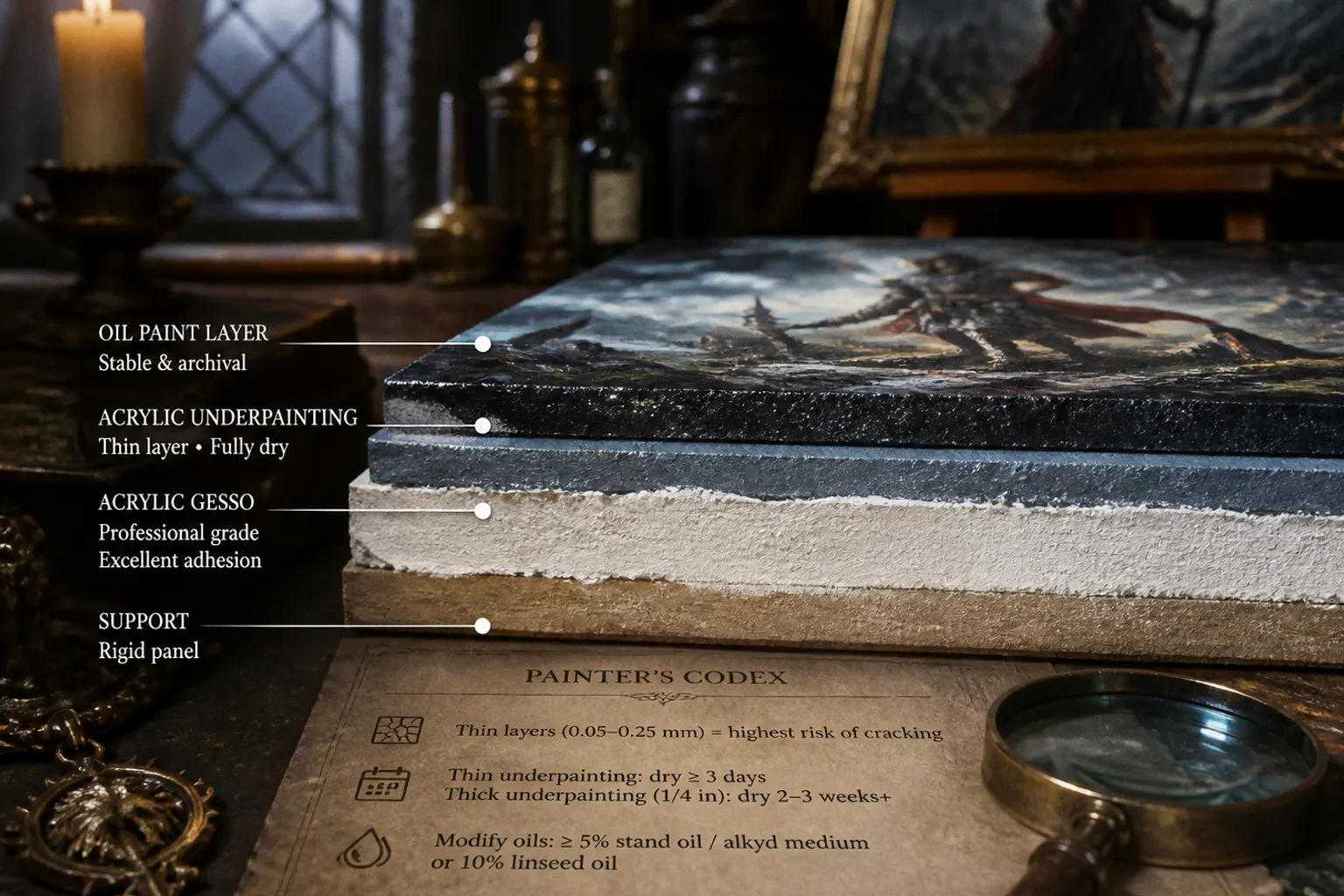
Paint films remember everything: gloss, absorbency, thickness, flexibility, and whether the painter got impatient on a deadline.
The good news is that acrylic underpainting under oil paint safety is not some fringe studio gamble. High-quality acrylic gesso has long been a reliable, archival ground for oils. Many working illustrators use acrylic to block an image quickly, establish value masses, kill the white of a panel, and then bring in oils for the slow, useful work: edges, atmosphere, skin transitions, metal, smoke, and the final focal point.
The bad news is equally simple. “Acrylic underpainting” covers wildly different surfaces. A thin matte grisaille on a rigid panel is one thing. A glossy gel collage over a flexing canvas, followed by lean tube oil, is another. Both may look fine on Friday. Only one is behaving like a painting rather than a future conservation problem.
The question is not whether oil can go over acrylic. It can. The question is whether the acrylic layer gives the oil a surface it can actually live on.
The archival reality: acrylic below oil is a one-way street
Oil paint can be applied over fully dry acrylic. Acrylic should not be applied over oil. That sequence is not a stylistic preference; it is the basic architecture of the painting.
Acrylic dries into a plastic-like film. Oil dries by oxidation into a different, progressively more brittle film. Put the flexible water-based layer on top of the smooth, water-resistant oil layer and it has little meaningful mechanical grip. Eventually, it can crack or flake away. No amount of good intentions, studio incense, or dramatic fantasy subject matter changes that.
The workable sequence is:
1. Support: panel, linen, canvas, or prepared board.
2. Acrylic ground: usually professional acrylic gesso, in multiple coats.
3. Acrylic underpainting: optional, used for drawing, value design, local color blocking, or texture.
4. Oil painting: opaque development, scumbles, glazes, and final accents.
5. Varnish: only after the oil layer has cured sufficiently—not when it merely feels dry to the touch.
For fantasy painters, this is a highly efficient system. Acrylic handles the unromantic labour fast: perspective grids, silhouette grouping, value maps, terrain shapes, dragon anatomy corrections, and the broad light-dark read of a cover image. Oils then enter where they earn their slower pace: a face at the focal point, reflected firelight on armour, spectral atmosphere against a cool sky, the soft edge that turns a painted moon from a flat disc into a light source.
Acrylic does not replace oil craft. It clears the runway.
Acrylic gesso is not just white paint
A proper acrylic gesso ground is formulated to accept paint. It gives oil a sound surface with appropriate tooth and adhesion. Three or more coats of professional white acrylic gesso are commonly used where a painter wants a dependable, even ground. Sanding between coats can produce a smoother field for portrait-like passages, polished steel, or the clean graphic planes of science-fiction hardware.
But the ground is not merely a neutral technical layer. It changes the way a fantasy image reads.
- A smooth gessoed panel supports controlled drawing, crisp hard edges, thin glazes, and the porcelain transitions useful in faces or ceremonial armour.
- A moderately toothed surface catches broken brushwork and makes dry-brushed texture easier—useful for stone, bark, old cloth, and weathered creatures.
- A coarser canvas texture can add energy, but it also interrupts fine drawing. It is rarely the best ally for a small central face meant to sell a narrative at thumbnail size.
This is where many illustrations lose their hierarchy. The painter chooses a dramatic texture because it feels painterly, then tries to render an eight-millimetre eye over a landscape of little canvas pits. The surface has already won the argument.
Dry is not a mood: give acrylic its actual drying window
Acrylic may feel dry within minutes or hours. That does not mean it has dried through its full thickness. The distinction matters before oil goes on top.
Thin acrylic underpaintings should be allowed at least three days to dry fully before oil painting begins. A thick acrylic application—say, a raised passage around a quarter inch deep—may need two to three weeks or more. This is not a ceremonial waiting period imposed by people who enjoy watching paint do nothing. It is time for water to leave the entire layer and for the acrylic film to settle into a stable state.
For a conventional fantasy oil sketch, a thin acrylic imprimatura or monochrome block-in is the sensible route. Keep it lean in physical build, not necessarily pale in color. A dark violet-grey ground, a warm earth-red value map, or a cool blue-green nocturne can all work beautifully beneath oils. Just apply the acrylic in thin, even coats and let it dry properly.
Thick acrylic relief is where the workflow becomes less elegant. A raised ridge may seem perfect for dragon scales, ancient runes, or armour ornament. It may also leave you waiting weeks before oils can safely enter the picture. Worse, if the acrylic texture remains soft or spongy, the eventual oil layer may be asked to flex along with it. Oil paint does not enjoy that assignment.
A practical studio schedule
For artists building cover art, card art, or a personal fantasy panel under real deadlines, the safest schedule is boringly effective:
1. Day one: prepare the panel or canvas with acrylic gesso; apply your acrylic drawing or value block-in thinly.
2. Days two to three: work on studies, reference, compositional corrections, color notes, or another panel. Leave the underpainting alone.
3. Day four: test the surface with your hand and eye. It should be uniformly dry, not cool, soft, or visibly darker in thicker areas.
4. Then begin oils: establish the major opaque passages first, reserving richer medium-heavy layers and glazes for later stages.
On a rigid panel, this sequence is particularly robust. On stretched canvas, it still works, but keep the acrylic structure sensible and avoid building a miniature sculpture before covering it in oil.
The pressure point is commercial illustration. Deadlines encourage painters to turn every layer into a wet-on-wet event. That can be visually exciting, but acrylic and oil are not both oils. The mixed-media stack needs a pause between acts.
Glossy acrylic is where oil starts to skate
The most common failure is not “oil over acrylic” in general. It is oil over the wrong acrylic surface.
Glossy acrylic mediums and gels can create a slick, relatively non-absorbent film. If oil paint is applied directly from the tube over that surface—with no added oil or solvent—the risk of early cracking rises sharply. Tests have shown a particular vulnerability in oil layers roughly 0.05 mm to 0.25 mm thick: thin enough to form a constrained film, thick enough to become problematic. That is approximately the thickness of one to five sheets of office paper.
That range is uncomfortably close to the way many illustrators paint. We lay down a neat, thin opaque correction. We drag a narrow light over a ridge. We paint a controlled face plane. We scumble mist over a dark acrylic sky. It looks disciplined. It may also be exactly the layer construction that does not forgive a glossy base.
The solution is not to abandon acrylic. It is to build a surface and oil mixture that cooperate.
| Surface beneath the oil | What happens in practice | Better approach |
|---|---|---|
| Quality acrylic gesso, dry and lightly toothy | Reliable grip for most oil applications | Paint normally; build oil layers with sound fat-over-lean progression |
| Matte or satin acrylic color | Usually workable, but lean oil films need help | Add at least 5% stand oil or alkyd medium, or 10% linseed oil |
| Gloss acrylic gel or glossy medium | Oil can sit too cleanly on the surface; thin films are vulnerable | Avoid direct lean tube oil; alter the oil medium and test the surface first |
| Absorbent acrylic ground | Can pull binder from oil paint | Seal or avoid it for direct oil painting |
| Soft modelling or crackle paste | Remains flexible; oil becomes brittle | Do not use it as the structural ground beneath oil |
For oil paint over satin, matte, aggregate acrylic products, or acrylic colors, modifying the oil paint with at least 5% stand oil or alkyd medium, or 10% linseed oil, is a practical safeguard against cracking. This is not an invitation to drown every mixture in medium. It is a measured adjustment to the oil film so it is not left too lean and too vulnerable on an acrylic surface.
Stand oil gives a longer, enamel-like pull and can be excellent for controlled glazing, skin modelling, and richly lit metal. Alkyd medium speeds the working rhythm and is useful for production painting, though it can push the process faster than a painter’s judgment. Linseed oil is direct and familiar, but too much can make passages slower-drying and more yellow-prone over time. Use the minimum that solves the structural problem. A medium should support the image, not become its own special effect.
A glossy underlayer may look like a clean technical decision. Under a lean oil film, it can become a trapdoor.
“Fat over lean” still applies—but not in the way people repeat it
The phrase fat over lean gets thrown around as if it were a sacred password. It is more useful than that, but less magical.
Within the oil paint system, later layers should generally be more flexible and oil-rich than earlier layers. Start with relatively leaner paint applications, then move toward fatter mixtures, richer glazes, and medium-containing finishing passages. This helps the upper layers remain flexible enough while the lower ones continue to cure.
But acrylic beneath oil is not simply the “lean” stage of a fat-over-lean recipe. Acrylic is a separate, water-based film. It belongs below the oil sequence, fully dry. Once oil painting starts, normal oil-paint logic resumes.
A clean approach for acrylic underpainting for fantasy illustration might look like this:
- Acrylic stage: charcoal or pencil transfer; thin acrylic linework; a broad value map in umber, ultramarine, burnt sienna, or a limited chromatic block-in.
- First oil pass: relatively lean opaque paint to restate drawing, build major forms, and establish the focal zone.
- Second oil pass: more developed color, softened transitions, selective scumbling, and clearer edge hierarchy.
- Late oil stage: fatter glazes, reflective accents, transparent shadow colour, and only the details that survive reduction.
That last point matters. A fantasy illustration is not a tax return. It does not need every feather, buckle, star, and engraved rune painted at equal volume. Acrylic makes it easy to over-describe the early image because it dries fast. Oils make it easy to over-render the late image because they feel luxurious. Neither habit improves the narrative hook.
Keep the underpainting subordinate to the final framing. If the main story is a sorcerer’s face lit by a spell, the acrylic block-in should already make that face the unavoidable focal point. Do not spend three hours decorating a distant citadel because the acrylic happens to be behaving nicely.
The materials that quietly sabotage the painting
Some acrylic products are designed to create texture, crackle, softness, or extreme absorbency. They can be perfectly valid within an acrylic-only painting. They are not automatically valid as the foundation of an oil painting.
Soft and spongy pastes are not structural grounds
Light molding pastes, crackle pastes, and similar soft acrylic materials can remain flexible indefinitely. Oil paint, by contrast, becomes increasingly brittle as it ages. Put brittle oil over a support layer that compresses and flexes, and the oil may eventually crack across the movement.
This is especially tempting in fantasy work because physical texture feels narratively relevant. A cracked ruin should have crackle paste. A dragon’s hide should be sculpted. A magical portal should have raised gel ridges. It is all very convincing until the painting starts performing its own aging effect decades ahead of schedule.
If you need texture under oils, use it with restraint and choose materials intended to create a stable, firm painting surface. Better yet, make the illusion with paint. The viewer reads texture through value contrast, edge variation, directional marks, and selective highlights—not through how enthusiastically you attacked a tub of paste.
Absorbent grounds can starve the oil paint
Highly absorbent acrylic grounds can draw excessive oil binder out of the paint placed over them. The resulting oil layer can become underbound, matte, friable, and vulnerable to cracking or flaking. It may look attractively chalky at first. A lot of material failure looks interesting before it starts failing.
An absorbent surface may be useful for particular water-based techniques, but it is not the default choice for oil painting. If you want the optical depth of oil—its body, translucency, and rich darks—do not place it on a surface eager to drink the binder out of it.
This is particularly relevant for dark fantasy scenes. Painters often want dry, dead-looking shadow passages in ruins, cloaks, or night skies. Achieve that visual effect with controlled color temperature and surface handling, not by starving the paint film of what holds it together.
Keep zinc white out of lower layers
Oil paints containing zinc oxide, identified as PW4, are best avoided in lower painting layers. Zinc can contribute to zinc soap formation, embrittlement, and adhesion problems over time. This is not a reason to panic over a tube already in the studio. It is a reason not to build the structural base of a painting around it.
For lower layers, choose dependable whites and mixtures appropriate to your palette, then reserve any more delicate material choices for situations where they are genuinely needed. Most fantasy painters do not need a fragile white hidden beneath six later layers. They need a stable value structure and the discipline to stop repainting the moon twelve times.
Panel versus canvas: the support changes the risk
Acrylic beneath oils is most comfortable on a rigid support. Properly prepared wood panel, composite panel, or other stable board minimizes movement. The paint layers can concentrate on being paint layers rather than adapting to every change in tension, humidity, and handling.
Canvas is still viable, and plenty of excellent oil paintings use acrylic grounds on canvas. But it asks for restraint:
- Keep the acrylic underpainting thin and well dried.
- Avoid heavy, soft acrylic texture beneath oil.
- Do not build thick oil impasto over unstable or highly flexible areas.
- Use a properly primed, well-stretched support rather than treating bargain canvas as neutral terrain.
- Consider linen or panel-mounted linen when the image requires detailed oil handling and a long archival horizon.
For small fantasy panels, rigid support has another advantage: it makes precise drawing easier. A card illustration, book-cover character study, or small narrative scene often depends on tiny decisions in silhouette and focal contrast. The panel does not bounce under the brush. The image stays where you put it. A small mercy, but a useful one.
A dependable route for a modern fantasy oil sketch
If the goal is a physical oil sketch with an acrylic start—not a laboratory experiment—use a narrow, repeatable system.
Begin with a rigid panel coated in several layers of quality acrylic gesso. Sand only as much as the image requires. Transfer the drawing with pencil, charcoal fixed lightly if necessary, or a thin acrylic line. Block the composition in acrylic using large value shapes, not premature decoration. Let that layer dry for at least three days.
Then enter with oils. Keep the first pass controlled and not excessively fatty. Build the main light source and focal figure before touching peripheral theatre. Use medium sparingly but deliberately when painting over acrylic color, particularly if the surface is satin or glossy. Add stand oil or alkyd medium in a measured proportion where needed; do not rely on tube paint alone to solve every adhesion question.
As the painting develops, shift your effort toward the visual hierarchy:
1. Narrative hook: What is the image actually about at a glance?
2. Focal point: Where does the eye land first—face, weapon, creature eye, spell, architectural breach?
3. Light logic: Does every secondary highlight serve the primary light source?
4. Edge control: Are the sharpest edges reserved for the information that matters?
5. Surface variety: Are metal, flesh, smoke, stone, and cloth separated by handling—not merely by local color?
That is the actual payoff of a sound acrylic-oil workflow. It gives you speed early and depth later without forcing you to compromise the painting’s physical logic.
Acrylic underpainting is not cheating. It is not a threat to oil painting’s dignity. It is simply a tool, and tools become dangerous when painters mistake convenience for permission. Build a dry, stable, appropriately toothy acrylic layer. Avoid soft pastes and overly absorbent grounds. Do not let glossy acrylic seduce you into laying lean oil straight over it. Then let the oils do what they do best: turn a competent block-in into an image with weight, atmosphere, and a focal point that refuses to let the viewer leave.